
AI in Fantasy Sports: How AI Is Transforming Fantasy Sports – Best Use Cases
 by Sumit Kumar
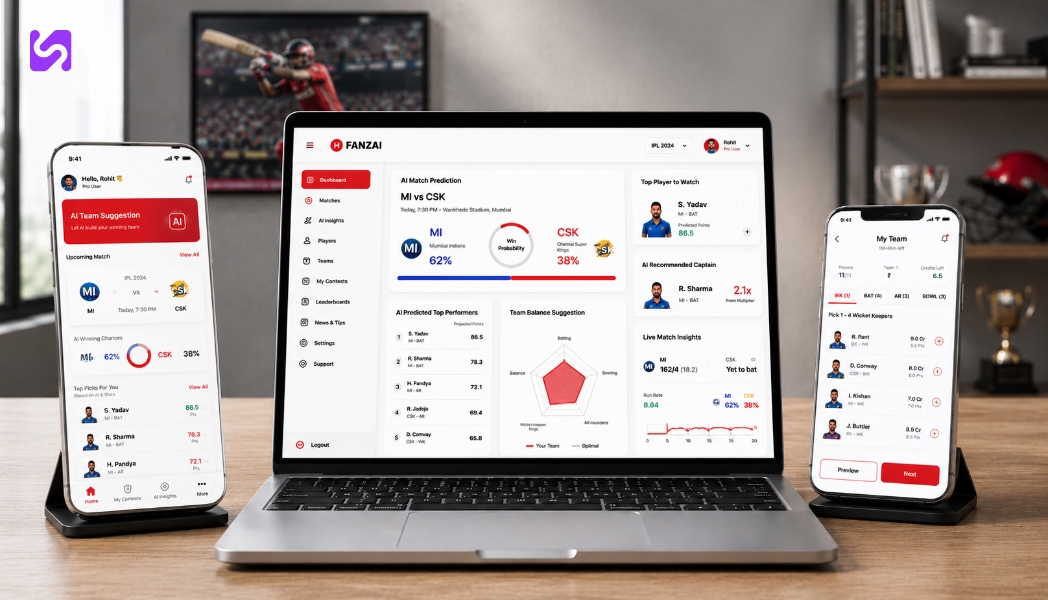
AI in fantasy sports has quietly become the difference between a platform that simply runs contests and one that genuinely helps users win. Artificial intelligence in fantasy sports now powers predictive player projections, lineup optimization, personalized recommendations, real-time injury alerts, and smart chatbots that answer questions instantly. For players, AI-powered fantasy sports means smarter decisions in less time. For operators, AI for fantasy sports means higher engagement, stronger retention, and a serious competitive edge.
This guide breaks down exactly how AI is transforming fantasy sports, the most valuable use cases of AI in fantasy sports, and where the technology is headed next. Whether you run a platform or are planning to build one, understanding these AI use cases will help you turn raw sports data into the kind of experience users come back to every day.
Quick answer: AI is transforming fantasy sports through predictive analytics, AI lineup optimization, personalization, real-time insights, chatbots, fraud detection, and dynamic contest recommendations making play smarter for users and platforms more profitable for operators.
Understanding AI in Fantasy Sports
At its core, AI in fantasy sports is about turning enormous volumes of sports data into useful, real-time guidance. Every game produces a flood of statistics on players, matchups, weather, injuries, and form. No human can process all of it fast enough to act. Machine learning algorithms can.
This is where AI makes a difference.
AI-powered fantasy sports platforms use player performance prediction models, real-time sports analytics, and recommendation engines to surface insights that would otherwise stay buried.
The system studies historical and live data, spots patterns, and translates them into projections, suggestions, and alerts. The result is a platform that does not just host the game but actively helps users play it better, while quietly automating tasks that used to require manual effort.
Why Fantasy Sports Platforms Are Investing in AI
Operators are not adopting AI for novelty. They are investing because it moves the numbers that matter to a fantasy business.
- Higher Engagement. Personalized insights and recommendations keep users active longer and coming back more often.
- Better Retention. AI-driven decision making helps users feel successful, which builds loyalty and reduces churn.
- Smarter monetization. Dynamic contest recommendations and personalization lift participation and revenue per user.
- More Revenue Per User. Smart contest recommendations and dynamic matching lift participation and spend.
- Operational Efficiency. Fantasy sports automation handles scoring, alerts, and moderation that once needed manual work.
- Trust and Fairness. AI fraud detection protects the integrity of contests, which protects your brand.
- Competitive edge. In a crowded market, AI-powered player insights are a genuine differentiator.
For a fantasy sports startup or an established brand, AI is increasingly the feature set that separates the leaders from the rest.
Traditional Fantasy Sports vs AI-Powered Fantasy Sports
The contrast between the old way and the AI-driven way is stark.Traditional platforms leave users to do the heavy lifting alone. AI-powered platforms put a data scientist in every user’s pocket.
| Aspect | Traditional Fantasy Sports | AI-Powered Fantasy Sports |
| Player research | Manual stats and gut feel | AI-generated player projections |
| Lineup building | Trial and error | AI lineup optimization |
| Recommendations | Generic or none | Personalized to each user |
| Injury updates | Users check manually | Real-time AI alerts |
| Support | Slow, human-only | Instant AI chatbots |
| Fraud control | Reactive and manual | Proactive AI monitoring |
| Engagement | One-size-fits-all | Tailored, data-driven |
| Decision speed | Slow | Instant, real-time |
How Artificial Intelligence Reoutlining Fantasy Sports- Best Use Cases of AI in Fantasy Sports
Here are the most impactful ways artificial intelligence is being used in fantasy sports apps today, with the practical benefits each delivers to players and platforms.
1. AI Predictive Analytics for Fantasy Sports: Performance Forecasting
Predictive analytics is one of the most valuable AI features in fantasy sports, and many other AI capabilities are built on it. It uses machine learning to analyze a large amount of data, such as a player’s past performance, recent form, opponent strength, home or away records, weather conditions, playing time, and many other factors.
Based on this analysis, AI fantasy sports predictions predict how each player is likely to perform in an upcoming match. Instead of choosing players based on guesswork or recent headlines, users receive data-driven player recommendations that help them make smarter decisions.
Another advantage is that sports AI keeps learning over time. As new match results become available, the system updates its predictions, making them more accurate throughout the season.
While AI-powered predictive analytics cannot guarantee a winning team, it helps users make better-informed decisions with greater confidence. That’s why leading fantasy sports platforms are increasingly using AI-powered player projections to improve the overall fantasy gaming experience.
Key benefits of AI powered forecasting in fantasy sports:
- Smarter drafting and lineups built on data-backed player performance prediction, not guesswork
- A level playing field for casual users who lack the time to research deeply
- Continuously improving accuracy as models learn from fresh results
- A foundation that powers optimization, recommendations, and insights downstream
2. AI Lineup Optimization in Fantasy Sports
Building the strongest possible lineup under a salary cap and roster rules is a genuine mathematical puzzle with a near-endless number of combinations. AI lineup optimization solves it in seconds.
Instead of manually testing different combinations, AI algorithms evaluate thousands of possible lineups within seconds. They consider player salaries, projected performance, recent form, contest type, and risk level before recommending the strongest combinations.
What’s particularly interesting is that AI doesn’t generate identical lineups for everyone.
A beginner entering a small contest might receive a balanced, lower-risk team recommendation. An experienced player participating in a high-stakes tournament may receive a more aggressive lineup designed to outperform thousands of competitors.
For daily fantasy players especially, this collapses an hour of manual tinkering into a single, confident tap.
Advantages of AI driven lineup optimization in fantasy sports:
- Massive time savings, turning lengthy research into an instant suggestion
- Mathematically stronger lineups that respect every salary and rule constraint
- Multiple diversified lineups for users playing many contests
- Lower barrier to entry that helps newer players compete with veterans
3. Personalized Contest and Team Recommendations
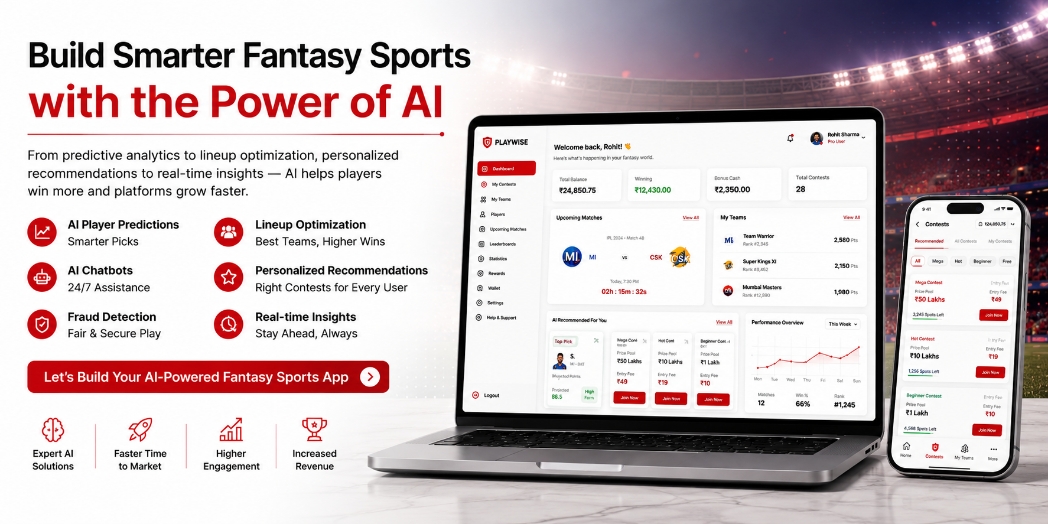
No two users want the same experience. A casual weekend player and a high-volume grinder have completely different goals, budgets, and risk appetites. AI recommendation engines study each user’s behavior, contest history, preferences, and skill level, then surface the contests and teams that genuinely fit them.
Instead of displaying hundreds of available contests, the platform recommends the ones most relevant to each user.
AI can recommend players based on previous team selections, suggest strategic lineup changes, highlight upcoming tournaments likely to interest the user, and even identify opportunities to improve fantasy performance.
These personalized experiences benefit everyone involved.
Users spend less time searching and more time playing, while businesses improve engagement, increase contest participation, and generate higher lifetime customer value.
Outcome of AI based Personalization in fantasy sports:
- Higher participation as users find relevant contests faster
- Less choice overload through tailored, curated options
- Greater satisfaction from an experience that feels personal
- Better matchmaking that pairs users with contests suited to their level
4. Real-Time Injury Updates and Performance Insights
A single late scratch minutes before lock can sink an otherwise perfect lineup. AI continuously monitors live data feeds, news sources, and even social signals to deliver real-time injury updates and performance insights the instant they break.
Users receive immediate alerts and can swap players before the deadline, while live player statistics keep them informed through every quarter, inning, or over. This real-time vigilance is something no human could match consistently, and it is one of the features users appreciate most.
Benefits of AI in Performance Insights:
- Protection against late injuries with instant, actionable alerts
- Faster reactions that let users adjust before lock
- Live in-game insights through real-time sports analytics
- Greater confidence that users are never caught off guard
5. AI Chatbots and Virtual Fantasy Assistants
AI chatbots for fantasy sports act as an always-on teammate inside the app. Users can ask which player to start, clarify a scoring rule, request lineup advice, or get an explanation for a recommendation, and receive instant answers in natural, conversational language.
Because these assistants are available around the clock, users get help the moment they need it, even minutes before a contest locks.
Imagine receiving a notification an hour before kickoff saying:
“Your selected striker has been ruled out due to injury. Based on current projections, Player X is the strongest replacement within your budget.”
That level of proactive assistance improves both user confidence and engagement.
For operators, the same chatbots deflect a large share of routine support queries, freeing human teams for complex issues.
Advantages:
- Instant, 24/7 guidance for players whenever they need it
- A more interactive experience through natural-language conversation
- Lower support costs as chatbots handle routine questions
- Faster decisions with on-demand advice right before lock
6. Fraud Detection and Fair Play Monitoring
As fantasy sports platforms grow, ensuring fairness becomes just as important as improving user experience. With thousands or even millions of users participating in contests, the risk of fraud, duplicate accounts, bot activity, and unfair advantages increases significantly.
This is where AI in fantasy sports plays a crucial protective role.
AI-powered fraud detection systems continuously monitor user behavior patterns to identify suspicious activity. Instead of relying on manual checks, machine learning models analyze data such as login behavior, device fingerprints, contest entry patterns, payment methods, and gameplay timing.
For example, if multiple accounts are created from the same device and consistently enter the same contests in a coordinated manner, AI can flag this as potential collusion. Similarly, if a user suddenly changes behavior patterns—such as entering unusually high-value contests without historical activity—the system can trigger additional verification steps.
This ensures that the platform remains fair for genuine users while reducing the risk of manipulation.
Outcome Benefits:
- Fairer contests that protect honest, paying users
- Real-time protection that stops abuse before it spreads
- Stronger brand trust and platform credibility
- Reduced losses from fraud, chargebacks, and manipulation
7. AI for User Engagement and Player Retention
Acquiring a user is expensive; keeping one is where the real value sits. AI studies how each user behaves and uses those patterns to keep them engaged at the right moments. It sends personalized notifications, and timely nudges that feel relevant rather than spammy.
Instead of treating all users the same, AI segments them based on activity, spending patterns, preferred sports, and engagement frequency. This allows platforms to create highly targeted monetization strategies.
For instance:
- Casual users may receive reminders about free contests or low-entry games.
- Competitive users might be shown high-stakes tournaments.
- Inactive users may get re-engagement offers or bonus credits.
This personalization directly impacts fantasy sports app monetization strategy, improving conversion rates and increasing lifetime value per user.
Crucially, AI can predict when a user is drifting toward churn and trigger a well-timed offer or reminder to win them back. Over time, this targeted attention compounds into significantly stronger loyalty.
Positive Outcomes:
- Higher retention through churn prediction and timely intervention
- Relevant, personalized nudges instead of generic blasts
- Increased lifetime value from longer, more active relationships
- Stronger daily engagement that builds lasting habits
8. Dynamic Pricing and Smart Contest Recommendations
AI can fine-tune contest pricing and route the right games to the right users at the right time. By analyzing demand, user budgets, and skill levels, dynamic systems pair each player with contests they are likely to enter and enjoy, which improves fill rates and keeps prize pools healthy. Smart matchmaking ensures beginners are not thrown against seasoned sharks, protecting the experience for everyone. The result is a win on both sides: better-matched, more satisfying contests for users and stronger revenue for the platform.
Key Advantages:
- Higher contest fill rates through smart demand matching
- Better-balanced contests that protect newer players
- Increased platform revenue from optimized pricing
- A healthier ecosystem where users keep coming back
Real-World Examples: DraftKings, FanDuel, Sleeper & ESPN Fantasy
Leading platforms in the fantasy sports industry are already leveraging AI to enhance their products.
DraftKings uses predictive models and machine learning algorithms to improve contest recommendations, player projections, and personalized user experiences. AI helps them optimize engagement across millions of daily users.
FanDuel focuses heavily on personalization and real-time analytics. Their systems analyze user behavior to suggest relevant contests and improve retention through targeted promotions and dynamic content.
Sleeper, known for its strong community-driven approach, uses AI to enhance season-long engagement, providing smarter notifications, draft suggestions, and league insights.
Even ESPN Fantasy integrates advanced statistical models to help users make informed decisions based on performance trends and expert projections.
These companies demonstrate a clear trend: AI is no longer optional in fantasy sports—it is a core part of product strategy.
Future Trends: Generative AI, Digital Coaches & Hyper-Personalization
The next wave of AI for fantasy sports is already taking shape.
One of the biggest upcoming shifts is the rise of Generative AI. Instead of just analyzing data, AI will soon be able to create personalized fantasy strategies, explain player choices in natural language, and act as a fully interactive assistant.
Imagine asking:
“Build me the best fantasy cricket team for today’s match under a 100-credit budget.”
And receiving a fully optimized lineup along with reasoning behind each selection.
AI digital coaches will guide users through an entire season, learning their style and offering proactive advice like a personal analyst. Hyper-personalization will tailor every element of the experience, from contests to content to notifications, around each individual user. Expect deeper real-time analytics, smarter automation, and AI that feels less like a tool and more like a teammate.
For fantasy sports platforms, the message is simple: the future of AI in fantasy sports rewards those who adopt early and build it into the core experience.
SonicTechPro Can Help You Bring AI Into Your Fantasy Sports App
Understanding the use cases of artificial intelligence in fanatsy sports is the easy part. Implementing them so they actually perform is where most teams stall. SonicTechPro’s AI specialists help fantasy sports businesses bring intelligent features into existing apps or build AI-powered platforms from scratch.
We handle the full stack of the work: predictive analytics, AI lineup optimization, recommendation engines, chatbots, fraud detection, and real-time insights, each tuned to your sport, your users, and your goals. Whether you want to upgrade a live product with a few high-impact AI features or launch a fully AI-driven fantasy experience, our team owns the strategy, data science, and engineering end to end. Share your vision, and we will help you turn AI into a measurable advantage.
[Get a Free Quote] · [Book a Free Consultation]
Related reading: Fantasy sports app development, Custom vs white label fantasy sports software, DFS vs season-long fantasy sports
Conclusion
AI in Fantasy Sports is no longer a future promise in fantasy sports. It is here, reshaping how users research players, build lineups, get insights, and stay engaged, while helping operators boost retention, protect fairness, and grow revenue. From predictive analytics and lineup optimization to chatbots, fraud detection, and hyper-personalization, the use cases of AI in fantasy sports are both wide and genuinely valuable.
The platforms winning in 2026 and beyond are the ones treating AI as core infrastructure rather than a bolt-on feature. If you run or plan to build a fantasy sports app, now is the time to put artificial intelligence to work. Do it well, and you give your users a smarter game and your business a lasting edge.
Frequently Asked Questions
