
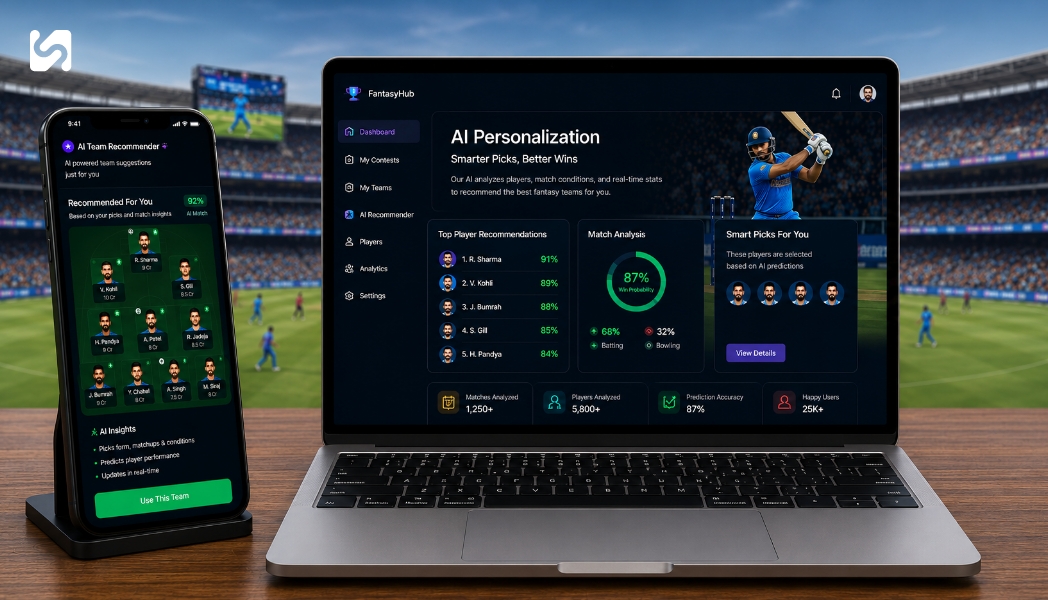
How AI Personalization in Fantasy Sports Is Revolutionizing Team Recommendations
 by Sumit Kumar
AI personalization in fantasy sports has changed what users expect from the apps they play on. A few years ago everyone saw the same contests, the same player pool, and the same generic advice. Today, AI fantasy sports recommendations tailor the experience to each individual, surfacing the right players, lineups, and contests for that specific user. The result is smarter play, higher engagement, and platforms that feel like they were built for one person at a time.
At the heart of this shift sits the AI recommendation engine. By learning from how each user drafts, trades, and competes, personalized fantasy sports platforms can deliver AI team recommendations that genuinely improve decisions. This guide explains how AI personalization in fantasy sports works, how AI recommendation engines turn raw sports data into tailored suggestions, and why AI personalization in fantasy sports is now one of the most powerful tools an operator can build into their app.
Quick answer: AI personalization in fantasy sports uses recommendation engines and machine learning to analyze each user’s behaviour. It collects live sports data, then deliver tailored team recommendations, lineup suggestions, and contest matches for making play smarter and keeping users engaged.
Why Personalization Matters in Fantasy Sports
Fantasy sports is a game of decisions, and most users are overwhelmed by them. There are hundreds of players to evaluate, dozens of contests to choose from, and constant new data to process. For a casual player, that complexity is intimidating. For a serious one, it is time-consuming. Personalization in fantasy sports solves both problems by cutting the noise and surfacing what matters to each user.
The business case is just as strong. Generic experiences treat a first-time weekend player exactly like a daily-fantasy veteran, which serves neither well. Personalized fantasy sports experiences keep users engaged with relevant options, help them feel successful, and build the kind of loyalty that reduces churn. In a crowded market, the platform that understands its users best is the one that keeps them.
What Is AI Personalization in Fantasy Sports?
AI personalization in fantasy sports is the use of machine learning to tailor the experience to each individual user. Instead of showing everyone the same content, AI personalization studies a user’s behavior, preferences, skill level, and history, then adapts what it shows them. That includes personalized team suggestions, smart lineup recommendations, contest matches, and timely notifications.
The goal is simple: make every user feel like the app understands them. A beginner gets gentler guidance and lower-risk contests. A veteran gets advanced insights and high-stakes options. The same platform delivers two completely different experiences, each shaped by data-driven fantasy sports intelligence working quietly in the background.
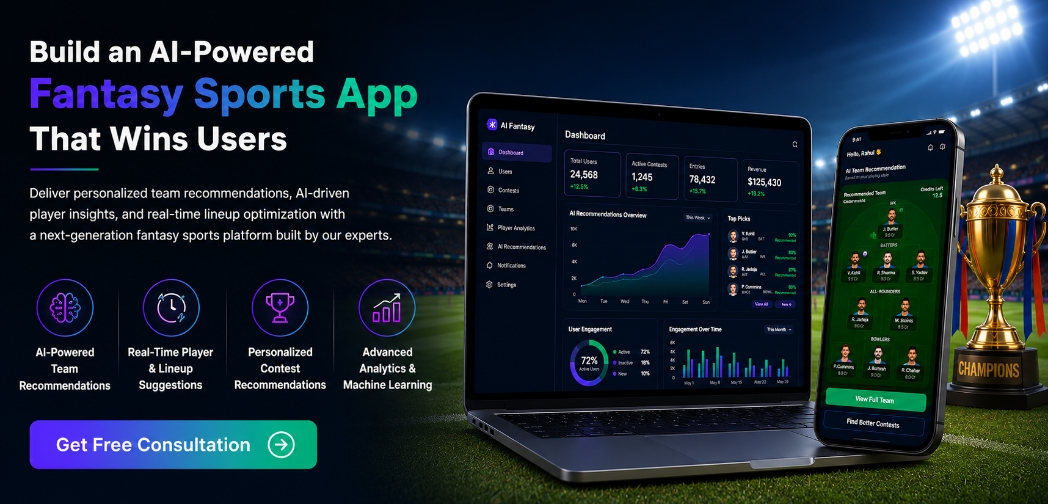
A Comparison of Traditional Recommendation systems vs. AI-Powered Personalization.
Here’s a focused comparison of traditional recommendation systems versus AI-powered personalization in fantasy sports, across the aspects that matter most.
| Aspect | Traditional Fantasy Sports Recommendation Systems | AI-Powered Personalization in Fantasy Sports |
| Basis for suggestions | Fixed rules and simple filters | Machine learning on user behavior + live data |
| Personalization level | Same suggestions for similar users | Unique to each individual user |
| Data used | Basic stats and popularity | Behavior, history, skill, preferences, real-time data |
| Adapts over time | Rarely, needs manual updates | Continuously learns from every interaction |
| Real-time response | Limited or none | Instant reaction to injuries, form, and news |
| Player suggestions | Generic “top picks” lists | Tailored to user’s style and risk appetite |
| Lineup advice | One-size-fits-all optimal | Optimized around individual goals |
| Contest matching | Manual browsing | Smart matching by budget and skill |
| Accuracy | Static, degrades over a season | Improves the more a user plays |
| User experience | Functional but impersonal | Feels built for the individual |
| Engagement impact | Modest | Strong, drives retention and loyalty |
| Scalability of relevance | Weakens as users grow | Strengthens with more data |
The core difference in one line: traditional systems apply the same logic to everyone and rarely change, while AI-powered personalization learns each user individually and gets sharper over time which is exactly why it lifts engagement and retention where rule-based systems plateau.
How AI Recommendation Engines Work
An AI powered recommendation engine is the technology that powers all of this. At a high level, The system follows three steps.
First – Collect data on each user, including the players they pick, the contests they enter, how they respond to suggestions, and their results.
Second – Combines that personal data with live and historical sports data such as form, matchups, and projections.
Third – Recommendation algorithms identify patterns and predict what each user is most likely to want next.
The AI engine improves continuously. Every action a user takes feeds back into the model, sharpening future recommendations. Over time, the system learns not just what players perform well in general, but what suits this particular user’s style, risk appetite, and goals. That feedback loop is what separates true AI personalization from simple, one-size-fits-all suggestions.
Understanding User Behaviour Through AI Personalization in Fantasy Sports
The foundation of personalization in fantasy sports is user behavior analysis. AI watches how users interact with the platform and builds a profile from those signals. Does this user favor star players or value picks? Do they enter many small contests or a few large ones? How they act on recommendations? they play daily or only on weekends?
By interpreting these patterns, the platform understands each user’s preferences without ever asking them directly. This behavioral understanding lets the system tailor everything from team recommendations to notification timing. The more a user plays, the richer the profile becomes, and the more accurate and helpful the personalization gets.
How AI Personalizes Fantasy Sports Recommendations
AI-Powered Team Recommendations
Creating a fantasy team can be exciting but it can also be overwhelming.
With dozens of players to choose from and multiple combinations available, even experienced fantasy managers sometimes struggle to make the right decisions.
This is where AI-powered fantasy sports team recommendations make a real differenceAI-powered fantasy sports team recommendations combine a user’s behavioral profile with live player data to suggest the players and teams that fit them best.
Rather than handing every user the same projections, the engine factors in their style, past choices, and risk tolerance, then recommends picks aligned with how they actually play.
For a value-focused user, the system highlights underpriced players with strong upside. For a user who chases the ceiling, it surfaces high-variance options. These AI player suggestions feel personal because they are, and that relevance is exactly what keeps users coming back to draft again.
Personalized Lineup Optimization
Selecting good players is only part of the challenge.
The real task is combining those players into the strongest possible lineup while staying within salary caps and contest rules. This is where AI-powered lineup optimization becomes valuable.
Instead of testing hundreds of possible combinations manually, AI analyzes thousands of lineup possibilities in just a few seconds. The result is a lineup that offers the best possible balance between safety and scoring potential. Personalized lineup optimization takes the user’s preferences and constraints, then recommends the strongest full lineup tuned to their goals.
A cautious user receives balanced, lower-risk builds. An aggressive user receives high-upside combinations built to win big contests.
Personalization goes a step beyond standard AI-powered lineup optimization by layering personal style on top of pure math. The system still respects salary caps and rules, but it shapes the recommendation around the individual rather than a generic optimum. The outcome is a smart lineup recommendation the user is far more likely to trust and use.
Real-Time Player Suggestions Based on Live Data
AI Personalization in fantasy sports is not only about history; it works in real time too. As live data flows in, the platform delivers real-time player recommendations that respond to breaking news, injuries, and form.
If a star is ruled out minutes before lock, the ai driven recommendation engine suggests a replacement that fits both the lineup and the user’s style.
Imagine receiving a notification saying:
“Player A has been ruled out due to injury. Based on today’s match conditions, Player B is now the strongest replacement within your remaining budget.”.
This blend of live sports data and personal preference is powerful. Users get suggestions that are both timely and tailored, helping them react quickly without abandoning their approach. Real-time personalization turns a stressful last-minute scramble into a guided, confident decision.
Personalized Contest Recommendations
Not every fantasy contest is suitable for every player.
Some users enjoy free practice contests, while others prefer high-entry competitions with larger prize pools.
AI helps users discover contests that match their interests instead of making them search through hundreds of options.
Using previous contest history, spending habits, favorite sports, and participation frequency, AI identifies the contests most relevant to each user.
For example:
- New users may receive beginner-friendly contests with lower competition.
- Casual players might see affordable daily contests.
- Experienced users may be recommended premium tournaments or grand leagues.
These personalized contest recommendations improve user satisfaction because players spend less time searching and more time competing.
For businesses, they also increase contest participation rates and improve overall platform engagement.
This is one of the simplest yet most effective examples of how AI personalization in fantasy sports creates value for both users and platform owners.
AI and User Engagement: Keeping Players Active
Personalization is one of the strongest levers for engagement and retention. By understanding each user, AI can send the right nudge at the right time: a tailored challenge, a reminder before a favorite team plays, or a recommendation aligned with their interests. These touches feel relevant rather than spammy, so users welcome them.
AI can also predict when a user is at risk of drifting away and intervene with a timely, personalized offer. This proactive approach to user engagement in fantasy sports directly strengthens loyalty and lifts lifetime value. The platform that keeps showing users they are understood is the platform they keep opening.
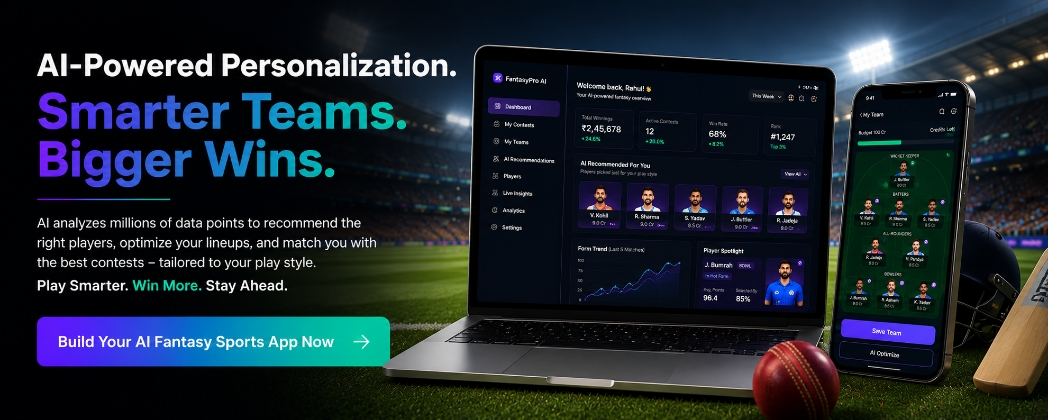
Benefits of AI Personalization for Fantasy Sports Platforms
The advantages of building AI personalization for fantasy sports platforms are substantial.
- Higher User Engagement. When players receive relevant team suggestions, contest recommendations, and timely notifications, they are more likely to stay active on the platform.
- Stronger Retention. Personalized experiences build loyalty and reduce churn.AI also helps platforms reduce user churn. By identifying players who are becoming less active, the system can automatically trigger personalized offers, reminders, or incentives before they leave the platform.
- Better Decisions for Users. Tailored suggestions help players succeed, which keeps them happy.
- Operational Efficiency: AI automates many repetitive tasks, including recommendation generation, customer segmentation, and campaign optimization, allowing businesses to scale without increasing manual effort.
- Increased Revenue. Personalized recommendations encourage more users to join paid contests, subscribe to premium features, or explore additional services within the app.
- A Real Competitive Edge. Deep AI driven personalization on fantasy sports platforms is hard for rivals to copy quickly. Delivering a customized experience can be the difference between retaining users and losing them to competing platforms.
- Healthier Contests. Skill-based matching protects newer users and keeps games balanced.
- Richer data. Every interaction sharpens the recommendation engine, compounding the advantage over time.
Real-World Examples of AI Personalization in fantasy sports: DraftKings, FanDuel & Sleeper
Some of the world’s most successful fantasy sports platforms already use AI to improve personalization.
DraftKings
DraftKings uses AI and advanced analytics to recommend contests based on user behavior and playing history. The platform also provides player projections, performance insights, and personalized promotions that encourage users to participate more frequently.
FanDuel
FanDuel focuses on delivering a tailored experience through personalized contest recommendations and targeted promotional campaigns. By analyzing user activity, the platform suggests contests that match each player’s interests and skill level.
Sleeper
Sleeper has built its reputation on creating a community-driven fantasy sports experience. AI helps the platform send smart notifications, draft reminders, waiver suggestions, and personalized league updates. These features keep users engaged throughout the season rather than only on match days.
Although each platform has its own strategy, they all use AI-powered recommendations to create experiences that feel personal rather than generic.
Challenges of Implementing AI Personalization in Fantasy Sports
AI Personalization in fantasy sports delivers real value, but it is not effortless to build. A few challenges are worth planning for.
Data quality and quantity. AI Personalization in fantasy sports needs clean, sufficient data to work well. New platforms with few users face a cold-start problem until they gather enough behavioral data.
Technical complexity. Building and maintaining a robust recommendation engine requires real machine learning and data science expertise, which many teams lack in-house.
Privacy and trust. Collecting user data responsibly is essential. Platforms must be transparent and compliant with data-protection rules to maintain user trust.
Balancing personalization and discovery. Over-personalizing can trap users in a narrow bubble. Good systems still introduce fresh options so the experience stays varied.
Future Trends in AI-Powered Fantasy Sports Recommendations
The next wave of AI personalization in fantasy sports will feel even more human.
Generative AI will power conversational assistants that explain their recommendations and adapt advice in natural language. AI digital coaches will guide users across an entire season, learning their style and offering proactive, personalized strategy.
Hyper-personalization is another growing trend. Future platforms will consider even more factors, including user skill level, preferred contest formats, playing habits, and historical decision-making patterns to deliver highly customized experiences.
Voice assistants are also likely to become more common. Imagine asking your fantasy app, “Who should I make captain today?” and receiving an instant AI-generated recommendation with supporting statistics.
Expect deeper real-time personalization, smarter cross-sport recommendations, and engines that anticipate needs before users even express them. For platforms, the trajectory is clear: personalization will only grow more central to a winning fantasy sports experience.
How Startups Can Build Personalized Fantasy Sports Apps
For a fantasy sports startup, personalization can feel ambitious, but it is achievable with the right approach. Start by capturing clean user and sports data from day one, since data is the fuel for any recommendation engine. Begin with simpler rule-based personalization, then layer in machine learning as your user base and data grow.
Choosing the right development partner matters enormously. Building an AI recommendation engine, integrating live sports data, and tuning it for real users takes specialized expertise.
Many startups accelerate by working with an experienced team or building on a platform that already supports personalization, then customizing from there. The key is to treat personalization as a core feature, not an afterthought.
Build with SonicTechPro: Our AI and fantasy sports developers help startups and established brands build personalized, AI-powered fantasy platforms from recommendation engines and lineup optimization to real-time player suggestions. Get a Free Quote and let’s bring intelligent personalization to your app.
Conclusion: AI Personalization in fantasy sports
AI personalization has redefined what a great fantasy sports app looks like. By understanding each user and tailoring team recommendations, lineups, contests, and engagement to Users. Personalized Fantasy sports platforms deliver smarter play and stronger loyalty.
From recommendation engines and behavioural analysis to real-time suggestions, the AI driven personalization turns a generic product into one that feels built for every individual.
Fantasy sports platforms leading the market in 2026 treat personalization as core infrastructure, not a bonus feature. If you run or plan to build a fantasy sports app, investing in AI personalization is one of the surest ways to boost engagement, retention, and revenue. Understand your users, recommend what fits them, and they will keep coming back.
Related reading: Custom vs white label fantasy sports software, White label fantasy sports app development guide, Fantasy sports app development services
Frequently Asked Questions
