
AI in the Travel Industry: 15 Use Cases, Real-World Examples and Benefits
 by Sumit Kumar
Planning a trip often means jumping between several websites. You might find a destination on Instagram, compare hotel prices on a booking platform, check routes on Google Maps, and contact a travel agent to confirm details. Even after hours of research, some questions remain unanswered. This is where AI in travel industry can help.
AI in the travel industry is helping connect these separate steps. Travel companies can use artificial intelligence to interpret traveler preferences, prepare itineraries, answer booking questions, forecast demand, and identify potential disruptions. Some applications support travelers directly. Others help airlines, hotels, tour operators, and online travel agencies manage their operations.
Artificial intelligence in travel also creates new challenges. An AI-generated itinerary may suggest an attraction that is closed. A chatbot may misunderstand a cancellation policy. An automated booking agent may find a suitable flight but fail to account for baggage fees.
For travel businesses, successful AI adoption requires more than adding a chatbot to an app. The real work involves choosing the right use case, connecting reliable data, protecting customer information, and measuring whether the solution improves the business.
This guide covers 15 AI use cases in travel and tourism, real-world company examples, research-backed statistics, implementation challenges, and opportunities for travel startups.
How Is AI Used in the Travel Industry?
AI in the travel industry supports trip planning, personalized recommendations, flight and hotel search, customer service, demand forecasting, pricing, fraud detection, and travel operations. Travel apps can use AI to prepare itineraries and answer questions, while hotels and airlines can apply predictive models to manage demand and disruptions. The most reliable systems combine AI with verified travel data, booking integrations, and human oversight for important decisions.
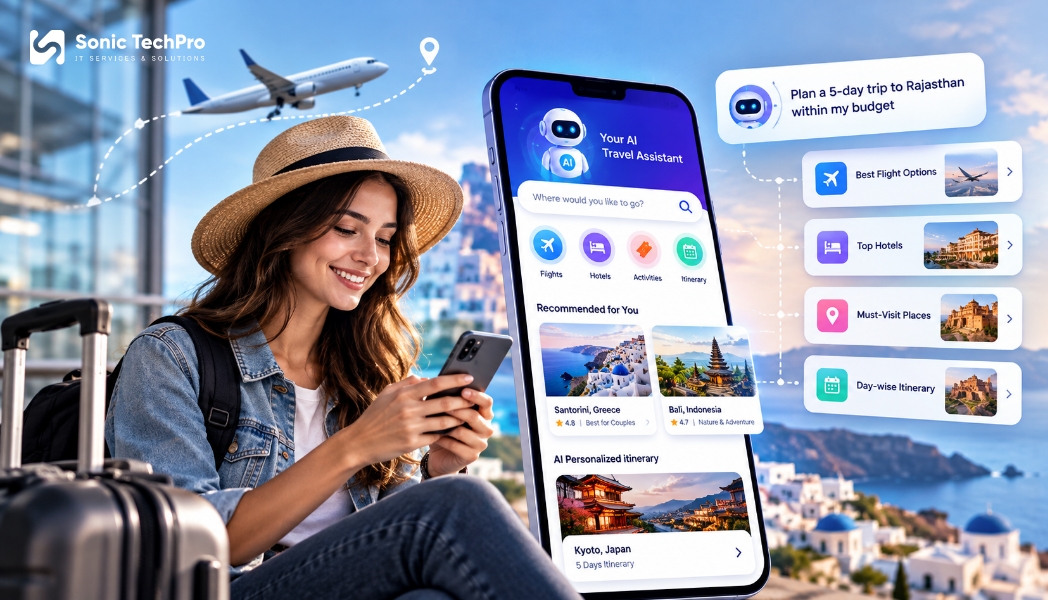
Consider a traveler planning a five-day trip to Rajasthan. An AI travel planner can turn the traveler’s budget, interests, and dates into an itinerary. A connected booking system can then check hotel availability, retrieve current prices, and present suitable options.
That last step matters. AI can suggest a trip, but only a connected and reliable booking system can confirm current availability and complete a reservation.
AI in Travel: Statistics and Research
Traveler surveys show growing interest in AI-assisted planning, alongside clear concerns about trust and control. The following findings help explain where travel companies can focus their efforts.
| Research finding | Source and context |
| 89% of respondents wanted to use AI in future travel planning. | Booking.com Global AI Sentiment Report, July 2025 |
| 67% had already used AI in some aspect of travel. | Booking.com, 2025 |
| 71% appreciated AI recommendations that could help avoid overcrowded destinations or peak travel times. | Booking.com, 2025 |
| 53% were comfortable letting AI suggest travel options. | Expedia Group’s AI Trust Gap research, April 2026 |
| 40% said they used or would use AI to help build itineraries. | Expedia Group, 2026 |
| 68% preferred booking with a trusted travel brand over AI platforms, even when AI booking was available. | Expedia Group, 2026 |
Booking.com’s 2025 report surveyed 37,325 consumers across 33 markets. Expedia Group’s 2026 study surveyed more than 5,700 adults in the United States, United Kingdom, and India. The studies used different questions and research methods, so the results should not be compared as if both surveys measured the same thing.
What should travel companies learn from these statistics?
Travelers appear more comfortable using AI to research destinations and explore options than handing over control of a purchase. That distinction has direct implications for product design.
A travel app can offer AI-generated itineraries, explain hotel differences, and monitor prices. Before a customer pays, the platform should display verified availability, the full price, cancellation terms, and the identity of the booking provider.
The commercial opportunity lies in making AI helpful without making the customer feel removed from the decision.
What Is Artificial Intelligence in Travel?
Artificial intelligence in travel refers to technologies that analyze information, recognize patterns, interpret language, generate content, or recommend actions across the travel journey.
The term covers several technologies with different roles:
- Machine learning: Uses historical data to predict demand, identify patterns, or rank travel options.
- Natural language processing: Helps software understand questions and requests written or spoken in everyday language.
- Generative AI: Produces itineraries, summaries, travel recommendations, and conversational responses.
- Computer vision: Analyzes images and video for applications such as visual search and document processing.
- Predictive analytics: Estimates likely future outcomes, such as booking demand or disruption risk.
- AI agents: Coordinate multiple tasks through connected tools and systems, subject to defined permissions.
These technologies can work together inside one travel product. A conversational assistant may interpret a request, a recommendation model may rank hotels, and a booking API may retrieve availability. The application then presents the results for the traveler to review.
Traditional automation remains useful for predictable tasks such as sending booking confirmations or processing standard notifications. AI becomes more useful when the system must interpret varied requests, rank options, or make predictions from data.
15 AI Use Cases in the Travel Industry
The following use cases cover the main stages of a trip, from initial research to hotel operations and post-trip feedback. Each application has different data requirements and business outcomes.
1. AI-Powered Travel Planning and Itinerary Generation
A travel itinerary needs to work in the real world, not just look attractive on a screen. Travelers need sensible routes, realistic travel times, suitable activities, and enough flexibility to handle changes.
An AI itinerary planner can turn a request such as “Plan four days in Jaipur for a family with two children” into a draft schedule. The system can group nearby attractions, suggest family-friendly activities, and organize the day around the traveler’s interests and budget.
The technical challenge is keeping the itinerary accurate. Generative AI can draft the plan, but opening hours, transport schedules, and booking availability should come from dependable sources.
For travel startups, useful measures include itinerary saves, the number of plans users edit, booking conversion, and repeat usage. These figures help determine whether travelers find the planner useful enough to return or pay for additional features.
2. Personalized Destination and Hotel Recommendations
A traveler looking for a quiet beach holiday has different needs from someone planning a nightlife-focused city break. AI recommendation engines can rank destinations, hotels, restaurants, and activities according to budget, trip dates, stated interests, and permitted customer preferences.
For example, a hotel booking app could prioritize properties near public transport for a traveler who doesn’t plan to rent a car. Another traveler may care more about accessibility, family facilities, or proximity to outdoor activities.
The recommendation engine should explain relevant differences rather than simply showing a ranked list. Businesses should also monitor whether ranking rules unfairly favor particular suppliers or consistently hide suitable lower-priced options.
Measure the outcome: Search-to-booking conversion, recommendation click-through rate, booking cancellations, and customer satisfaction.
3. AI Travel Chatbots and Virtual Assistants
Travel support teams receive many recurring questions about baggage allowances, check-in times, cancellation policies, booking references, and hotel facilities. An AI chatbot can handle common questions by retrieving answers from approved company information.
A connected assistant can go further. When a traveler asks about changing a reservation, the system can retrieve the relevant booking and explain the applicable policy. If the request involves a fee, refund, or supplier approval, the assistant should present the conditions and request confirmation before proceeding.
A chatbot that merely generates plausible answers is not enough for a travel business. The system needs access controls, accurate source information, and a clear route to human support.
Measure the outcome: First-contact resolution, average handling time, escalation rate, customer satisfaction, and cost per resolved query.
4. AI-Powered Flight Search and Booking Assistance
Flight search involves more than finding the lowest fare. Travelers compare departure times, connections, baggage allowances, airport locations, fare restrictions, and total journey duration.
AI can translate a natural-language request into search criteria. A user might ask for a morning flight from Delhi to London with one checked bag and no more than one connection. The assistant can organize the request, retrieve suitable options from a flight-search provider, and explain the trade-offs.
Current prices and seat availability must come from live supplier systems or approved booking APIs. AI-generated text cannot confirm a fare, and the final booking flow should show baggage fees, fare rules, and cancellation terms before payment.
This feature can reduce search friction and help travelers compare suitable flights without manually changing multiple filters.
5. Dynamic Pricing and Revenue Management
Hotels, airlines, and tour operators manage inventory that loses value when the service date passes. AI-based forecasting can help revenue teams assess demand using booking pace, seasonality, local events, historical patterns, and available market data.
A hotel in Jaipur, for example, may expect stronger demand during a major festival. A forecasting system can alert the revenue team to rising demand and help staff review room rates or package offers before the busiest dates arrive.
AI should inform the pricing decision, not set prices without oversight. Teams need to account for supplier agreements, customer expectations, local rules, and the long-term effect of pricing on trust.
Measure the outcome: Forecast error, revenue per available room, average daily rate, booking pace, and cancellation patterns.
6. Predictive Analytics for Travel Demand
Travel businesses often need to commit staff and inventory before the full demand picture becomes clear. Predictive analytics can help estimate future bookings by combining historical patterns with information such as school holidays, major events, and seasonal trends.
A tour operator could forecast which excursions are likely to sell out and arrange additional guides where practical. A hotel group could estimate room demand by property and adjust staffing plans before arrival dates.
Forecasts are less dependable when a major disruption or unusual event breaks historical patterns. Teams should track forecast accuracy and review unexpected changes instead of treating every prediction as a certainty.
This use case is especially relevant to businesses managing several destinations, properties, or tour schedules.
7. AI for Customer Support and Service Recovery
A delayed flight or missed transfer can turn into a complicated support case involving several providers. AI can help a support agent collect the relevant booking details, summarize the customer’s problem, retrieve policy information, and prepare possible next steps.
Suppose a traveler reports that an airport transfer never arrived. The system can retrieve the transfer reference, supplier details, pickup instructions, and applicable refund policy. A support agent can then decide whether to contact the supplier, arrange another transfer, or offer compensation under the company’s rules.
This is a stronger use of AI than sending a generic apology. It reduces the time spent gathering information while leaving important decisions with the people responsible for resolving the case.
8. AI for Travel Disruption Prediction
Severe weather, road closures, transport delays, and operational problems can affect an itinerary with little notice. AI can analyze available forecasts and operational feeds to identify bookings or activities that may be affected.
A travel app might flag heavy rain that could disrupt an outdoor excursion and suggest indoor alternatives. A travel management platform could identify affected customers and prepare notifications for a support team to review.
The system must distinguish a possible disruption from a confirmed cancellation. Alerts should identify the source and timing of the information, and customers should not be told that a booking has changed unless the relevant provider has confirmed the change.
9. AI Translation and Multilingual Travel Assistance
Language barriers can make simple travel tasks difficult. AI translation can help users understand menus, communicate with accommodation providers, read local information, and ask questions in a preferred language.
A travel marketplace could translate property descriptions and tour information to serve customers in additional countries. A mobile travel assistant might help a visitor understand local transport instructions while preserving the original text for reference.
Translation quality deserves particular attention when instructions involve medical needs, emergencies, legal requirements, or travel restrictions. Businesses should provide verified information and human assistance where a translation error could cause harm.
10. AI Fraud Detection and Booking Security
Travel platforms handle payments, refunds, loyalty points, identity information, and large booking transactions. AI-based fraud detection can identify unusual patterns, such as repeated payment failures, suspicious account activity, or bookings that differ sharply from normal behavior.
A platform might flag several high-value reservations made in quick succession for review. The system could request additional verification or route the transaction to a fraud specialist.
A flagged transaction is not proof of fraud. False positives can block legitimate travelers and create unnecessary support work. Businesses should track detection accuracy, provide a fair review process, and protect the data used by fraud systems.
11. AI Visual Search and Virtual Tours
Travelers often want to see a destination or accommodation before paying. Computer vision can help organize visual content and identify features in images, while visual search can help users find places that resemble a reference photo.
For instance, a traveler could upload an image of a mountain village and look for destinations with similar scenery. A hotel platform might also help users find rooms with specific visual features, provided the features are accurately identified.
Virtual tours can give customers a better view of rooms and facilities before booking. AI-generated imagery must be clearly distinguished from actual property photos; misleading visuals can lead to complaints and refund requests.
12. AI Sentiment Analysis for Reviews and Customer Feedback
Hotels and tour operators may receive thousands of reviews across booking platforms, surveys, and social media. Reading every comment individually makes it harder to identify recurring issues.
AI can classify feedback by topic and sentiment. A hotel group might find that guests regularly praise its location but complain about slow check-in. A tour company might discover repeated concerns about unclear meeting points or late departures.
Managers can use those patterns to prioritize service changes and check whether complaints decline after an improvement. Sentiment scores should guide investigation rather than replace reading individual complaints, especially when a review describes a serious incident.
13. AI in Hotel Operations and Hospitality Management
Hotel teams coordinate reservations, housekeeping, maintenance, guest requests, and staffing throughout the day. AI can help predict workload and organize tasks using reservation records and operational information.
A housekeeping system could prioritize rooms based on expected arrivals and departures. A maintenance tool might identify recurring equipment issues from service logs, allowing the team to inspect a problem before more guests report it.
The benefit depends on connecting AI to the hotel’s property management and operational systems. Staff should retain responsibility for safety issues, unusual guest requests, and decisions requiring personal judgment.
14. AI for Travel Marketing and Content Personalization
Travel marketers create campaigns for different destinations, customer groups, seasons, and booking windows. AI can help teams draft campaign variations, categorize feedback, analyze customer segments, and identify which offers attract qualified interest.
A travel company might prepare different campaign drafts for families, solo travelers, and adventure tourists. The marketing team can then test those messages and compare qualified leads or completed bookings.
Human review remains necessary for destination details, hotel descriptions, brand voice, and claims about travel experiences. Automated content should never invent facilities, customer reviews, or local attractions.
15. AI Travel Agents and Agentic Booking Workflows
An AI travel agent can coordinate several tasks rather than simply answer a question. Depending on its integrations and permissions, the system might gather trip requirements, compare flights and hotels, assemble an itinerary, check availability, and prepare a booking for approval.
The important distinction is between preparing an action and executing one. Searching for flights is different from paying for a ticket. Suggesting a hotel change is different from cancelling an existing reservation.
Travel businesses should set transaction limits, require explicit approval for consequential actions, and maintain records of what the agent did. If prices conflict or a supplier cannot confirm a change, the system should stop and ask for help rather than improvise.
Real-World Examples of AI in Travel
Several companies have announced or launched products that show how AI can support travel planning and booking. The examples below refer to documented company initiatives rather than hypothetical use cases.
Expedia: Turning Instagram Reels into Travel Itineraries
In May 2025, Expedia announced Trip Matching, an AI-powered feature that lets users share publicly available travel-related Instagram Reels with Expedia and receive itinerary ideas, destination recommendations, and travel tips.
The feature connects social media inspiration with trip planning. Instead of watching a video and researching every location separately, a traveler can use the content as a starting point for a plan and then review bookable options.
Expedia subsequently announced that Trip Matching was live for U.S. travelers in June 2025.
Source: Expedia’s Trip Matching launch announcement.
Google: AI-Assisted Travel Planning in Search
Google announced AI travel-planning features in Search on November 17, 2025. The announcement described help with building itineraries, finding travel deals, and moving from trip ideas toward bookings.
The development matters because travel discovery doesn’t always begin on a booking website. Travelers may start with a conversational search, compare suggestions, and follow links to service providers.
For travel businesses, accurate destination information, current offers, useful website content, and dependable booking pages all contribute to the experience after discovery.
Expedia Group: AI Agents and Travel Booking Integrations
In May 2025, Expedia Group announced new generative AI partnerships and developments across its B2B platform. The announcement included work on an AI agent for Hotels.com and integrations intended to make travel discovery and booking available across additional interfaces.
These initiatives show why integrations matter. A conversational assistant becomes more useful when the system can retrieve real pricing, availability, reviews, and reservation information rather than generating recommendations from general knowledge alone.
Source: Expedia Group’s B2B platform and generative AI announcement.
Booking.com: Research on Traveler Attitudes Toward AI
Booking.com’s Global AI Sentiment Report, released in July 2025, surveyed more than 37,000 consumers across 33 markets. The report found strong interest in using AI for future travel planning, but also substantial concern about trust and independent decision-making.
The research offers an important lesson for product teams: customers may welcome AI recommendations without wanting an AI system to make every decision. Travel products should make it easy to review options, verify information, and retain control over purchases.
Source: Booking.com Global AI Sentiment Report.
AltexSoft: AI Across Travel Operations
AltexSoft’s analysis discusses applications including personalization, customer support, demand forecasting, sentiment analysis, and disruption management. These use cases show that AI can support internal teams as well as customer-facing products.
For a travel business, the best first project may not be a public-facing chatbot. A demand forecasting tool or support-agent assistant could address a measurable operational problem with fewer changes to the customer booking experience.
Source: AltexSoft’s analysis of artificial intelligence in travel.
Additional perspectives are available from Scry AI’s tourism use cases, Software.travel’s AI travel analysis, and VASS’s discussion of AI in tourism.
Benefits of AI in Travel and Tourism
The commercial benefits of AI depend on the task being automated or improved. A hotel forecasting model and a travel-planning assistant should not be judged by the same measures.
Less time spent on routine work
A customer service assistant can retrieve policies and booking details before a support agent responds. A trip planner can organize destination research into a draft itinerary. Both applications reduce manual work when the underlying information is reliable.
More relevant travel recommendations
Personalization can help travelers compare options that fit their budget, interests, and schedule. Businesses should measure whether those recommendations lead to more useful searches and completed bookings, rather than assuming that more personalization always improves conversion.
Better demand planning
Forecasting tools can help hotels, airlines, and tour operators estimate demand and plan inventory. Accuracy should be measured against actual bookings, with special attention to seasonal changes and unexpected events.
Faster responses when plans change
AI can help identify affected reservations, prepare customer messages, and organize alternative options. Human support remains necessary when a disruption involves compensation, supplier negotiations, or urgent customer needs.
Clearer customer feedback
Review analysis can reveal recurring problems that might be missed when teams look only at average ratings. Categorized feedback can help managers identify whether the main issue concerns cleanliness, check-in, transport, communication, or another part of the service.
New digital travel products
Startups can build AI itinerary planners, destination discovery tools, booking assistants, and B2B forecasting products. A sustainable product still needs a clear customer, a problem worth solving, and a business model that covers development and operating costs.
How AI Creates Revenue Opportunities
AI features can support revenue growth, but a feature doesn’t become a viable business model simply because it uses AI. The product must give customers or business partners a reason to pay.
| AI travel product | Possible revenue model | How it may work |
| AI itinerary planner | Freemium or subscription | Basic plans are free; advanced planning tools require payment |
| AI booking assistant | Booking commission | The platform earns commission on completed reservations |
| Destination recommendation tool | Affiliate revenue | Partner referrals generate revenue when users book |
| AI travel management software | B2B subscription | Agencies pay a recurring fee for operational tools |
| Hotel demand forecasting | SaaS subscription | Hotels pay for forecasting and revenue management features |
| AI travel marketplace | Vendor fees and commissions | Suppliers pay listing fees or commissions on completed bookings |
| Premium travel concierge | Subscription or service fee | Travelers pay for advanced planning and ongoing assistance |
A startup should test willingness to pay before building a large product. A small pilot can show whether users return to the planner, click partner offers, or complete bookings. Those results provide a stronger basis for investment than download numbers alone.
How to Implement AI in a Travel Business
Travel businesses should choose a project based on an identifiable problem, not simply because competitors are adopting AI.
Step 1: Identify a recurring problem
Look for a task that consumes staff time or causes friction for travelers. Examples include repetitive booking questions, low itinerary engagement, poor search conversion, or inaccurate demand forecasts.
Step 2: Define a measurable target
Decide what a successful pilot should achieve. A support assistant might aim to reduce average handling time without increasing incorrect answers. An itinerary planner might aim to increase saved plans or completed bookings.
Step 3: Check data quality
Review the information the AI needs. Booking policies, hotel details, availability, prices, and destination information must be current enough for the intended use.
Step 4: Select the right technology
A support assistant may need retrieval from approved documents and customer records. A demand forecasting tool may need historical bookings and a machine learning model. A generative AI model isn’t automatically the right choice for every problem.
Step 5: Build a limited pilot
Test the feature with a defined audience, destination, or task. A travel startup might begin with itinerary generation for one city before supporting multiple countries and live bookings.
Step 6: Connect the necessary systems
Depending on the product, integrations may include hotel inventory, flight search, booking APIs, maps, payment gateways, customer support platforms, and analytics tools. Each integration should have clear rules for errors, timeouts, and unavailable data.
Step 7: Add safeguards
Set rules for sensitive data, payments, cancellations, and uncertain answers. Record important actions and provide a clear route to human support.
Step 8: Review performance before expanding
Compare the pilot with the original baseline. Check accuracy, customer satisfaction, booking conversion, operating costs, and support workload. Expand only when the results justify the additional investment.
AI Travel App Development Cost
The cost of developing an AI-powered travel app depends on the features, platform, data sources, integrations, security requirements, and expected usage. An itinerary assistant has different requirements from a full booking marketplace connected to live hotel and flight inventory.
| Project type | Relative complexity | Main cost drivers |
| AI travel chatbot | Low to medium | Knowledge base, conversation design, support integrations |
| AI itinerary planner | Medium | Recommendation logic, maps, destination data, personalization |
| AI-powered booking app | High | Flight and hotel APIs, booking flows, payments, customer accounts |
| AI travel marketplace | High | Supplier onboarding, vendor tools, inventory, commissions |
| AI travel agent platform | High to very high | Multi-step workflows, permissions, live data, monitoring, safeguards |
These categories indicate relative complexity, not fixed prices. A reliable estimate requires a defined feature list, target platforms, expected usage, preferred AI services, integration requirements, and support expectations.
Budget planning should also include recurring model usage, third-party API fees, cloud hosting, data maintenance, monitoring, security reviews, and future development. Those expenses can become substantial as a product grows.
AI-Powered Travel Solutions by Sonic TechPro
Sonic TechPro helps travel businesses plan and develop travel mobile apps and digital platforms around customer needs and commercial goals. AI can form part of a travel product when a clear use case supports the business model.
Potential project capabilities include:
- AI itinerary planning: Generate draft travel plans based on dates, budget, interests, and destination preferences.
- Conversational travel assistance: Answer common questions and guide users through travel research.
- Flight and hotel integrations: Connect the app to suitable search, inventory, and booking providers.
- Personalized discovery: Rank destinations, stays, and activities using permitted user preferences.
- Maps and location services: Support route planning and location-aware recommendations.
- Travel marketplace tools: Manage suppliers, listings, commissions, and booking workflows.
- Admin and analytics panels: Track reservations, customer activity, and product performance.
- AI safeguards: Add access controls, approval steps, monitoring, and human escalation for sensitive actions.
A travel startup testing an AI itinerary planner will need a different scope from an established agency adding AI support to an existing booking system. Product planning should establish the required features, data sources, integrations, and success measures before development begins.
Explore Sonic TechPro’s travel app development services to discuss the requirements for your travel product.
Frequently Asked Questions About AI in Travel
Final Thoughts
AI in the travel industry is creating practical opportunities across trip planning, booking, customer support, pricing, and hotel operations. The strongest projects begin with a clear problem and a way to measure whether the technology solves it.
For a travel startup, a focused itinerary planner or support assistant may be a better first investment than an AI agent designed to manage an entire trip. Start with reliable data, connect the systems the feature needs, and test the result with real users.
Travelers should remain in control of important decisions. AI can make research easier and help teams work through complicated tasks, but accurate information, transparent booking terms, and dependable human support are still essential to a good travel experience.
