
 by Sumit Kumar
Wondering how to develop an app like DraftKings? You are asking the right question at the right time. The daily fantasy sports (DFS) industry is booming, and DraftKings sits right at the top of it. Millions of sports fans now build fantasy teams, join paid contests, and win real cash prizes all from their smartphones.
The numbers speak for themselves. The global fantasy sports market is estimated at USD 42.37 billion in 2026 and is projected to reach USD 80.31 billion by 2031, growing at a CAGR of 13.66%. That is a massive opportunity for startups and enterprises planning DraftKings app development or a DraftKings clone app.
In this complete guide, we will walk you through everything you need to build an app like DraftKings the business model, must-have features, technology stack, legal requirements, monetization strategies, development process, and of course, the DraftKings app cost. Whether you want to build a fantasy football app, a fantasy cricket app, or a multi-sport fantasy app, this guide has you covered.
Let’s dive in.
Why is DraftKings One of the Leading Fantasy Sports Apps?
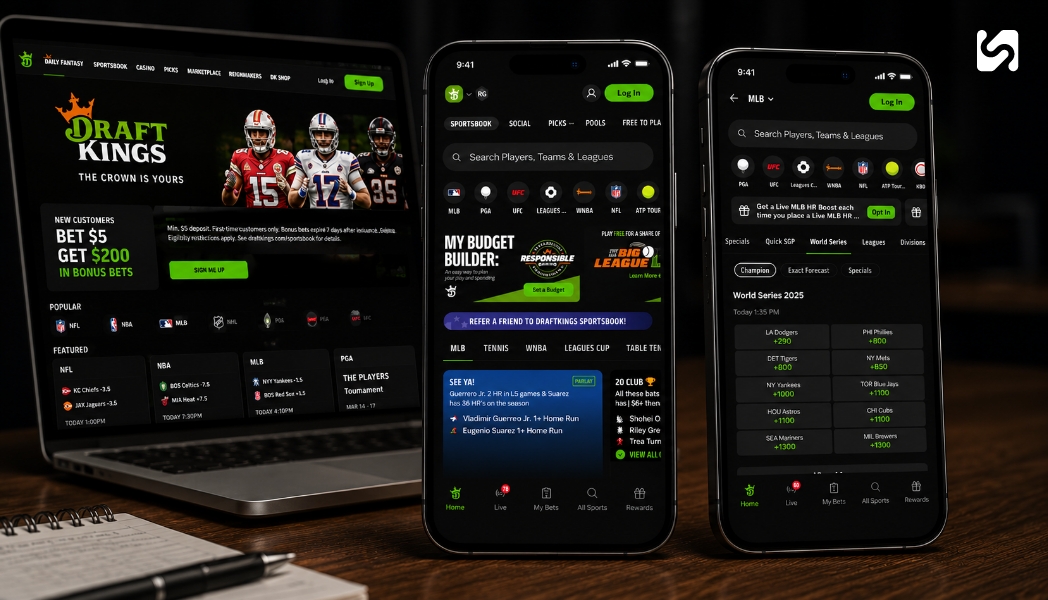
DraftKings started in 2012 as a daily fantasy sports platform and has grown into a full sports gaming platform covering DFS, sports betting, and iGaming. So what makes it the benchmark everyone wants to copy when they build a fantasy sports app like DraftKings?
- Daily Fantasy Sports (DFS) format. Unlike season-long fantasy leagues, DraftKings lets users join fantasy contests that last a single day or week. Faster results mean faster gratification and higher user engagement.
- Multi-sport coverage. NFL, NBA, MLB, NHL, golf, MMA, soccer, esports DraftKings is a true multi-sport fantasy app. Users never run out of fantasy contests to join.
- Seamless user experience. From sign-up and KYC verification to team building and prize withdrawal, every step is smooth. The fantasy team builder is intuitive even for first-time players.
- Real-time data. Live sports API integration delivers real-time scores, match statistics, and player analytics, so users stay glued to the app during live games.
- Trust and secure payments. A reliable user wallet, secure payment gateway integration, and fast prize distribution build long-term trust.
- Smart marketing and referral programs. Deposit bonuses, free contests, and referral rewards keep the user acquisition engine running.
If you plan Develop an app like DraftKings Or a daraftkings clone app, these are the pillars you need to replicate and then improve upon.
DraftKings Facts and Statistics You Should Know
Before you invest in DraftKings style fantasy sports app development, look at the market data:
- The global fantasy sports market is valued at roughly USD 42 billion in 2026 and is expected to nearly double by 2031.
- The North America fantasy sports market alone is worth USD 14.77 billion in 2026 and is forecast to reach USD 27.01 billion by 2031.
- Around 62.5 million people in the US and Canada play fantasy sports, and 84 million adults participated in fantasy sports or sports betting in the past year.
- DraftKings has reaffirmed 2026 revenue guidance of USD 6.5–6.9 billion, with millions of monthly unique paying users.
- Mobile devices account for over 65% of all fantasy sports transactions, and the mobile channel keeps growing at nearly 15% CAGR.
- Asia-Pacific is the fastest-growing region, driven by fantasy cricket apps Dream11 alone has crossed 200 million registered users in India.
The takeaway? Demand for DFS platforms similar to draftsKings is strong, mobile-first, and global. There has never been a better time to enter fantasy sports app development similar to draftking.
Understanding the DraftKings Business Model
To build an app like DraftKings, you first need to understand how the platform actually works. The DraftKings business model rests on a simple loop:
- Players deposit money into their user wallet through a secure payment gateway.
- Fans join paid fantasy contests by paying an entry fee (free contests exist too, to onboard new users).
- Users create fantasy teams of real athletes within a salary cap using the fantasy team builder.
- Real match performance decides scores. The app pulls real-time scores and match statistics through a sports data API.
- Winners share the prize pool. DraftKings keeps a commission (called “rake” or platform fee), typically around 10–15% of the entry fees.
- Prize distribution happens automatically, and users can withdraw winnings after user verification and KYC checks.
On top of this core DFS platform loop, DraftKings layers additional revenue streams sports betting, iGaming/casino, advertising, sponsorships, and subscription products. We will break down monetization in detail later in this guide.
Must-Have Features to Develop an App Like DraftKings
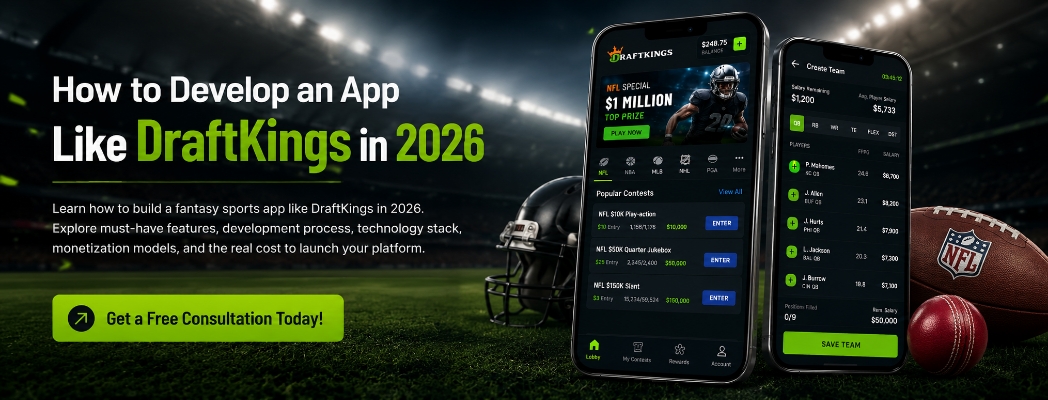
Features make or break a fantasy league app. Here are the core features of the DraftKings app you must include, split across the three panels every DFS platform needs.
User Panel Features For Draftkings Clone app Development
- Easy sign-up & login email, phone, and social login options.
- KYC integration & user verification mandatory for real-money gaming and responsible gaming compliance.
- Home dashboard upcoming matches, featured fantasy contests, and personalized recommendations.
- Fantasy team builder drag-and-drop team creation with salary cap logic and player analytics.
- Contest listing & joining free, paid, head-to-head, and mega contests with clear prize breakdowns.
- Live scores & match statistics real-time scores powered by a live sports API.
- Leaderboard live rankings during contests to keep the competition exciting.
- User wallet deposits, withdrawals, bonus cash, and transaction history in one place.
- Secure payment gateway cards, UPI, net banking, PayPal, Apple Pay, and more.
- Push notifications match reminders, lineup deadlines, contest results, and offers.
- Referral program invite friends and earn bonuses, the growth engine of every fantasy sports app.
Admin Panel Features To Build an App Like Draftkings
- Admin dashboard a bird’s-eye view of users, contests, revenue, and platform health.
- Contest management create, edit, schedule, and cancel fantasy contests across sports.
- User management approve KYC, handle disputes, and block fraudulent accounts.
- Prize distribution engine automated, rule-based payout of winnings.
- CMS & banner management control promotions, offers, and in-app content.
- Reports & analytics revenue reports, user behavior, contest performance, and retention metrics.
- Sub-admin roles role-based access for support, finance, and operations teams.
Match & Data Features
- Sports data API integration fixtures, squads, player stats, and live match data.
- Automated point calculation real-time fantasy point updates based on player performance.
- Multi-sport support football, cricket, basketball, baseball, kabaddi, esports, and more.
Advanced Features That Make Your DraftKings Clone App Stand Out
To beat established DFS platforms, your DraftKings clone app needs more than the basics. These advanced features drive retention and differentiate your sports gaming platform:
- AI predictions & smart lineups AI-powered team suggestions based on player form, pitch/venue conditions, and historical match statistics.
- Live fantasy (in-play contests) let users join or edit lineups while the match is live.
- Social & community features private leagues, chat, forums, and the ability to challenge friends.
- Gamification badges, streaks, loyalty points, and seasonal leaderboards.
- Second-screen experience live commentary, video highlights, and player heat maps.
- Multi-language & multi-currency support essential if you plan to expand into markets like India, Brazil, or Europe.
- Blockchain gaming elements NFT-based player cards, transparent smart-contract prize distribution, and crypto wallet support.
- Voice search & accessibility help casual fans find contests faster.
- Responsible gaming tools deposit limits, self-exclusion, session reminders, and age verification. These are not just “nice to have”; regulators expect them.
Step-by-Step Process to Build an App Like DraftKings
Here is the proven fantasy sports app development process we follow, broken into eight clear steps:
Step 1: Market Research & Niche Selection
Study your target market and competitors. Will you focus on a fantasy cricket app for India, a fantasy football app for the US, or a multi-sport fantasy app for global users? Your niche shapes everything: features, sports data API choice, and legal strategy.
Step 2: Legal Consultation & Licensing
Real-money fantasy sports are regulated differently in every country and even every US state. Engage gaming lawyers early to map out where you can operate and what licenses you need.
Step 3: Define Features & Create the Product Requirement Document
List MVP features vs. advanced features. A lean MVP (team creation, contests, wallet, leaderboard) gets you to market faster and cheaper.
Step 4: UI/UX Design
Fantasy players make quick decisions before lineup deadlines. Design for speed: minimal taps to create a team, clear contest cards, and a clean leaderboard. Prototype, test, refine.
Step 5: App Development (Frontend + Backend)
Develop the mobile apps (iOS/Android), the web app, the admin dashboard, and the backend that handles contests, scoring, and payments. Agile sprints with bi-weekly demos keep the project on track.
Step 6: Third-Party Integrations
Integrate the live sports API, payment gateway, KYC provider, push notifications, and analytics tools. (More on APIs in a dedicated section below.)
Step 7: Testing & QA
Load testing is critical fantasy apps face massive traffic spikes right before big matches like the Super Bowl or IPL finals. Test payment flows, point calculation accuracy, and security thoroughly.
Step 8: Launch, Marketing & Continuous Improvement
Launch on the App Store, Google Play (where permitted), and web. Run referral campaigns, deposit bonuses, and influencer marketing. Then keep iterating based on user analytics.
Right Technology Stack for a Fantasy Sports App Like DraftKings
Choosing the right technology stack for fantasy sports apps decides how well your platform handles real-time data and traffic spikes. Here is a battle-tested stack:
| Layer | Recommended Technologies |
| Mobile Apps | Flutter or React Native (cross-platform); Swift & Kotlin (native) |
| Web Frontend | React.js / Next.js, Tailwind CSS |
| Backend | Node.js, Python (Django/FastAPI), or Golang for high-concurrency scoring engines |
| Real-Time Layer | WebSockets, Socket.io, Redis Pub/Sub for live scores and leaderboards |
| Database | PostgreSQL / MySQL (transactions), MongoDB (flexible data), Redis (caching) |
| Cloud & DevOps | AWS / Google Cloud, Kubernetes, Docker, auto-scaling, CDN |
| Sports Data | Sportradar, SportsDataIO, Entity Sport, Goalserve, API-Football |
| Payments | Stripe, PayPal, Braintree, Razorpay/Cashfree (India) |
| Notifications | Firebase Cloud Messaging, OneSignal |
| Analytics | Mixpanel, Firebase Analytics, Amplitude |
| Security | SSL/TLS, OAuth 2.0, JWT, data encryption at rest, WAF, fraud detection |
Pro tip: Build your point-calculation engine as an independent microservice. During peak match hours, it should scale separately from the rest of the platform.
How to Build an App Like Draftkings with AI That Make Your DraftKings Clone App Stand Out
Artificial intelligence is the biggest differentiator in modern fantasy sports app development. Here is how AI can push your DFS platform ahead of the competition:
- AI-powered team suggestions. Recommend optimal lineups using machine learning models trained on player analytics, form, injuries, weather, and venue data.
- Personalized contest recommendations. Show each user the fantasy contests they are most likely to join the same recommendation logic that powers Netflix and Amazon.
- Dynamic pricing & prize pools. Use AI to optimize entry fees and guaranteed prize pools based on predicted participation.
- Fraud detection. Machine learning flags multi-accounting, collusion, bonus abuse, and suspicious payment behavior in real time.
- AI chatbots for support. Handle common queries (wallet issues, KYC status, contest rules) instantly, 24/7.
- Churn prediction. Identify users likely to drop off and re-engage them with targeted offers and push notifications.
- Responsible gaming AI. Detect risky play patterns early and nudge users toward healthy limits a feature regulators increasingly reward.
Third-Party APIs Required for DraftKings App Development
No fantasy league app is built entirely from scratch. These are the essential integrations for DraftKings app development:
- Live Sports API Sportradar, SportsDataIO, Goalserve, or Entity Sport for fixtures, live scores, and player statistics.
- Payment gateway APIs Stripe, PayPal, Braintree, Adyen; Razorpay or Cashfree for India-focused fantasy cricket apps.
- KYC & identity verification APIs Onfido, Jumio, Veriff, or IDfy for user verification and age checks.
- Geolocation APIs GeoComply or Radar to block users from restricted states/countries (a legal must-have in the US).
- Push notification services Firebase Cloud Messaging, OneSignal.
- SMS & email APIs Twilio, SendGrid for OTPs and transactional messages.
- Analytics & attribution Mixpanel, AppsFlyer, Adjust for tracking marketing ROI.
- Cloud storage & CDN AWS S3 + CloudFront for images, videos, and static content.
- Tax & payout APIs automated TDS (India) or 1099 (US) handling for winnings.
How Does DraftKings Make Money? Revenue Model & Monetization Strategies
Understanding the monetization of fantasy sports apps is essential before you invest. Here is how DraftKings and your clone can generate revenue:
- Contest entry fees (rake/commission). The primary revenue stream. The platform keeps roughly 10–15% of every paid contest’s entry pool.
- Sports betting margin. In regulated markets, the sportsbook holds a percentage of total wagers DraftKings’ biggest revenue driver today.
- Advertising & sponsorships. In-app banners, sponsored contests, and brand partnerships with teams and leagues.
- Subscription plans. Premium tiers offering advanced player analytics, expert picks, and ad-free experiences.
- In-app purchases. Extra team slots, contest boosters, or cosmetic upgrades.
- Affiliate & cross-promotion revenue. Promoting sportsbooks, merchandise, or ticketing partners.
- White-label licensing. Once your DFS platform matures, license the technology to other operators.
- Data monetization (compliant). Aggregated, anonymized engagement insights for media and sponsors.
A healthy fantasy sports business usually starts with contest commissions, then layers advertising and subscriptions as the user base grows.
Legal & Compliance Requirements to Develop an App Like DraftKings Or Draftkings Clone
Real-money gaming is heavily regulated. Ignore this section and even the best-built app will fail. Key requirements:
- United States: DFS is treated as a game of skill in most states, but each state has its own licensing, tax, and consumer-protection rules. Sports betting requires separate state licenses. Geolocation enforcement is mandatory.
- India: Fantasy sports have historically operated as games of skill, but the regulatory landscape shifted sharply India’s 2025 online gaming legislation banned real-money game formats, forcing platforms like Dream11 to pause paid contests. Free-to-play and ad-supported models remain viable; get current legal advice before launching paid contests in India.
- Europe & UK: Licensing through bodies like the UK Gambling Commission or Malta Gaming Authority, plus GDPR compliance for user data.
- Universal requirements:
- Age verification (18+ or 21+ depending on jurisdiction)
- KYC/AML (anti-money-laundering) compliance
- Responsible gaming tools deposit limits, self-exclusion, cooling-off periods
- Data protection and privacy compliance (GDPR, CCPA, DPDP Act)
- Transparent contest rules, prize structures, and tax handling on winnings
- Payment compliance (PCI-DSS)
Bottom line: Budget for legal counsel from day one and design your platform so features can be switched on/off per region.
Common Challenges in Developing a Fantasy Sports App Like DraftKings
Be prepared for these hurdles when you build an app like DraftKings:
- Traffic spikes. Millions of users edit lineups minutes before a big match. Without auto-scaling infrastructure, your app crashes at the worst possible moment.
- Real-time accuracy. A single wrong fantasy point can trigger thousands of complaints. Redundant sports data feeds and rigorous validation are essential.
- Regulatory complexity. Rules differ by state and country and change frequently build compliance flexibility into the architecture.
- Fraud & multi-accounting. Bonus abuse and collusion erode margins; invest in fraud detection early.
- High user acquisition costs. In North America, average customer acquisition cost has climbed to USD 300–350 per user due to intense competition. Referral programs and organic content reduce dependence on paid ads.
- Retention beyond big events. Engagement drops between seasons; multi-sport coverage, esports contests, and gamification keep users active year-round.
- Payment friction. Slow withdrawals kill trust. Automate prize distribution and offer instant payout options.
Why Choose SonicTechPro for DraftKings Fantasy Clone Development?
At SonicTechPro, we don’t just write code we build fantasy sports businesses. Here’s why startups and enterprises choose us as their fantasy sports app development company:
- Proven DFS expertise. We have delivered fantasy cricket apps, fantasy football apps, and multi-sport fantasy platforms with millions of contest entries processed.
- Ready-to-customize DraftKings clone framework. Develop an app like draftkings faster with our pre-built, white-label fantasy sports engine fully customizable to your brand.
- Scalable architecture. Microservices, auto-scaling cloud infrastructure, and real-time scoring engines built to survive Super Bowl-level traffic.
- Compliance-first development. Built-in KYC integration, geolocation, responsible gaming tools, and region-based feature toggles.
- AI capabilities. From AI predictions and smart lineups to fraud detection and churn prevention.
- End-to-end partnership. Strategy, UI/UX design, development, sports API integration, launch support, marketing consultation, and long-term maintenance.
- Transparent pricing and agile delivery. Fixed milestones, weekly demos, and no surprise costs.
Want to see a live demo of our fantasy sports platform? Contact SonicTechPro today for a free consultation.
Team Structure Required to Build a Fantasy Sports App Like DraftKings
To create a multisport fantasy sports app like draftkings you need to have an expert team that is experienced in the fantasy sports domain. A typical DraftKings clone app development team looks like this:
| Role | Count | Responsibility |
| Project Manager | 1 | Planning, sprints, and client communication |
| Business Analyst | 1 | Requirements, contest logic, compliance mapping |
| UI/UX Designer | 1–2 | Wireframes, prototypes, design system |
| Mobile Developers | 2–3 | iOS/Android or cross-platform apps |
| Backend Developers | 2–3 | APIs, scoring engine, wallet, contest management |
| Frontend/Web Developer | 1 | Web app and admin dashboard |
| QA Engineers | 1–2 | Functional, load, and security testing |
| DevOps Engineer | 1 | Cloud infrastructure, CI/CD, auto-scaling |
| Data/AI Engineer (optional) | 1 | AI predictions, analytics, fraud models |
For an MVP, a lean team of 6–8 specialists is usually enough. For a full-scale sports gaming platform, expect 10–15 team members.
How Much Does It Cost to Develop An App Like DraftKings? Cost Breakdown
The question everyone asks: how much does the DraftKings app cost to build? The honest answer: it depends on features, platforms, and team location. Here is a realistic cost to develop an app like draftkings.
Cost by App Complexity
| App Type | Features | Estimated Cost |
| MVP Fantasy App | Single sport, core contests, wallet, leaderboard | $25,000 – $50,000 |
| Mid-Level DFS Platform | Multi-sport, live scores, referral program, admin dashboard | $50,000 – $120,000 |
| Full DraftKings-Level Platform | Multi-sport + betting-ready, AI features, live fantasy, advanced analytics | $120,000 – $300,000+ |
Cost by Development Component
| Component | Approx. Share of Budget |
| UI/UX Design | 10–15% |
| Mobile App Development (iOS + Android) | 30–35% |
| Backend & Admin Panel | 25–30% |
| Third-Party API Integrations | 8–12% |
| QA & Testing | 10–12% |
| Deployment & DevOps | 5–8% |
Ongoing Costs (Often Overlooked)
- Sports data API licensing: $500 – $5,000+ per month depending on sports and data depth
- Cloud hosting: $500 – $10,000+ per month at scale
- Maintenance & updates: 15–20% of the initial build cost per year
- Legal & licensing: varies widely by jurisdiction
- Marketing & user acquisition: typically the largest post-launch expense
Region matters too. Development in North America can cost $100–$200/hour, Eastern Europe $40–$80/hour, and India $20–$50/hour. Many founders partner with an experienced offshore fantasy sports app development company like SonicTechPro to get DraftKings-level quality at 40–60% lower cost.
How Long Does It Take to Develop an App Like DraftKings?
Timelines depend on scope, but here is a realistic schedule:
| Phase | Duration |
| Discovery, research & legal groundwork | 2–4 weeks |
| UI/UX design | 3–5 weeks |
| MVP development | 12–16 weeks |
| API integrations & testing | 4–6 weeks |
| Launch & stabilization | 2–3 weeks |
- MVP fantasy sports app: 4–6 months
- Full-featured DraftKings clone app: 8–12 months
Using a pre-built white-label fantasy sports solution can compress launch time to 8–12 weeks, which is often the smartest route for validating your market before heavy investment.
Conclusion
Learning how to develop an app like DraftKings comes down to five things: a validated niche, a compliant legal foundation, a rock-solid real-time technology stack, features users love (fantasy team builder, live scores, leaderboards, secure wallet), and a monetization model that scales. With the fantasy sports market racing toward USD 80+ billion by 2031, the opportunity is real but so is the competition. The winners will be platforms that launch fast, stay compliant, and use AI to deliver a smarter, more personal fantasy experience.
Ready to build an app like DraftKings? SonicTechPro’s fantasy sports experts can take you from idea to launch MVP or full platform. Book your free consultation today and get a detailed cost estimate for your project.
Frequently Asked Questions
