
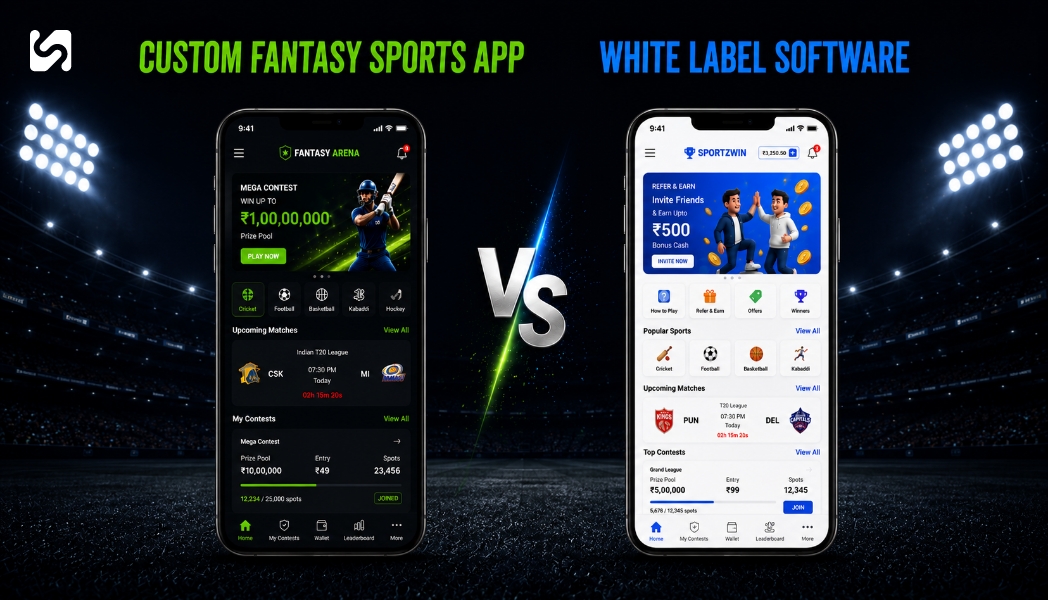
Custom vs White Label Fantasy Sports Software: Complete Guide 2026
 by Sumit Kumar
Choosing between a custom vs white label fantasy sports software build is one of the first big decisions any founder in this space has to make – and it shapes everything that follows: your budget, your launch date, how far you can scale, and how much of the platform you actually own. Get it right and you launch lean or build a moat. Get it wrong and you either overspend on features you didn’t need or hit a ceiling you can’t break through. This guide breaks down the white label vs custom fantasy sports app debate in plain terms, so you can match the model to your business instead of guessing.
The Growing Demand for Fantasy Sports Platforms
Fantasy sports has gone from a niche hobby to a mainstream industry. Cricket, football, kabaddi, basketball – fans don’t just watch anymore, they draft teams, join contests, and follow every ball and play with money and pride on the line. That surge in demand has pulled in entrepreneurs, established brands, and investors all chasing a slice of the market, and every one of them needs a platform to compete on.
Why You Have to Choose Between Custom and White Label
Custom vs White Label Fantasy Sports, Here’s the fork in the road: you can build a custom fantasy sports platform from scratch, tailored to your exact vision, or you can license a ready-made white label solution and brand it as your own. Both can succeed. But they pull in opposite directions on cost, speed, control, and ownership – so understanding the trade-off early saves you from an expensive course-correction later.
What Is a Custom Fantasy Sports App?
Definition and Overview
A custom fantasy sports app is built specifically for your business, from the ground up. Every feature, screen, contest format, and line of code is designed around your goals rather than borrowed from a shared template. You own the result outright – the design, the technology, and the roadmap.
Pros of Custom Fantasy Sports Software
The biggest draw is freedom. You decide exactly how the app looks, how contests work, which sports you cover, and how you make money. There are no platform restrictions, no shared codebase, and no waiting on a vendor to approve a feature. You also own the intellectual property, which matters enormously if you ever raise funding or sell the business.
Cons of Custom Fantasy Sports App
That freedom comes at a price. Custom development costs more upfront and takes longer to launch – months, not weeks. You’ll need a capable development team and a bigger budget, and you carry full responsibility for maintenance, security, and updates. For a tight-budget startup just testing the waters, that’s a heavy lift.
Key Benefits of Custom Fantasy Sports Software
- Complete brand control. Every pixel and interaction reflects your brand, not a vendor’s template.
- A unique user experience. You can design contest types and features no competitor offers.
- Enhanced scalability. The architecture is built for your growth plans, not a one-size-fits-all ceiling.
- Advanced monetization. Build any revenue model you want – entry fees, subscriptions, ads, or your own hybrid.
- A real competitive advantage. A distinctive product is far harder for rivals to copy than a licensed one.
What Is a White Label Fantasy Sports App?
Definition and Overview
A white label fantasy sports app is a pre-built platform developed by a vendor that you license, brand, and launch as your own. The core technology already exists and is shared across clients; you add your logo, colours, and content on top. It’s the fast lane into the market.
Pros of White Label Fantasy Sports Solution
Speed and savings lead the list. Because the platform is already built and tested, you can launch in weeks at a fraction of the cost of custom development. The features and integrations are ready out of the box, and the technical heavy lifting – servers, data feeds, payment systems – is largely handled for you.
Cons of White Label Fantasy Sports Software
The trade-off is control. You’re working within the vendor’s feature set, so deep customization is limited and your app may resemble others built on the same platform. You typically don’t own the source code, ongoing licensing fees add up over time, and your growth is tied to the vendor’s roadmap and reliability.
Key Benefits of White Label Fantasy Sports Solution
- Faster launch time. Go live in weeks instead of months and start capturing users sooner.
- Lower initial investment. A far smaller upfront cost makes it accessible to lean budgets.
- Reduced technical complexity. The vendor handles infrastructure, updates, and most maintenance.
- Ready-made features and integrations. Live scores, payments, and contest engines come built in.
- Ideal for startups and SMEs. A low-risk way to enter the market and validate demand quickly.
Custom vs White Label Fantasy Sports Software: Key Differences
1. Development Cost
Custom builds carry a high upfront cost. White label solutions are cheaper to start but charge ongoing licensing or subscription fees, so the long-term gap narrows the longer you operate.
2. Time to Market
White label wins on speed – weeks to launch versus several months for a custom build. If first-mover advantage or a seasonal sporting event is driving your timeline, this matters a lot.
3. Customization Capabilities
Custom is effectively unlimited; you can build anything. White label is bounded by the vendor’s platform, with surface-level branding and only the customization options they expose.
4. Scalability and Performance
A custom architecture can be engineered for massive concurrent traffic during big matches. White label scalability depends entirely on the vendor’s infrastructure and the plan you’re on.
5. Ownership and Intellectual Property
With custom, you own everything – code, design, and IP. With white label, you license the platform and rarely own the underlying source code, which can limit funding and exit options.
6. Security and Compliance
Custom lets you build security and regional compliance (KYC, payments, responsible-gaming rules) to your exact standards. White label inherits the vendor’s security posture, which you’ll need to vet carefully.
7. Maintenance and Support
Custom means you own maintenance, usually through your team or development partner. White label bundles maintenance and support into the licensing fee, which is simpler but less flexible.
8. Third-Party Integrations
Custom apps integrate with any data feed, payment gateway, or tool you choose. White label supports the integrations the vendor already offers, with limited room to add new ones.
Custom vs White Label Fantasy Sports Apps Cost Comparison
Initial development costs. White label entry is low – often a setup fee plus a subscription. Custom development for fantasy sports apps in 2026 runs significantly higher upfront because you’re funding the entire build.
Ongoing maintenance expenses. Custom apps carry server, update, and support costs you manage directly. White label folds most of this into recurring fees, so it’s predictable but never stops.
Hidden costs to consider. Watch for white label licensing escalations, per-user or revenue-share charges, and feature-unlock fees. On the custom side, budget for post-launch iterations, scaling, and data-feed costs.
Return on investment. White label gets you to revenue faster with less risk, which suits early validation. Custom typically delivers stronger long-term ROI once you scale, because there are no licensing fees eating your margin and the asset is yours.
When Should You Choose a Custom Fantasy Sports Solution?
- Enterprise-level businesses with the budget and a need for a fully differentiated product.
- Long-term growth plans where owning the IP and controlling the roadmap pays off over years.
- Unique business requirements – special contest formats, mechanics, or integrations no platform offers.
- Multi-sport and global platforms that need flexible architecture, localization, and regional compliance.
If your strategy depends on standing out and scaling big, custom is usually the smarter long-term bet.
When Should You Choose a White Label Fantasy Sports Software?
- Startups and new market entrants who need to launch fast and prove the concept.
- Businesses with limited budgets that can’t justify a large upfront build yet.
- Rapid market testing – validate demand before committing serious capital.
- Quick revenue goals where getting live in time for a tournament or season is the priority.
For a lean team chasing an MVP, white label is often the practical starting point – and you can always migrate to custom later once the model is proven.
Essential Features Every Fantasy Sports App Should Have
Custom vs White Label Fantasy Sports, Whichever model you pick, these features are non-negotiable:
- User registration and profiles – smooth onboarding with social login and secure accounts.
- Team creation and management – the core drafting and lineup experience.
- Real-time sports data integration – accurate, live feeds for scores and player stats.
- Live scores and analytics – real-time updates that keep users glued during matches.
- Secure payment gateway – trusted, compliant deposits, withdrawals, and contest entries.
- Push notifications – match alerts, contest reminders, and results that drive re-engagement.
- Leaderboards and rewards – rankings and prizes that fuel competition and retention.
- Social sharing – invites and sharing that turn users into a growth channel.
Custom vs White Label Fantasy Sports Software: Feature Comparison
| Aspect | Custom Fantasy Sports App | White Label Fantasy Sports Software |
| Upfront cost | High | Low |
| Ongoing cost | Maintenance you manage | Recurring licensing / subscription fees |
| Time to market | 4–9 months (typical) | 2–6 weeks (typical) |
| Customization | Unlimited — any feature or format | Limited to vendor’s platform |
| Branding control | Full, end to end | Surface-level (logo, colours, theme) |
| Scalability | Engineered for your growth | Tied to vendor infrastructure & plan |
| Performance under match-day load | Tunable to your traffic peaks | Depends on vendor’s capacity |
| Ownership / IP | You own code, design, and IP | Licensed; source code stays with vendor |
| Source code access | Yes | Usually no |
| Security & compliance | Built to your exact standards | Inherited from vendor; must be vetted |
| Maintenance & updates | Your team or dev partner | Bundled into licensing fee |
| Third-party integrations | Any data feed, gateway, or tool | Vendor-supported integrations only |
| Unique contest formats | Fully supported | Restricted to platform’s options |
| Monetization flexibility | Any model or hybrid you design | Within vendor’s supported models |
| Vendor dependency | None (you own it) | High (roadmap, uptime, pricing) |
| Funding / exit readiness | Strong (owned asset) | Weaker (licensed, no IP) |
| Initial risk | Higher (bigger investment) | Lower (small upfront, fast validation) |
| Long-term ROI | Stronger once scaled (no license fees) | Erodes over time via recurring fees |
| Time to first revenue | Slower | Faster |
| Best for | Enterprises, long-term growth, differentiation | Startups, MVPs, fast launch, tight budgets |
Custom vs White Label Fantasy Sports App – How to Choose the Right Model
Custom vs white label fantasy sports software The decision should I build custom or white label fantasy app isn’t about which model is “better” in the abstract it’s about which one fits your business right now. Weigh these seven factors before you commit.
1. Budget and Funding Position
Be honest about what you can invest today. White label fits limited or pre-revenue budgets with a low upfront cost, while custom demands a larger investment that’s easier to justify once you’re funded or already earning. Your available capital is often the deciding factor.
2. Time to Market
Look at your timeline and any seasonal pressure. If you need to launch before a major tournament or beat competitors to a new market, white label gets you live in weeks. If your launch date is flexible, custom’s longer build becomes far less of a drawback.
3. Customization and Differentiation Needs
Ask how different your product really needs to be. If your edge depends on unique contest formats, mechanics, or features no rival offers, custom is the only way to deliver them. If standard fantasy features are enough to compete, white label covers the essentials.
4. Scalability and Growth Plans
Think two or three years ahead, not just launch day. If you expect huge concurrent traffic on match days and rapid multi-sport or global expansion, a custom architecture is built for it. For steadier or smaller-scale growth, a white label plan can handle the load.
5. Ownership and Intellectual Property
Decide how much owning the asset matters to you. If you plan to raise funding, sell the business, or fully control your roadmap, owning the code and IP through a custom build is essential. If you simply want a working product live and earning, licensing is acceptable.
6. Technical Capacity and Maintenance
Factor in the team you have. Custom development means owning maintenance, security, and updates, which requires in-house skill or a reliable development partner. White label hands most of that responsibility to the vendor, which suits lean teams without technical depth.
7. Long-Term Vision and ROI
Step back and look at the bigger picture. White label maximizes speed and minimizes early risk, ideal for validating an idea. Custom maximizes long-term margin and control, rewarding businesses building to scale and own for years. Match the model to where you’re truly headed, not just where you are today.
A practical closing thought: many founders don’t treat this as permanent. Starting on white label to validate the market, then migrating to a custom fantasy sports platform once the numbers justify it, is a proven phased path that balances early speed with long-term ownership.
Custom vs White Label Fantasy Sports – Quick Self-Assessment
Answer these honestly – more “yes” answers on either side points to your fantasy sports development model:
| Question | If YES → lean |
| Is your budget tight or pre-revenue? | White label |
| Do you need to launch within weeks? | White label |
| Are standard fantasy features enough to compete? | White label |
| Do you lack an in-house technical team? | White label |
| Do you need unique features no competitor has? | Custom |
| Are you planning to raise funding or sell later? | Custom |
| Do you expect massive match-day traffic and global scale? | Custom |
| Is owning your code and IP a priority? | Custom |
Conclusion – Custom vs White Label Fantasy Sports
Custom vs white label fantasy sports software decision comes down to a trade-off between speed and control. White label gets you to market fast, cheap, and low-risk, making it ideal for startups, MVPs, and tight budgets. Custom costs more and takes longer, but it gives you full ownership, unlimited flexibility, and stronger long-term margins – the right call for enterprises and serious, long-haul players.
So which fantasy sports model is best for your business? White label fantasy sports or custom fantasy sports software? If you’re validating an idea or racing a tournament deadline, start with white label. If you’re building a brand to scale and own for years, invest in custom. And if you’re somewhere in between, the smartest move is often to launch white label, learn from real users, and graduate to a custom platform when growth demands it. Match the model to your goals, budget, and timeline – and you’ll be building on the right foundation from day one.
Frequently Asked Questions – Custom vs White Label Fantasy Sports Software
