
Social Commerce in Travel: Strategies for OTAs & Brands
 by Sumit Kumar
What is social commerce in travel? Social commerce in travel is the practice of turning social platforms into booking channels, so a traveller can discover a hotel, tour or flight and pay for it without leaving the app. TikTok, Instagram, Pinterest and Xiaohongshu now carry price, availability and checkout inside the feed. Discovery and transaction happen in one place.
The gap between inspiration and booking
Social has already won the top of the funnel. Expedia Group’s 2025 Traveller Value Index found 61% of travellers now find trip ideas on social platforms, up from 35% in 2022. A separate Expedia Group path-to-purchase study puts the figure at 77% when asking about primary source of inspiration.
Conversion tells a different story. Fewer than 1% of travel bookings are completed on social platforms today. Paid social converts at 2.1% in travel, the weakest of any digital channel, against 9.5% for referral traffic and 8.5% for organic search. On TikTok, 60% of users say the platform made them interested in a destination and 35% actually went.
A smoother checkout will not close that gap on its own. A £40 jumper is an impulse buy. A £2,000 holiday involves flight comparisons, dates, visas and usually another person’s opinion. The friction is structural, and it will take years to erode.
The economics still favour showing up. Google CPMs run roughly €9 to €28 while social platforms sit at €5 to €14, often with stronger engagement. Cheap attention with weak conversion is a real asset if you know what you are buying it for.
Why OTAs are moving first, again
In August 2025, TikTok and Booking.com launched in-app hotel booking in the US, Indonesia and Japan. A user taps a location pin in a travel video, sees hotel options and books through Booking.com’s infrastructure. The hotel gets demand. It also pays standard OTA commission, receives limited guest data and loses control of the brand presentation.
This is the search era playing out again on a new surface. OTAs eventually held 73% of first-page Google results and now charge 15-25% commission on bookings that hotels once acquired for nothing. Kalibri Labs analysis of 18,000 US hotels found commission costs rose 45% as a share of guest-paid revenue since 2015. The four largest OTAs spend a combined $17.8 billion a year on marketing.
Skift Research estimates social commerce in travel could reach around $7 billion in value across accommodation and airlines. The intermediaries are building the transaction layer for that market right now, and the inventory owners are mostly watching.
For OTAs, the opportunity is straightforward: own the checkout wherever discovery moves, before the platforms build their own booking stacks or hotels get their direct channels in order. The affiliate commission model transfers cleanly to a feed. The harder question is what happens when TikTok decides it would rather keep the margin.
What social commerce in hospitality looks like right now
Hotels face the sharpest version of this trade-off. Every booking that moves from your website to a social checkout run by an OTA costs you margin, guest data and the loyalty enrolment that would have followed.
Not every brand should react the same way. Four profiles behave differently:
| Profile | Position | Best move now |
| Experience and tour operators | Visual, pre-packaged, impulse-friendly price points | Invest actively; keep the transaction on your own platform |
| Challenger brands | No direct channel to protect | Move early; the cost of waiting outweighs the intermediation risk |
| Gen Z-dependent brands | Audience starts on social and skips loyalty programmes | Build presence now; absence has a direct cost |
| Established brands with strong direct channels | Working apps, active loyalty | Fix your own mobile checkout before building social booking flows |
Klook’s TikTok creator programme – Philippines
The operator case is the clearest. Klook’s TikTok creator programme drove close to 500,000 transactions in the Philippines alone within eight months, and the bookings completed on Klook’s platform rather than inside TikTok. TourRadar signed 3,500 creator ambassadors in the three months after launching its social content booking feature in June 2025. Social commerce works for this product type when the brand keeps the booking relationship.
Ryanair
The counterexample is just as instructive. Ryanair has about 2.7 million TikTok followers and hashtag content past 2.6 billion cumulative views, no social commerce capability at all, and sells over 99% of its tickets through its own site and app. Its former head of social put the strategy in one line: social media is where you get found, your own channel is where you get paid.
Gen Z changes the maths for some brands. This cohort spends an average of $3,432 a year on leisure travel, half start their search on social platforms, and 59% belong to no travel loyalty programme at all. If that is your growth market, sitting out is a decision with a price tag.
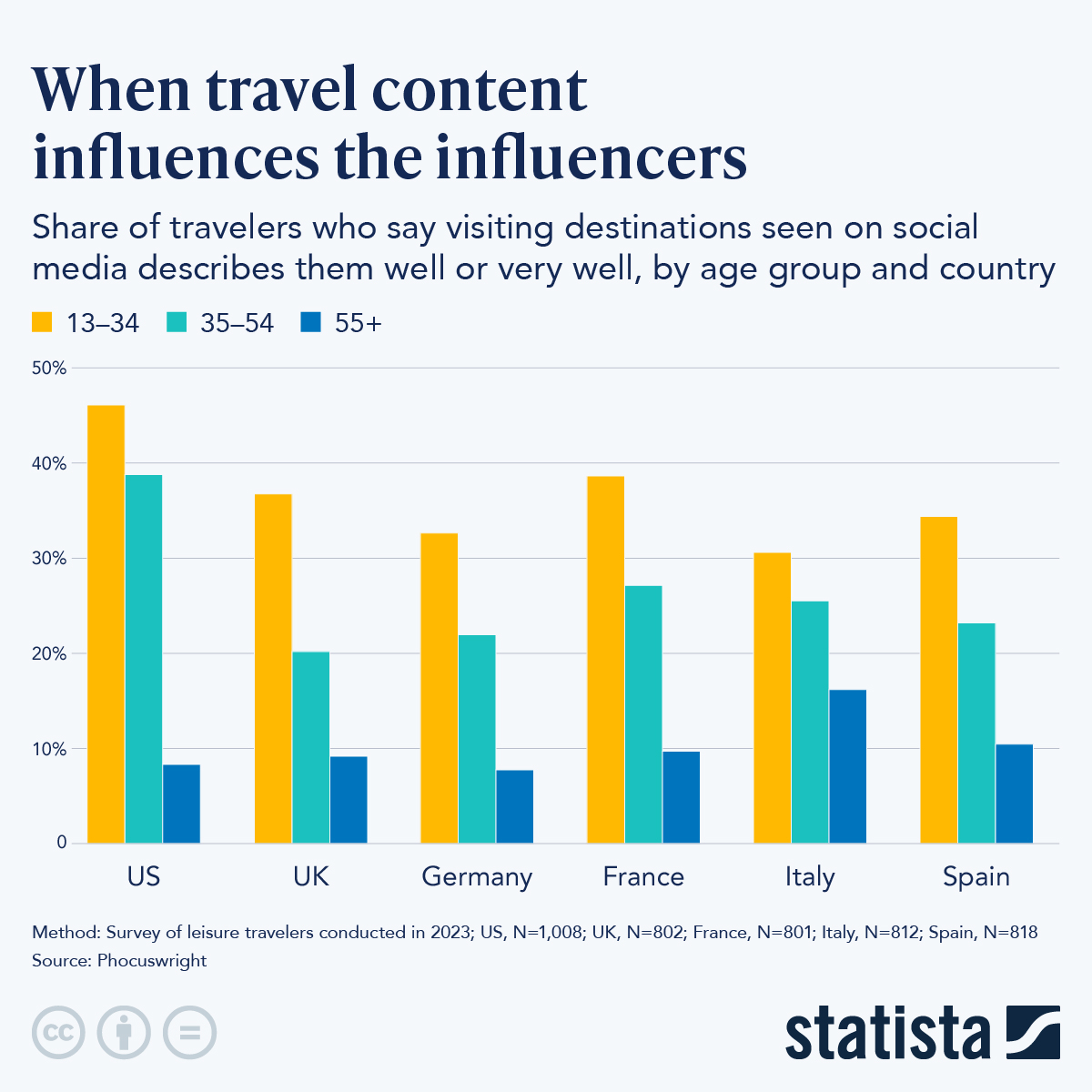
You will find more infographics at Statista
Social Commerce in Travel: Opportunities for travel creators and travel bloggers
Creators are the group whose economics improved most. Affiliate marketing has become creators’ primary monetisation method, and micro-creators now take close to half of US influencer marketing spend, up from under a fifth in 2021. Brands pay for trackable bookings rather than reach, which favours a 6,000-follower account with a defined niche over a generalist with a million.
The rates are real money in social commerce in travel. GetYourGuide pays from 8% per booking, hotel programmes typically run 4-8%, and most negotiated creator deals land between 4% and 12% scaled by tier and booking value. TikTok Go pays creators commission when a follower books a hotel from their video. One US creator profiled by Skift shifted her revenue mix from 80% branded content to 60% affiliate.
For travel bloggers, the practical shift is treating the blog as the conversion layer and social as the top of the funnel. A Reel earns the attention; an itinerary post with booking links earns the commission six weeks later when the trip gets planned. Group trips through platforms like TrovaTrip are a second lever, with hosts typically taking around 20% of trip revenue.
The risk is dependence. Platform commission terms are set by the platform, and a programme that pays 10% today can pay 4% next year. Creators with an email list and a site keep options that feed-only creators do not.
Social Commerce in Travel :Five priorities for travel brands
David Armstrong, CEO and co-founder of HolidayPirates Group, argues in PhocusWire that the path to purchase has become scroll-first rather than search-first, and sets out five priorities for brands adapting to it. In summary:
- Design for discovery. Make content that earns attention before the traveller has formed any intent to book, built for how people consume on a phone.
- Shorten the distance to the booking. Put the transaction as close to the moment of inspiration as the platform allows.
- Lead with short-form vertical video. Video is the dominant inspiration format across TikTok, Instagram and YouTube Shorts. Shoot native and vertical, show the experience rather than the property, and give the viewer a reason to act while they are still feeling something.
- Grow the channels you own. Apps, email, push and messaging give you a relationship no algorithm change can revoke, which lowers the risk of building a business on rented reach.
- Rethink how you measure. Last-click attribution cannot see what social discovery contributed, so it will keep telling you to defund the thing that started the trip.
Armstrong rates this shift as at least as consequential as the move to mobile-first a decade ago, and expects brands that adapt slowly to lose relevance.
Read that urgency against your own audience before acting on it. HolidayPirates sells deals to a scroll-first crowd, so the timeline that suits Armstrong’s business is faster than the one a luxury cruise operator needs. Much of the platform-level discovery data skews toward 18-24 year olds, while older travellers still hold the majority of total travel spend in most categories and still start with search and personal recommendation.
Read More – Social Commerce Integration in Travel and Online Shopping
Social Commerce in Travel – Statistics
| Stat | Latest Figure | What It Means for Travel Commerce | Source |
| Social Discovery | 60%+ | More than 60% of consumers cited social media as a source of travel inspiration in 2025, up from 35% in 2023. | Expedia Group — 2025 Traveler Value Index |
| Creator Influence | 70%+ | More than 70% of consumers said an influencer recommendation impacted their decision to book a travel element or trip. | Expedia Group — Influencer & Travel Research |
| Purchase Intent | ~75% | Nearly 75% of consumers said they would likely purchase a travel package based solely on an influencer recommendation. | Expedia Group — 2025 Traveler Value Index |
| Content → Decision | 62% | 62% of social users made a specific trip decision after viewing social media content. | Phocuswright — Social Media Usage in Travel |
Social Commerce in Travel – Strategies to win
The five priorities above set the direction. These are the moves that execute them.
Fix mobile before you build anything social. Around 31% of mobile web sessions happen inside in-app browsers, and Instagram, Facebook, TikTok and X all open external links in their own. Autofill breaks, payment integrations misbehave, tracking gets blocked. Test your checkout inside each in-app browser and fix what fails.
Build the measurement layer. Only 23% of businesses use social data to measure ROI. Server-side tracking through the Meta Conversions API, TikTok Events API and Pinterest Conversions API is still not standard practice. Without it, a traveller who sees a Reel in January and books in March through email gets credited entirely to email, and the report tells you to cut the creator budget. Every later decision about social commerce rests on data you do not currently have.
Buy TikTok on today’s terms. TikTok Travel Ads launched in September 2025. Etihad reported a 17% lift in bookings; Meliá reported ROAS gains of 156-291% across campaigns. Traffic still clicks through to your own booking flow, which means the transaction and the customer stay with you. That will not last forever.
Use Pinterest for outbound intent. Pinterest Travel Catalogues send users to your booking flow rather than completing the sale in-platform. TUI’s beta produced a 6x improvement in outbound click-through rate and an 80% cut in cost per click.
Pay creators on bookings, not views. Issue unique codes and UTM-tagged links per creator, and layer post-purchase surveys on top, since no single method captures travel attribution cleanly.
Make loyalty a booking engine. Marriott Bonvoy drives 73% of room nights and Hilton Honors over 60%. Most travel loyalty programmes still function as passive points collection, which is a direct channel asset sitting unused.
Where to start this quarter
Measure what share of your bookings arrive through direct channels today and whether that share is growing or shrinking. If it is shrinking while your social referral traffic grows, the intermediation is already happening and the fix is your own checkout, not a social storefront. Hire a Travel app development company that can turn your social commerce idea into reality.
Frequently Asked Questions About Social Commerce in Travel
