
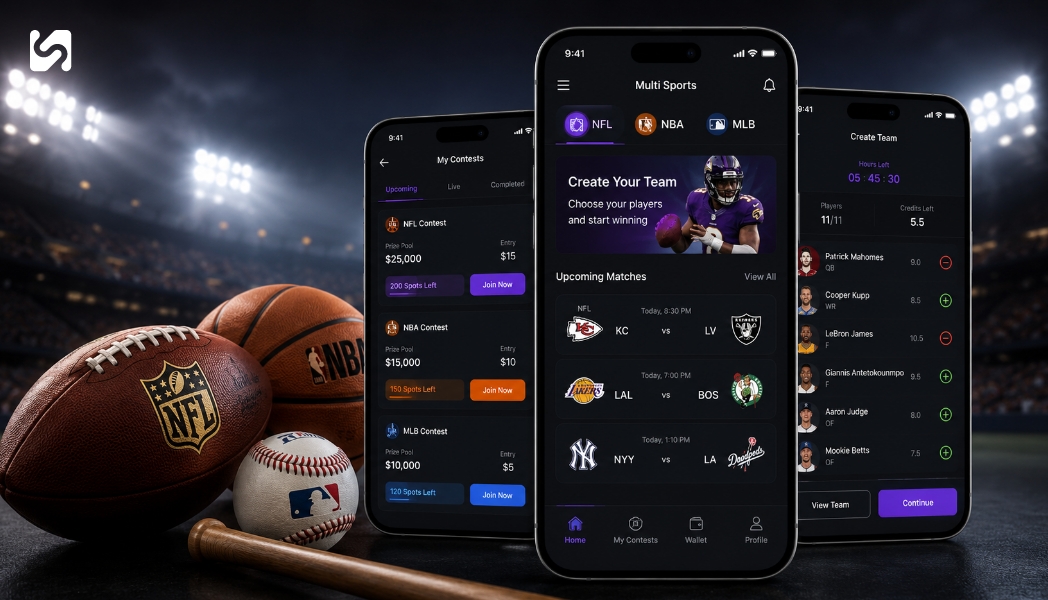
How to Build a Multi Sport Fantasy App? NFL + NBA + MLB Under One Roof
 by Sumit Kumar
Quick Summary: Building a multi sport fantasy app means combining NFL, NBA, MLB, and other leagues into one. Multi Sport platform share unified contest engine, real-time scoring and wallet. Multi-sport fantasy app development typically costs between $40,000 and $400,000+. Development cost depends on the number of sports, AI features, and real-time infrastructure required, with most MVPs taking 4–6 months to launch.
If you’re researching how to build a multi sport fantasy app, you’ve probably already noticed the pattern: the platforms winning the biggest chunk of the market aren’t single-sport apps anymore. Multi sport fantasy platforms let a user draft their NFL lineup on Sunday, jump into an NBA contest on Tuesday, and set their MLB roster by Thursday all without leaving the app.
That’s not a coincidence. The global fantasy sports market is on track to hit approximately $42.37 billion in 2026, and it’s projected to nearly double to $80.31 billion by 2031. North America alone accounts for over 46% of that revenue, driven largely by fans who already follow the NFL, NBA, and MLB on the same weekend. A platform that only covers one of those sports is leaving the other two-thirds of that user’s attention and wallet on the table.
This guide walks through everything involved in multi sports fantasy app development architecture, features, APIs, AI layer, cost, and the exact steps to take your idea from concept to launch. Whether you’re planning a multi league fantasy sport platform covering three major US sports or a multi sports DFS platform spanning cricket, football, and kabaddi for a global audience, the fundamentals in this guide apply.
What Is a Multi-Sport Fantasy App?
A multi-sport fantasy app is a single platform that lets users create fantasy teams, join contests, and compete across more than one sport instead of being locked into just fantasy football or just fantasy cricket. One login, one wallet, one leaderboard system, multiple sports running simultaneously.
Think of it as the difference between a single-purpose tool and an ecosystem. A fantasy football app only works during NFL season six months of activity followed by six months of dormancy. A multi-sport platform stitches together fantasy football, fantasy basketball, fantasy baseball, fantasy hockey, fantasy cricket, fantasy soccer, and even fantasy kabaddi into one continuous experience. When football season ends, basketball season is already in full swing on the same app, with the same users, in the same wallet.
This is exactly why multi-sport fantasy platforms like DraftKings and FanDuel structure their DFS platform around dozens of sports rather than one American Football alone delivered 58.25% of 2025 fantasy revenue in North America, but Baseball, Basketball, and Ice Hockey (the fastest-growing sub-segment at 14.38% CAGR) fill in the gaps and keep users engaged year-round.
How Does a Multi-Sport Fantasy App Work?
The mechanics are simple to explain but require serious engineering underneath. A user opens the app, picks a sport and either joins a daily fantasy contest or drafts into a fantasy league running for the full season. Users build their fantasy team using a fantasy team builder interface, spending a virtual salary cap to draft real athletes.
Once a live match starts, the app pulls real-time scores and sports statistics through a match API, updating each user’s point total as actual game events happen: a touchdown, a three-pointer, a home run. The leaderboard refreshes continuously so players can track their rank against thousands of competitors mid-contest.
Behind the scenes, the same core engine scoring logic, wallet, leaderboard, notification system needs to work identically whether the sport is NFL or MLB. That’s the real engineering challenge in multi-sports fantasy platform development: building one scoring and contest engine flexible enough to handle wildly different sports without needing a rebuild every time you add a new league.
Why Multi-Sport Fantasy Apps Are Growing Faster Than Single-Sport Platforms
A football-only platform is busy for roughly four months a year and quiet the rest of the time. That’s a brutal economic model: you’re paying for servers, support, and marketing twelve months a year but only converting revenue in a third of that window.
Multi-sport platforms solve this by design. When one sport’s season ends, another begins, and the same user base rolls straight into the next contest without ever needing to be re-acquired. Operators actively lock in this retention by running cross-promotions that roll football players into basketball or baseball slates once the season concludes.
There’s also a discovery effect. A user who signs up specifically for fantasy football often discovers fantasy basketball or fantasy cricket inside the same app purely because it’s already there with no fresh download, no new account, no re-entering payment details. More than 55% of active fantasy users already participate in multiple contests weekly, which tells you the appetite for cross-sport engagement already exists; multi-sport platforms are simply the ones capturing it.
And geographically, this matters even more. North America runs on NFL, NBA, and MLB. India runs on cricket. The UK and Europe run on football (soccer). A platform built for global reach or targeting NRI and diaspora audiences needs multi league fantasy sport support baked in from day one, not bolted on later.
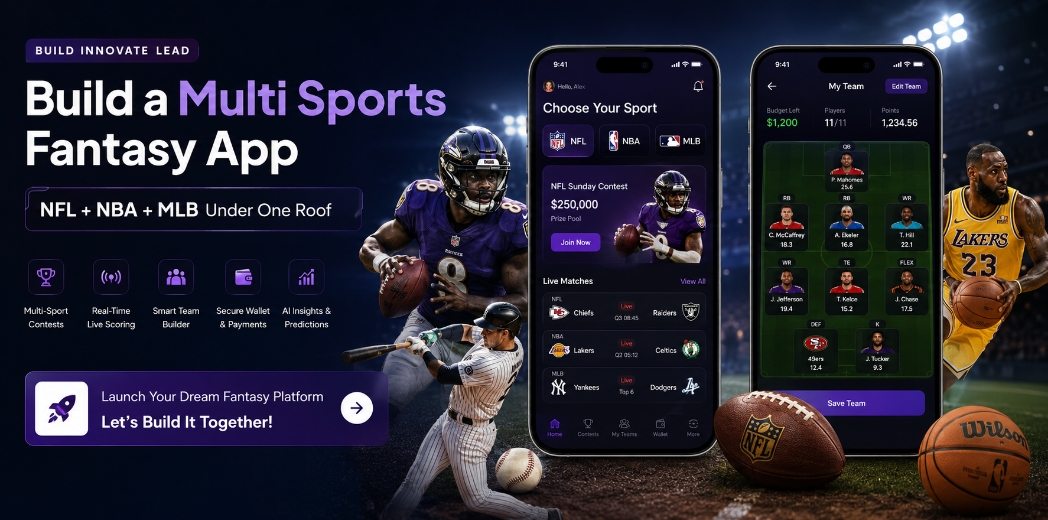
Benefits of Investing in Multi-Sport Fantasy App Development
Higher user lifetime value. A user engaged across three sports spends more per year than a user engaged in one, simply because there are more opportunities to enter paid contests throughout the calendar.
Reduced customer acquisition cost per active user: Acquiring a fantasy sports user in North America now costs $300–$350 on average given the marketing intensity of the category. Spreading that cost across a user who stays active year-round dramatically improves your return per acquisition dollar.
Stronger data and personalization signal: The more sports a user interacts with, the more behavioral data your platform collects, which directly powers better AI-driven team recommendations and contest suggestions.
Diversified revenue exposure: If one sport underperforms in a given season (a lockout, an off year, reduced media attention), platform revenue doesn’t collapse while other sports continue generating entry fees and engagement.
Broader addressable market: You’re not fishing in one pond. A platform covering NFL, NBA, MLB, cricket, and soccer can realistically target North America, South Asia, and parts of Europe simultaneously, instead of being geographically boxed in by a single sport’s cultural footprint.
Key Features Every Multi-Sport Fantasy App Should Include
Building a genuinely competitive multi sports fantasy app means going well beyond a basic drafting screen. Here’s what actually needs to be in the build:
Multi-sport contest engine: A single backend capable of running NFL, NBA, MLB, cricket, and soccer contests using sport-specific scoring rules without needing separate codebases for each.
Real-time live match tracking: Every point update, every scoring event, streamed to the user’s screen within seconds of it happening on the field or court.
Fantasy Team builder: An intuitive drag-and-drop or salary-cap-based interface for assembling a roster, with position rules and budget constraints enforced automatically per sport.
Dynamic leaderboard system: live-updating rankings across every active contest, segmented by sport, league, and contest type (head-to-head, tournament, or season-long).
Referral rewards program: Built-in mechanics to reward users for bringing in new players, which remains one of the lowest-cost acquisition channels available.
Wallet integration and payment gateway: Unified wallet across all sports so users don’t need to manage separate balances per sport, plus support for multiple regional payment methods.
Push notifications for contest reminders, live score alerts, lineup lock warnings, and promotional nudges that keep users returning during active game windows.
User dashboard: Single home screen showing active contests, past performance, wallet balance, and upcoming matches across every sport the user follows.
Admin dashboard: Operational backbone for your team to manage contests, monitor fraud signals, configure prize pools, and analyze platform-wide performance data.
KYC and identity verification: KYS is mandatory in most regulated markets before real-money withdrawal is permitted, and a key trust signal for user retention.
Multi-language and multi-currency support: essential if you’re targeting more than one geographic region, particularly across US, UK, and South Asian markets simultaneously.
Choosing the Right Technology Stack for Multi Sport/League Platform
The right technology stack for multi-sports fantasy app development depends on your scale ambitions, but a few architectural decisions matter regardless of size.
Frontend: React Native or Flutter are the standard choice for cross platform apps, letting you ship to iOS and Android from a single codebase while still achieving near-native performance for real-time score updates.
Backend: Node.js or Go are commonly used for the core contest and scoring engine because both handle high-concurrency, low-latency workloads well critical when thousands of users are receiving live score updates simultaneously during peak game windows.
Database: A combination of PostgreSQL for structured data (users, contests, transactions) and Redis for high-speed caching (live leaderboards, real-time scores) is the standard pairing. Redis in particular is what makes sub-second leaderboard updates possible at scale.
Real-time communication: WebSocket connections (via Socket.io or a similar library) push live score and leaderboard updates to users without requiring constant page refreshes non-negotiable for a live match tracking experience that feels genuinely real-time.
Cloud infrastructure: AWS, Google Cloud, or Azure, with auto-scaling configured specifically for traffic spikes. Fantasy platforms see massive, predictable surges during marquee events Super Bowl Sunday, IPL finals, NBA playoffs and infrastructure that can’t scale elastically during those windows will crash exactly when revenue potential is highest.
Message queuing: Kafka or RabbitMQ to handle the firehose of live sports data events without dropping updates or overloading your primary database during high-traffic periods.
Multi Sport Fantasy App Architecture Design
| # | Layer | Component | What It Does | Technology / Tools |
| 1 | Client Apps | Mobile, Web & Admin Dashboard | User-facing apps for players plus internal dashboard for operations team | React Native / Flutter, Next.js, React |
| 2 | API Gateway & Auth | Routing, Authentication, KYC | Routes requests to services, manages login/sessions, verifies user identity | AWS API Gateway, Auth0, Onfido |
| 3 | Contest & Fantasy Engine | Team Builder, Scoring, Leaderboard | Core engine running contests, drafting, scoring rules, and live rankings across all sports | Node.js, Go, Redis Sorted Sets |
| 4 | Real-Time Sports Data | Live Match APIs, Event Streaming | Pulls live scores and stats, streams events to the scoring engine without delay | Sportradar, Stats Perform, Kafka |
| 5 | AI & Personalization | Recommendations, Predictions, Fraud Detection | Suggests lineups, forecasts player performance, flags suspicious activity | TensorFlow, AWS Personalize |
| 6 | Wallet, Data & Infra | Payments, Database, Cloud, Security | Handles transactions, stores platform data, and scales infrastructure for peak traffic | PostgreSQL, Stripe, AWS, Cloudflare |
Best APIs for Live Scores, Player Statistics & Fantasy Data
Your entire platform lives or dies on the reliability of your sports data feed. A few seconds of lag on a match API during a live event is enough to break user trust in your scoring accuracy.
The major providers offering fantasy sports app API integration include Sportradar and Stats Perform for professional-grade, low-latency data across NFL, NBA, MLB, NHL, soccer, and cricket. These are the same data providers used by DraftKings and FanDuel, and they offer play-by-play granularity needed for accurate fantasy scoring.
Cricket-specific data is critical if you’re building toward IPL or international cricket audiences. API providers like CricAPI and SportMonks offer ball-by-ball data feeds that plug directly into fantasy scoring engines.
When evaluating any sports data API for your build, check these four things:
- latency (how many seconds behind live action is the data),
- sport coverage (does it support all the sports on your roadmap),
- historical data depth (needed for AI-driven predictions and past performance analytics),
- pricing model (some providers charge per API call, others on a flat licensing basis this materially affects your unit economics at scale).
AI Features That Can Improve Multi Sport Fantasy Platforms
AI is no longer an optional layer bolted onto a fantasy platform it’s becoming the primary differentiator between apps competing on the same sports data feeds. Dream11 alone built an internal AI model incorporating more than 50 task-specific personalization systems, trained on roughly 50 petabytes of behavioral data across its 250-million-plus user base. It is a clear signal of where the entire industry is heading.
AI-powered team recommendations analyze a user’s past drafting behavior, current player form, and matchup data to suggest optimal lineups directly increasing both engagement and win rates, which in turn improves retention.
Predictive player performance modeling uses historical statistics to forecast how a player is likely to perform in an upcoming match, giving users data-backed confidence before they lock in a roster.
Fraud and anomaly detection flags suspicious account behavior multiple accounts from one device, bot-like drafting patterns protecting contest integrity and platform reputation.
Dynamic contest personalization recommends specific contests to specific users based on their sport preferences, average entry size, and historical participation patterns, increasing contest fill rates.
Churn prediction identifies users showing early signs of disengagement so the platform can trigger targeted retention campaigns, a bonus offer, a personalized contest invite before the user goes dormant entirely.
The premium subscriptions segment tied to these AI-driven analytics features is projected to grow at 16.5% CAGR through 2035, faster than almost any other monetization category in the industry, making AI investment a direct revenue lever, not just a UX nicety.
Steps to Develop a Multi Sport Fantasy App
Step 1: Market and competitor research. Identify which sports your target audience actually follows, study competitor feature sets, and validate demand before writing a single line of code.
Step 2: Define your business model. Decide whether you’re building a multi sports DFS platform (daily contests), a season-long multi league fantasy sport platform, or a hybrid supporting both formats simultaneously.
Step 3: Feature and MVP scoping. Prioritising which sports and features launch in version one versus which get added post-launch trying to launch all sports and all features simultaneously is the most common reason multi-sport builds blow their timeline and budget.
Step 4: UI/UX design. Design wireframes and prototypes for the fantasy team builder, live scoring screens, wallet, and admin dashboard with particular attention to how the interface adapts across sports with very different scoring structures.
Step 5: Select your sports data API provider(s). Lock in your match API and statistics provider early since integration and testing take real time, and switching providers mid-build is costly.
Step 6: Core development. Build the contest engine, scoring logic, wallet and payment gateway, user and admin dashboards, and real-time communication layer.
Step 7: AI layer integration. Layer in recommendation engines, predictive analytics, and fraud detection either through in-house models or third-party AI services depending on your budget and timeline.
Step 8: QA and load testing. Simulate peak-traffic scenarios a Super Bowl Sunday, an IPL final to confirm your infrastructure holds up under real concurrent load, not just steady-state traffic.
Step 9: Compliance and legal review. Confirm your app meets fantasy sports regulations in every state or country you plan to operate in, and implement KYC flows accordingly.
Step 10: Launch and post-launch monitoring. Deploy to the App Store and Google Play, and closely monitor performance, crash rates, and user behavior during your first live sporting events.
How Much Does It Cost to Create a Multi League Fantasy Sports App?
The honest answer: it depends heavily on scope, but here’s a realistic range breakdown.
A basic multi-sport fantasy app covering 2–3 sports with core features (team builder, live scoring, wallet, basic leaderboard) typically falls in the $30,000–$70,000 range.
A mid-tier platform supporting 4–6 sports with AI-powered recommendations, advanced analytics, referral systems, and multi-currency support generally runs $70,000–$150,000.
An enterprise-grade platform built to DraftKings/FanDuel-level scale supporting dozens of sports, real-time infrastructure capable of handling millions of concurrent users, deep AI personalization, and full regulatory compliance across multiple jurisdictions can run $150,000–$400,000+.
These figures reflect multi sports fantasy app development cost realities across the industry in 2026, and the single biggest cost driver isn’t the number of sports supported it’s the sophistication of your real-time infrastructure and AI layer.
Factors Affecting Multi Sport Fantasy App Development Cost
Number of sports and leagues supported: Each additional sport requires its own scoring logic, even if the underlying engine is shared.
Real-time infrastructure sophistication: Sub-second live score updates cost significantly more to build and maintain than near-real-time (30–60 second delay) alternatives.
AI and personalization depth: A basic recommendation feature costs far less than a fully custom machine learning pipeline trained on your own platform data.
Third-party API and data licensing costs: Sports data providers charge based on data granularity, sport coverage, and call volume, and these costs scale with your user base.
Compliance and regulatory requirements: Building KYC, age verification, and geo-restriction logic for multiple US states or international markets adds meaningful development time.
Platform choice: Native iOS and Android development (separate codebases) costs more than a single cross-platform build, though native can offer better performance at extreme scale.
Post-launch support and maintenance: Ongoing infrastructure costs, bug fixes, and feature updates typically run 15–20% of the original development cost annually.
Monetization Strategies for Multi Sport Fantasy Apps
Entry fee commissions (the rake) remain the dominant model entry-fee contests generated 60.95% of 2025 fantasy revenue in North America, with platforms typically retaining 10–15% of each contest’s prize pool.
Premium subscriptions for advanced analytics, AI-powered lineup optimization, and ad-free experiences are the fastest-growing monetization segment, projected to grow at 16.5% CAGR through 2035.
In-app advertising and sponsorships from sports brands, betting-adjacent companies, and beverage or apparel sponsors targeting your engaged, high-attention user base.
Referral and affiliate programs that reward existing users for bringing in new players are one of the most cost-efficient acquisition channels available in a market where paid acquisition costs $300+ per user.
Freemium upsells free-to-play contests that convert engaged users toward paid tournament entries once they’ve experienced the platform’s value.
Cross-sport bundling promotions discounted or bonus entries that incentivize users already playing one sport to try contests in another, directly leveraging your multi league fantasy sport structure to increase average revenue per user.
Security & Legal Compliance for Multi Sport Fantasy Platforms
Fantasy sports regulation varies significantly by state and country, and a multi sports fantasy platform operating across multiple US states or international markets needs to navigate this carefully from day one.
KYC and age verification are mandatory in nearly every regulated market before real-money contests or withdrawals are permitted to build this into your onboarding flow, not as an afterthought.
Geo-restriction logic must dynamically detect a user’s location and restrict access to contests not legally available in that jurisdiction, since fantasy sports legality still varies state by state in the US.
Data encryption and PCI-DSS compliance for any platform handling payment information isn’t optional, and payment processors will require it before approving your integration.
Skill-based scoring transparency most fantasy sports regulation hinges on the platform demonstrating skill predominance over chance, meaning your scoring algorithms need to be transparent, auditable, and consistently applied to avoid classification as gambling in jurisdictions where that distinction matters legally.
Fraud detection infrastructure as transaction volumes grow, so does fraud risk; multi-account detection, bot-drafting prevention, and payment fraud monitoring should be built into the platform from the outset, not retrofitted after an incident.
Multi Sport Fantasy App Development Checklist
Before you commit budget and timeline to a build a multisport fantasy platform, run through this checklist:
- Market research – validate demand for your target sports and geography
- Business model definition – DFS, season-long, or hybrid format
- Feature prioritization – define MVP scope vs. post-launch roadmap
- UI/UX design – Wireframes tested against real user drafting behavior
- Sports API selection – lock in your sports data provider(s) early
- Payment integration – wallet, gateway, and multi-currency support configured
- KYC & compliance – Age verification and geo-restriction logic built in
- QA testing – including peak-load simulation for live sporting events
- App Store deployment – iOS and Android submission requirements met
- Marketing strategy – launch plan tied to an actual sporting calendar event
Expert Tips for Building a Successful Multi Sport Fantasy App
Start with an Multi Sport Fantasy App MVP covering 2–3 sports. Trying to launch NFL, NBA, MLB, cricket, and soccer simultaneously on day one is the single most common reason multi-sport builds run over budget and miss their launch window. Prove the model with two or three sports first.
Prioritize fast, reliable live-score integrations above almost everything else. Users forgive a lot of UI rough edges. They do not forgive incorrect or delayed scoring; it destroys trust in a way that’s very hard to recover from.
Use gamification to improve Multi Sport Fantasy App retention. Streaks, badges, leaderboard tiers, and season-long achievement systems keep users returning even during weeks when they’re not actively drafting a new lineup.
Build scalable infrastructure for peak event traffic from day one. Don’t architect for average load and hope it holds during a Super Bowl or IPL final. That’s exactly when your platform needs to perform flawlessly, and it’s exactly when it’s most likely to fail if under-engineered.
Continuously analyze user behavior to refine features. The sports and formats your users actually engage with post-launch will differ from your initial assumptions and build your roadmap around real usage data, not launch-day guesses.
Key Takeaways
- Multi-sport fantasy sports platforms attract a significantly broader and more consistently engaged audience than single-sport apps, since user activity continues year-round instead of collapsing during off-seasons.
- Real-time data APIs are the single most critical technical dependency delayed or inaccurate scoring breaks user trust faster than almost any other platform flaw.
- AI-driven personalization and predictive analytics are becoming a primary competitive differentiator, not an optional add-on, with the premium analytics segment growing faster than almost any other monetization category.
- Secure payments, KYC compliance, and transparent scoring logic build the trust required for real-money contest participation and long-term regulatory sustainability.
- Scalable, cloud-native architecture designed specifically for traffic spikes during major sporting events is essential average-load infrastructure fails exactly when revenue potential is highest.
- Development cost for multi sport fantasy platforms scales primarily with the sophistication of your real-time infrastructure and AI layer, not simply the number of sports supported.
- Starting with a focused 2–3 sport MVP and expanding based on real user data consistently outperforms attempting a full multi-sport launch on day one.
Why Choose SonicTechPro for Multi Sport Fantasy Platform Development?
Building a multi sport fantasy app that actually holds up under Super Bowl-level or IPL-final-level traffic requires more than a generic app development team; it requires engineers who understand contest logic, real-time sports data pipelines, and fantasy-specific compliance requirements from the first sprint.
SonicTechPro brings hands-on experience building fantasy sports platforms with real-time scoring engines, AI-powered recommendation systems, and scalable cloud architecture. We work across the full stack from sports API integration and wallet infrastructure to KYC compliance and post-launch performance monitoring so you’re not stitching together multiple vendors to get a single platform live.
Whether you’re planning a focused multi sports DFS platform covering NFL, NBA, and MLB, or a broader multi league fantasy sport platform spanning cricket, football, and kabaddi for a global audience, our team scopes the architecture around your actual growth plan not a one-size-fits-all template.
Frequently Asked Questions
