
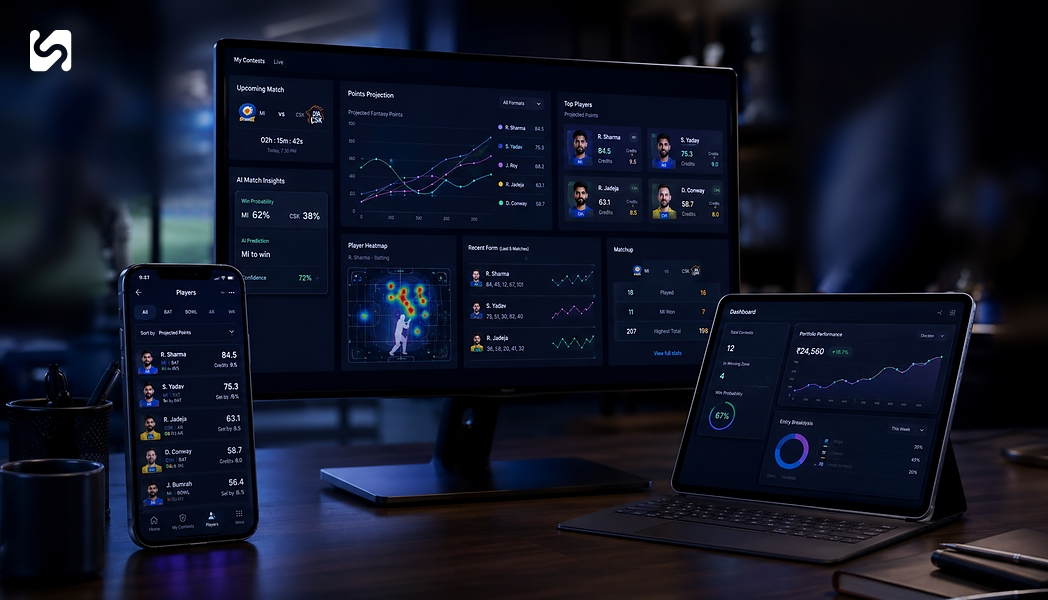
Predictive Analytics in Fantasy Sports: How AI Forecasts Player Performance
 by Sumit Kumar
Quick Summary
Predictive analytics in fantasy sports uses machine learning models trained on historical player data, live match data, and contextual factors (injuries, weather, matchups) to forecast how athletes will perform in upcoming games. Fantasy platforms use these forecasts to power team recommendations, win probability displays, injury prediction alerts, and personalized contest suggestions.
Modern AI models reach 75–85% accuracy in outcome prediction, compared to the 50–60% ceiling of traditional statistical models, which is why predictive analytics has shifted from a premium add-on to a core expectation for any serious DFS platform or fantasy league product. This article explains how Predictive analytics in fantasy sports works, what data and models power it, what it costs platforms to ignore it, and how to implement it well.
Predictive Analytics In Fantasy Sports
Fantasy sports predictive analytics has quietly become the biggest competitive divider in the industry. Ten years ago, a fantasy platform competed on contest variety and payout speed. Today, users expect the app itself to help them win and predictive analytics in fantasy sports is how platforms deliver that. The numbers behind this shift are hard to ignore: the AI in sports analytics market is worth $9.76 billion in 2026 and growing at 27.85% CAGR toward $33.32 billion by 2031, while the broader fantasy sports software and platforms market is projected to grow from $28.68 billion to $86.74 billion by 2033.
If you run a fantasy platform, manage a sports tech product, or are planning AI fantasy sports predictions as your differentiator, this guide covers the full picture: how the models work, the data behind them, the tools to build with, and the mistakes to avoid.
What Is Predictive Analytics in Fantasy Sports?
Predictive analytics in fantasy sports is the use of data science and machine learning to forecast future player performance, match outcomes, and user behavior based on historical and real-time data.
In practical terms, predictive analytics answers the questions every fantasy player asks before locking a lineup:
- How many fantasy points will this player likely score this week?
- What’s the injury risk of picking this player?
- Which matchup favors my roster?
- What’s my probability in this contest?
Traditional fantasy sports data analytics was descriptive; it told you what a player did. Predictive models in fantasy sports tell you what a player is likely to do next, and prescriptive layers on top of that recommend what you should do about it (bench him, trade him, fade him in DFS).
For platforms, the same discipline extends beyond player forecasting into business forecasting: predicting which users will churn, which contests will fill, and which promotions will convert.
Why AI Is Empowering Fantasy Sports Analytics
Three forces explain why AI-powered predictive analytics in fantasy sports has accelerated so fast:
The data exploded. Player tracking systems, wearables, and granular play-by-play feeds generate volumes no human analyst can process. Platforms like Dream11 process up to 44TB of data per day. Machine learning is the only realistic way to extract signal from that scale.
The accuracy gap became undeniable. Modern AI models reach 75–85% accuracy in predicting game winners, while traditional statistical models plateaued around 50–60%. Once that gap was visible, offering users anything less than model-driven insight started to look like a product weakness.
Users now expect it. Around 47% of fantasy platforms already provide AI-driven predictive insights, and 82% of sports organizations have adopted AI in some form. Fantasy managers who once relied on gut feel now expect matchup insights, injury flags, and lineup optimization inside the app. A platform without them feels dated.
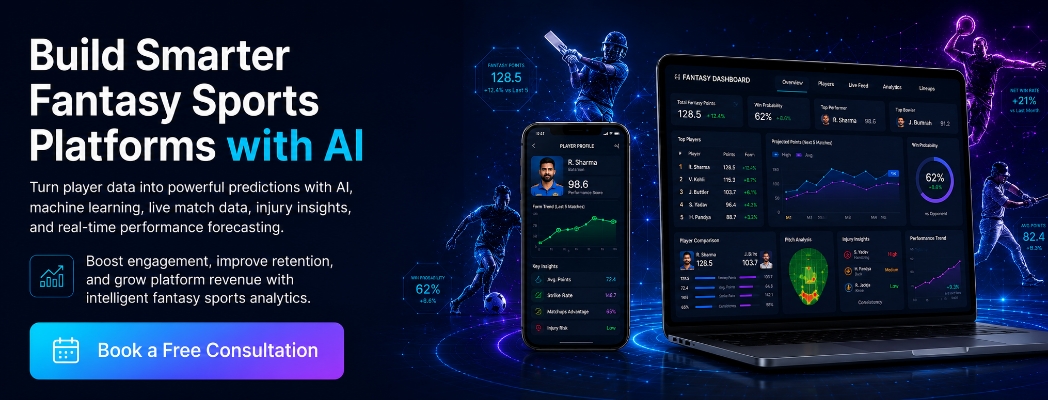
How Predictive Analytics Forecasts Player Performance in Fantasy Sports Apps
Here’s the pipeline, step by step, how predictive analytics runs inside a real fantasy platform:
- Data ingestion. Sports APIs stream in historical player data, live match data, injury reports, team news, and venue/weather conditions. User-side data (past picks, contest behavior) flows in from the platform itself.
- Feature engineering. Raw statistics get converted into predictive features: rolling form averages, opponent-adjusted performance, rest days, home/away splits, usage rates, matchup histories. This step matters more than model choice better features beat fancier algorithms in this domain.
- Model training. Machine learning models learn the relationship between those features and actual fantasy point outcomes across seasons of historical data.
- Prediction generation. Before each slate, the models output projected fantasy points, floor/ceiling ranges, injury risk scores, and win probability estimates for every relevant player.
- Real-time updating. Live match data feeds recalibrate predictions during play a starting lineup change or an early injury shifts projections instantly, and the AI recommendation engine adjusts what it surfaces to users.
- Delivery in the product. The forecasts show up as team suggestions in the fantasy team builder, alerts via push notification, sortable projections in the contest lobby, and data visualization on the user dashboard.
Key Components of Predictive Analytics for Fantasy Sports Prediction
A production-grade fantasy sports predictive analytics system has five layers:
Data layer. Sports APIs, historical databases, and real-time streams – the raw material. Quality and latency here cap everything above it.
Processing layer. Big data infrastructure (stream processing, feature stores) that cleans, joins, and transforms data fast enough for pre-match and in-match use.
Modeling layer. The machine learning and deep learning models themselves – performance forecasting, injury prediction, ownership projection, churn modeling.
Serving layer. Low-latency APIs that deliver predictions into the app, plus the AI recommendation engine that decides which insight to show which user.
Feedback layer. Post-match evaluation comparing predictions to actual results, feeding continuous retraining. Without this loop, model accuracy decays every season.
What Data Sources Are Used for Fantasy Sports Predictions?
The fantasy sports forecast is only as good as its inputs. Serious platforms combine:
- Historical player statistics: multi-season performance logs, split by opponent, venue, and situation
- Live match data: real-time scores, play-by-play events, and player tracking during games
- Injury and availability data: official reports, practice participation, and increasingly, injury prediction models built on workload data
- Team context: lineup changes, coaching decisions, tactical shifts, schedule congestion
- Environmental factors: weather, pitch/surface conditions, altitude, travel distance
- Market signals: DFS salary movements, ownership projections, betting line movements (a strong external prediction signal)
- Unstructured data: beat reporter news and press conferences processed via natural language processing, and player movement analysis via computer vision from broadcast feeds
- Platform behavioral data: user pick patterns, contest history, and session behavior for personalization models
Real-World Applications of Predictive Analytics in Fantasy Sports
Lineup optimization. The most visible application: AI suggests optimal fantasy team selection within salary cap constraints, balancing projected points against ownership and variance. ESPN, CBS, and major DFS platforms all now ship versions of this.
Trade and roster analysis. Season-long fantasy league products use predictive models to evaluate trade fairness and recommend waiver pickups CBS Fantasy’s trade analyzer is a well-known example.
Injury risk alerts. Models flag elevated injury probability from workload and movement data, letting users pivot before news breaks.
Win probability displays. Live contest win probability keeps users watching (and re-entering) during matches rather than checking out after a bad start.
Personalized contest recommendations. Predicting which contests a specific user is most likely to enter and enjoy a direct revenue lever.
Churn prediction and retention. Forecasting which users are about to lapse (especially between seasons) so retention offers arrive at the right moment.
Fraud and collusion detection. Pattern models that identify multi-accounting and coordinated play, protecting contest integrity and prize pools.
Machine Learning Models Behind Fantasy Sports Predictive Analytics
Different fantasy sports prediction problems call for different model families:
Gradient boosting (XGBoost, LightGBM). The workhorse for player performance forecasting on structured/tabular data. Fast to train, strong accuracy, and interpretable enough to explain predictions to users.
Regression models. Still valuable as baselines and for problems where relationships are relatively linear – and essential for calibrating what “improvement” from complex models actually looks like.
Neural networks and deep learning. Best where data is high-dimensional or sequential – modeling a player’s form trajectory over time (recurrent architectures), or learning from raw tracking data.
Ensemble methods. Production systems rarely rely on one model; blending multiple predictive models consistently outperforms any single one, especially across different sports with different statistical profiles.
Computer vision models. Extracting positioning, movement load, and event data from broadcast video where tracking feeds aren’t available.
Natural language processing. Converting injury reports, news, and press conferences into structured signals a forecasting model can use.
Classification models for platform intelligence. Churn prediction, fraud detection, and contest-fill forecasting typically run on classification models trained on behavioral data rather than sports data.
One honest note: no model eliminates variance. Sport is played by humans, and even the best systems hit 75–85% accuracy on outcomes, not 100%. Good products communicate ranges and probabilities, not false certainty.
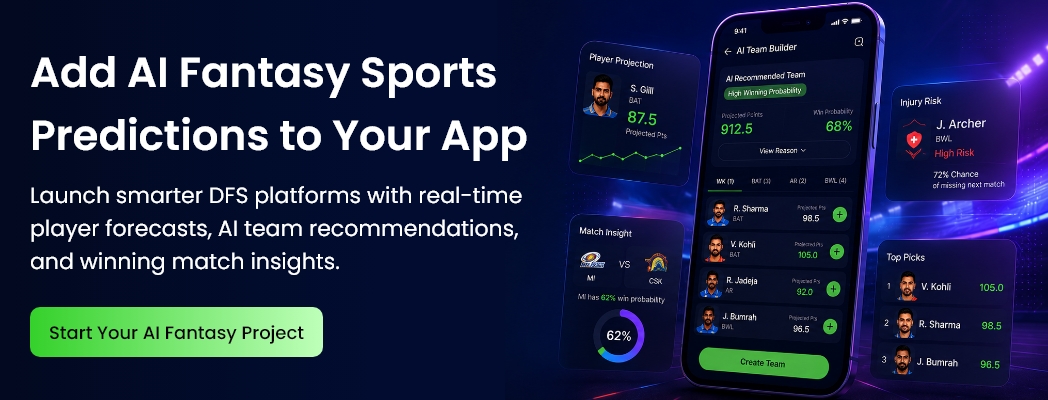
Tools and Technologies for Predictive Analytics in Fantasy Sports
A typical predictive analytics implementation stack looks like this:
Data acquisition: Sportradar, Stats Perform (Opta), SportsDataIO, Entity Sports – the sports APIs providing historical player data and live match data feeds.
Data infrastructure: Apache Kafka for streaming, Spark for large-scale processing, Snowflake/BigQuery for warehousing, Redis for low-latency serving.
Modeling: Python as the standard language; scikit-learn, XGBoost, and LightGBM for structured prediction; TensorFlow or PyTorch for deep learning; MLflow for experiment tracking and model versioning.
Serving: FastAPI or similar for prediction APIs; feature stores (Feast) to keep training and serving data consistent.
Visualization: In-app data visualization for users (projection charts, matchup graphics) and internal dashboards (Grafana, Metabase) for monitoring model accuracy.
LLM layer (increasingly common): Large language models to translate model outputs into plain-language explanations “Why is this player projected higher this week?” which materially improves user trust in AI fantasy sports predictions.
What Are the Key Benefits of Predictive Analytics in Fantasy Sports?
Fantasy Sports Predictive Analytics Benefits For users:
- Better-informed fantasy team selection without hours of research
- A more level playing field between casual and expert players
- Real-time insight during matches, not just before them
Predictive Analytic Benefits For Fantasy Platforms:
- Engagement and retention. AI-driven platforms report roughly 40% increases in personalized content interaction, and users who trust the platform’s insights come back more often.
- Higher revenue per user. Premium analytics tiers, more contest entries per user, and better-targeted promotions all flow from prediction quality.
- Lower operational costs. Fraud detection and automated support handle problems that would otherwise scale linearly with headcount.
- Competitive differentiation. In a market where dozens of DFS platform options compete for the same users, prediction quality is one of the few durable moats.
Challenges of AI-Based Predictive Analytics Adoption in Fantasy Sports
Being straightforward about the hard parts:
Data cost and quality. Official, low-latency sports data is expensive, and models trained on incomplete or delayed data produce forecasts users learn not to trust.
Small sample problems. Low-frequency events resist prediction – a World Cup runs 64 matches, and confidence intervals stay wide. Platforms that present uncertain forecasts as certainties damage their own credibility.
Historical data bias. Models trained on biased historical distributions reproduce those biases – major leagues are overrepresented, newer leagues and women’s sports underrepresented, which matters as platforms expand coverage.
Model drift. Rule changes, roster turnover, and tactical evolution mean a model that was accurate last season quietly degrades. Continuous retraining isn’t optional.
Privacy and regulatory pressure. Behavioral prediction runs on user data, which brings GDPR-class obligations, and regulators increasingly scrutinize how prediction features interact with real-money play.
Talent and cost. Building in-house means competing for data science talent; buying means integration and vendor-dependence tradeoffs. Most platforms land on a hybrid.
Future of Predictive Analytics in Fantasy Sports
- Real-time everything. 5G latency down to ~1 millisecond enables live, in-play prediction products – micro-contests and mid-game roster edits built directly on streaming forecasts.
- Conversational prediction. LLM interfaces where users ask “who should I captain tonight?” and get a reasoned, personalized answer rather than a static projections table.
- Wearable and biometric signals. As athlete monitoring data becomes commercially available, injury prediction and fatigue modeling will get materially better.
- Generative scenario simulation. Simulating thousands of match outcomes per slate to give users distribution-level insight (boom/bust probability) instead of single-point projections.
- Prediction as the product. The line between fantasy platforms and prediction markets keeps blurring; forecasting infrastructure built for fantasy increasingly powers adjacent products.
Expert Tips for Using AI-Driven Predictive Analytics in Fantasy Sports
- Start with high-quality historical data. Two seasons of clean, complete data beats five seasons of gappy data. Audit your data before you model it.
- Combine predictive models with live feeds. Pre-match projections alone are table stakes; the engagement wins come from forecasts that update during play.
- Continuously retrain models as new seasons progress. Schedule retraining and accuracy monitoring from day one – model drift is a certainty, not a risk.
- Explain AI recommendations to build user trust. “Projected 18.4 points because of a favorable matchup and increased usage rate” converts skeptics; an unexplained number doesn’t.
- Use AI to personalize, not just predict. Generic projections are everywhere. Tailoring which insights each user sees – based on their sports, risk appetite, and contest history – is where retention actually moves.
- Present uncertainty honestly. Ranges and probabilities age better than confident single numbers that miss. Users forgive variance; they don’t forgive being misled.
Key Takeaways
- Predictive analytics in fantasy sports uses machine learning trained on historical player data and live match data to forecast performance, injury risk, and win probability.
- Modern AI models reach 75–85% outcome accuracy versus 50–60% for traditional statistical approaches – the gap users can feel in product quality.
- Nearly half of fantasy platforms already ship AI-driven predictive insights; prediction has become a baseline expectation, not a differentiator by itself.
- Real-time sports APIs and continuous model retraining matter as much as model architecture – data quality and freshness cap forecast quality.
- Predictive analytics pays for itself through engagement, retention, premium tiers, and fraud reduction, not just user-facing projections.
- Explaining predictions in plain language is the single highest-leverage trust feature most platforms underinvest in.
- The next wave is real-time, conversational, and personalized – platforms building that infrastructure now will own the category’s next chapter.
Why Choose SonicTechPro for Implementing Predictive Analytics in Fantasy Sports?
We build predictive analytics into fantasy platforms as engineers who ship production systems, not just proof-of-concepts: We at sonicytechPro have vast experience not only in developing Fantasy sports applications but incorporating future ready technology.
End-to-end pipeline delivery. From sports API integration and feature stores to model serving and in-app data visualization – we build the full stack, not just the model notebook.
Sport-specific modeling experience. Fantasy cricket behaves differently from fantasy football statistically; our models are built and validated per sport, not copy-pasted across them.
Real-time architecture. Streaming infrastructure designed for live, in-play prediction updates at match-day concurrency.
Explainability built in. Every recommendation we ship can tell the user why – the feature that separates trusted AI from ignored AI.
Retraining and monitoring included. We deliver the feedback loop (accuracy tracking, drift detection, scheduled retraining), because a model without maintenance is a depreciating asset.
Compliance-aware design. User-data modeling built to GDPR-class standards, with responsible gaming considerations factored into recommendation logic.
Planning to add AI fantasy sports predictions to your platform, or building a new DFS platform with analytics at the core?
Frequently Asked Questions
