
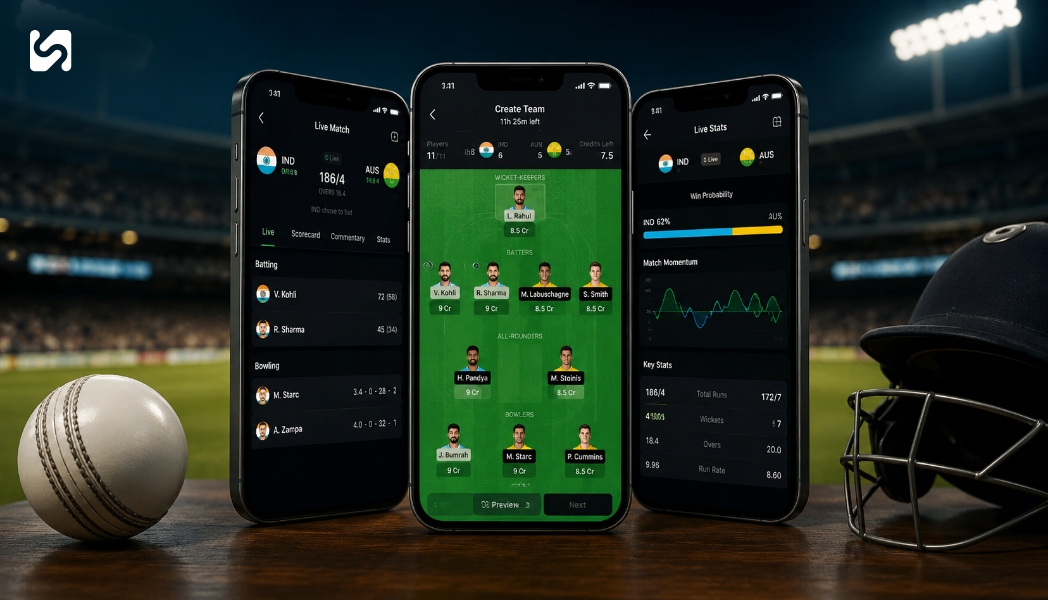
Top 10 Live Data APIs for Fantasy Sports Apps (Compared & Ranked)
 by Sumit Kumar
Quick Summary
The best sports data APIs for fantasy sports apps in 2026 depend on your sport and budget: Sportradar and Genius Sports for official enterprise data, SportsDataIO for US fantasy (NFL/NBA/MLB with built-in DFS salaries), SportMonks for football and cricket value from €29/month, Entity Sports for fantasy cricket and kabaddi with a ready-made fantasy points system, and API-Sports for budget MVPs from ~$19/month. Stats Perform leads on analytics depth, while MySportsFeeds, LSports, iSports API, and The Odds API fill budget and specialist roles. Match your choice to four factors, 1.sport coverage, 2. live-scoring latency, 3. licensing needs, and 4. monthly budget and expect data to be your platform’s biggest recurring cost after infrastructure. This guide compares all eleven providers side by side so you can pick the right one before you write a line of integration code.
Best Live Sports Data APIs Providers for Fantasy Sports
If you’re evaluating the best sports data APIs for fantasy sports apps, you already understand something many founders learn the expensive way: the data feed is the product. A fantasy platform can survive an average UI, but it cannot survive scores that update slower than the TV broadcast. Choosing among the top live data APIs for fantasy sports is one of the most consequential technical decisions you’ll make. It determines your latency, your data costs, your sport coverage, and how painful (or painless) your next two years of development will be.
The stakes keep rising. The fantasy sports software and platforms market was valued at $28.68 billion in 2024 and is projected to reach $86.74 billion by 2033, and every one of those platforms runs on a sports data API underneath. This guide compares and ranks the ten providers we most often evaluate in real fantasy sports app development projects with honest pros, cons, and pricing.
Why Live Sports Data APIs Are Essential for Fantasy Sports Apps
A fantasy sports API does one deceptively simple job: it delivers real-world sports events runs, goals, touchdowns, wickets into your platform fast enough and accurately enough to score fantasy contests in real time.
Without a reliable live sports data API, nothing else in a fantasy product works:
- Fantasy points can’t be calculated without accurate, timely player statistics
- Contests can’t settle without verified final match data
- Users won’t trust the platform if their app shows a boundary 40 seconds after the stadium crowd reacts
- Disputes multiply when scoring data is incomplete or corrected after payouts
Building this data collection yourself isn’t realistic it would mean stationing scouts at every venue or scraping sources with no reliability guarantee (and real legal risk). Sports API providers solve this at scale, which is why every serious DFS platform and fantasy league product licenses its data rather than gathering it.
How Sports APIs Power Every Core Fantasy Feature
It helps to see exactly which product features depend on which API capabilities:
| Fantasy Feature | What the API Provides |
| Live scoring | Real-time match events (ball-by-ball, play-by-play) via push feeds or low-latency polling |
| Leaderboards | Continuous player stats that your scoring engine converts to fantasy points and rankings |
| Player stats & team builder | Historical sports data, form, and season statistics that users research before locking lineups |
| Match schedules & contest creation | Fixtures API data upcoming matches, start times, venue info that your contest lobby is built around |
| Push notifications | Event triggers (wickets, touchdowns, lineup changes) via webhooks that fire user alerts instantly |
| Player availability | Injury reports and confirmed lineups, critical in the minutes before contest lock |
One practical implication: when comparing providers, evaluate them against this feature list, not against their marketing pages. A provider with “70+ sports” but no player-level stats for your key sport is useless for a fantasy platform.
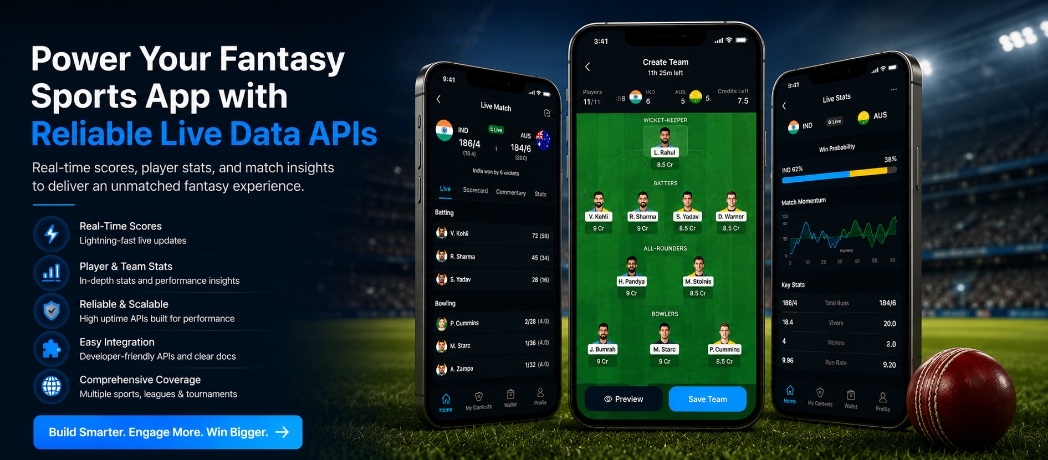
Top 11 Sports Data APIs for Fantasy Sports Apps
Here’s our ranked comparison, weighted for fantasy-specific needs: player-level data depth, live latency, coverage, documentation, and total cost of ownership.
1. SportMonks
About: Founded in 2016 to make quality sports data affordable for developers, SportMonks has grown into one of the most popular mid-market providers, handling 6.4 billion API requests per month with 99.99% published uptime. It’s the go-to choice for football-first fantasy platforms that want professional-grade data without an enterprise contract or sales cycle.
Key Features:
- 2,200+ football leagues from top European competitions to niche domestic leagues, plus cricket and Formula 1
- Live scores and fixtures real-time match data with fast update cycles suited to fantasy scoring
- Player and team statistics detailed per-match and seasonal stats for fantasy point calculation
- Include-and-filter API design pull fixtures, lineups, and stats in a single request instead of stitching multiple calls
- Odds data pre-match and in-play odds available as add-ons
- Standings and league tables auto-updated across covered competitions
Best For: Football and cricket fantasy platforms at startup-to-scale stage.
Rating: 8.7/10
2. Sportradar
About: Sportradar is the global enterprise leader in sports data the provider behind major sportsbooks, broadcasters, and league partnerships, covering 80+ sports with official data rights across the NFL, NBA, MLB, NHL, and hundreds of global competitions. If your fantasy platform contractually or legally requires official licensed data, this is effectively the default choice.
Key Features:
- Official league data feeds exclusive partnerships that remove licensing risk for regulated operators
- Ultra low-latency delivery push and WebSocket feeds built for real-money speed requirements
- Play-by-play and player tracking the deepest live event granularity in the industry
- Injury reports and lineups official availability data before contest lock
- Historical archives decades of verified historical sports data
- 99.9% uptime SLAs with dedicated account management
Best For: Large fantasy platforms, regulated real-money operators, and anyone requiring official data.
Rating: 9.2/10
3. API-Sports (API-Football)
About: API-Sports is the indie developer favorite a family of simple, affordable APIs spanning football (its flagship API-Football product covers 1,100+ leagues), basketball, baseball, NFL, hockey, rugby, and more. It’s the fastest way to get a working fantasy prototype connected to real live data, often within an afternoon.
Key Features:
- Live scores updating ~every 15 seconds sufficient for casual fantasy formats
- Player statistics on every tier no gating of core fantasy data behind top plans
- Fixtures, standings, and head-to-head data everything a contest lobby needs
- Odds endpoints bookmaker data for prediction-flavored features
- Generous free tier 100 requests/day across the API-Sports family, no credit card needed
- Simple, consistent JSON structure one of the easiest learning curves in the space
Best For: MVPs, prototypes, and budget-conscious startups validating a fantasy concept.
Pricing: Free tier; paid plans from ~$19/month.
Rating: 8.3/10
4. Genius Sports
About: Genius Sports is an official data rights holder and one of the two enterprise giants alongside Sportradar, with official data partnerships spanning the NFL, NCAA, and major global leagues. Its orientation is betting-and-media-first, but its official feeds make it a serious option for regulated fantasy operators particularly anything touching NFL or college sports data.
Key Features:
- Official NFL and NCAA data exclusive rights that matter for US real-money products
- Live, low-latency league feeds betting-grade speed applied to fantasy scoring
- Precise event data verified at the source through league partnerships
- Media and engagement tools widgets and content products beyond raw data
- Integrity services data validation infrastructure built for regulated markets
Best For: Regulated operators and platforms needing official NFL/NCAA feeds.
Pricing: Enterprise contracts; betting-first orientation with B2B sales cycles.
Rating: 8.6/10
5. Stats Perform (Opta)
About: Stats Perform owns Opta the most famous name in sports analytics and delivers the deepest, research-grade event data available anywhere: every touch, pass, and defensive action, across football, basketball, cricket, baseball, and more. It powers major broadcasters and is the pick when analytical depth is your product’s differentiator.
Key Features:
- Opta event-level data the industry’s most granular match data, unmatched for advanced fantasy scoring formats
- AI-driven insights win probabilities, expected goals, and predictive models as data products
- Deep player analytics form, fatigue, and performance metrics beyond basic box scores
- Decades of historical data the foundation serious projection models are built on
- Multi-sport coverage with football depth as the crown jewel
Best For: Platforms building advanced analytics, AI predictions, or premium data tiers.
Pricing: Enterprise-only, negotiated per use case; onboarding typically requires direct support.
Rating: 8.8/10
6. Entity Sports
About: Founded in 2016 and based in Jaipur, India, Entity Sports is purpose-built for the fantasy sports market one of the few providers with a ready-made fantasy points system for cricket, soccer, NBA, MLB, and NHL built directly into the API. Its cricket and kabaddi coverage makes it a near-default choice for India-facing fantasy platforms.
Key Features:
- Built-in fantasy points system pre-computed fantasy scoring that shortcuts months of engine development
- Deep cricket coverage all domestic First Class, List A, and T20 leagues including IPL, BBL, PSL, BPL, CPL, and internationals
- Kabaddi API detailed Pro Kabaddi League coverage that most global providers skip entirely
- Ball-by-ball live data real-time scoring for the formats fantasy cricket depends on
- 60+ ready-made widgets live score, standings, and stats widgets for fast frontend builds
- Free development sandbox historical data from completed seasons for risk-free prototyping
- Phone and email support unusual at this price tier
Best For: Fantasy cricket and kabaddi platforms, especially India and South Asia focused.
Rating: 8.4/10
7. MySportsFeeds
About: MySportsFeeds is a developer-beloved North American sports data provider covering NFL, MLB, NBA, NHL, and MLS with schedules, scores, box scores, play-by-play, lineups, injuries, DFS data, and odds. Its transparent per-league pricing and genuinely free personal-use tier have made it a staple for US fantasy projects that don’t have enterprise budgets.
Key Features:
- DFS-relevant feeds included daily fantasy salaries and data alongside core stats
- Play-by-play and box scores the granularity fantasy scoring engines need
- Injuries and lineups availability data before lock
- Three output formats JSON, XML, and CSV, fitting any stack or analysis workflow
- All feeds on every plan no picking and choosing endpoints by tier
- Free for non-commercial use plus a 14-day automatic free trial for commercial evaluation
- Official SDKs Python, Ruby, Go, and .NET client libraries maintained on GitHub
Best For: US-sports fantasy apps on startup budgets; personal and portfolio projects.
Pricing: Free for personal/non-commercial use; transparent per-league commercial plans.
Rating: 8.0/10
8. LSports
About: LSports is a betting-industry data provider with broad multi-sport coverage and a reputation for genuinely fast in-play feeds. Built primarily for sportsbooks and iGaming operators, its latency standards translate directly to fantasy platforms running live, real-money contests where seconds matter.
Key Features:
- Low-latency in-play feeds push delivery engineered for betting-grade speed
- Broad multi-sport coverage football, basketball, tennis, and dozens more
- Pre-match and live odds market data for hybrid fantasy/prediction products
- Fixtures and settlement data verified results for contest settlement
- Push-based architecture designed for real-time products rather than polling
Best For: Real-money DFS platforms and operators blending fantasy with prediction mechanics.
Pricing: Commercial/custom, aimed at operators rather than indie developers.
Rating: 7.8/10
9. iSports API
About: iSports API positions itself as a cost-effective, high-coverage alternative to enterprise providers, with core strength in football and basketball and particular depth in Asian leagues and markets. For budget-limited teams whose target leagues fall inside its coverage, it delivers a strong cost-to-data ratio.
Key Features:
- Football and basketball depth live scores, player stats, and match events
- Asian league coverage competitions Western-first providers often skip
- Odds data included alongside core statistics
- Long-term historical archives multi-season data for projections
- Low-latency delivery positioned on accuracy and speed at value pricing
Best For: Budget-conscious startups, especially Asia-facing football/basketball fantasy products.
Pricing: Tiered commercial plans notably below enterprise rates.
Rating: 7.5/10
10. The Odds API
About: The Odds API does one thing well: aggregated bookmaker odds across 70+ sports, delivered through one of the simplest APIs in the industry. For fantasy platforms, betting lines are one of the strongest external prediction signals available sharp money is genuinely predictive making this a smart supplement to a primary stats provider.
Key Features:
- Odds from dozens of bookmakers aggregated and normalized in one feed
- Line movement tracking market shifts that signal injury news and sharp action
- 70+ sports covered breadth for multi-sport prediction features
- Dead-simple REST/JSON API integration measured in hours, not days
- 500 free credits per month enough for real prototyping
Best For: Adding prediction signals or pick’em mechanics on top of a primary data provider.
Pricing: Free tier; usage-based paid plans.
Rating: 7.3/10
11. SportsDataIO
About: SportsDataIO is widely described as the gold standard for North American fantasy sports data, covering 13+ leagues including NFL, NBA, MLB, NHL, college sports, soccer, golf, NASCAR, and MMA. What sets it apart for this audience is that fantasy isn’t an afterthought it ships purpose-built fantasy endpoints that save platforms months of internal modeling work.
Key Features:
- Dedicated Fantasy Sports API player projections and DFS salaries as first-class endpoints
- BAKER predictive engine machine-generated predictions available as a data product
- Betting odds feeds live odds alongside stats from one vendor
- Historical data vault deep archives for projection modeling
- Free cross-provider ID mapping (GRid) invaluable when combining multiple data sources
- 13+ US leagues from one vendor NFL + NBA + MLB under a single contract
Best For: US-focused fantasy platforms; the natural first evaluation for NFL/NBA/MLB products.
Pricing: Tiered commercial plans; quotes for scale.
Rating: 8.5/10
Side-by-Side Comparison of the Top Sports Data APIs for Fantasy Sports
| Provider | Best For | Fantasy-Ready Player Stats | Live Latency | Entry Pricing | Multi-Sport |
| SportMonks | Football/cricket value | Very good | Fast | EUR 29/mo | Football, cricket, F1 |
| Sportradar | Enterprise/official data | Excellent | Fastest (push) | Enterprise only | 80+ sports |
| API-Sports | MVPs & startups | Good | ~15s updates | Free / ~$19/mo | 12+ sports |
| Genius Sports | Official NFL/NCAA | Excellent | Very fast (push) | Enterprise only | Broad |
| Stats Perform (Opta) | Analytics depth | Excellent | Fast (push) | Enterprise only | Broad |
| Entity Sports | Fantasy cricket/kabaddi | Excellent (fantasy points built in) | Fast | ~$100/mo | Cricket, football, NBA, kabaddi+ |
| MySportsFeeds | US sports on a budget | Very good (DFS feeds) | Fast | Free personal / per-league | NFL, NBA, MLB, NHL, MLS |
| LSports | Real-money/betting hybrid | Good | Very fast (push) | Commercial | Broad |
| iSports API | Budget + Asian markets | Good | Fast | Low commercial tiers | Football, basketball |
| The Odds API | Odds signal | N/A (odds only) | Fast | Free tier | 70+ sports (odds) |
| SportsDataIO | US fantasy (NFL/NBA/MLB) | Excellent (DFS-native) | Fast | Commercial tiers | 13+ US leagues |
What to Look for in the Best Sports Data APIs
Six criteria separate a provider you’ll thank yourself for from one you’ll migrate away from at the worst possible time:
Data accuracy and correction policy. Ask how each provider handles stat corrections a fantasy contest paid out on data that later gets corrected is a support nightmare. Providers with multi-source validation earn their premium here.
API latency and delivery method. Push delivery (webhooks/WebSockets) beats polling for live scoring. If a provider only supports REST polling, your update speed is capped by your polling interval and their rate limits.
Player-level depth for your sports. Match scores aren’t enough fantasy scoring needs the granular player stats API layer: passes, tackles, strike rates, usage. Verify depth per sport, per league, per plan tier.
Historical sports data. Projections, player cards, and AI features all need multi-season history. Some budget providers have player stats but thin multi-season depth a limitation you’ll hit exactly when you try to build smarter features.
Rate limits vs. your traffic model. Model your peak match-day request volume before choosing a plan. Free tiers with daily caps die quietly in production on the first big slate.
Licensing terms. Confirm the license covers commercial fantasy use in your operating jurisdictions especially for real-money contests, where official data requirements sometimes apply.
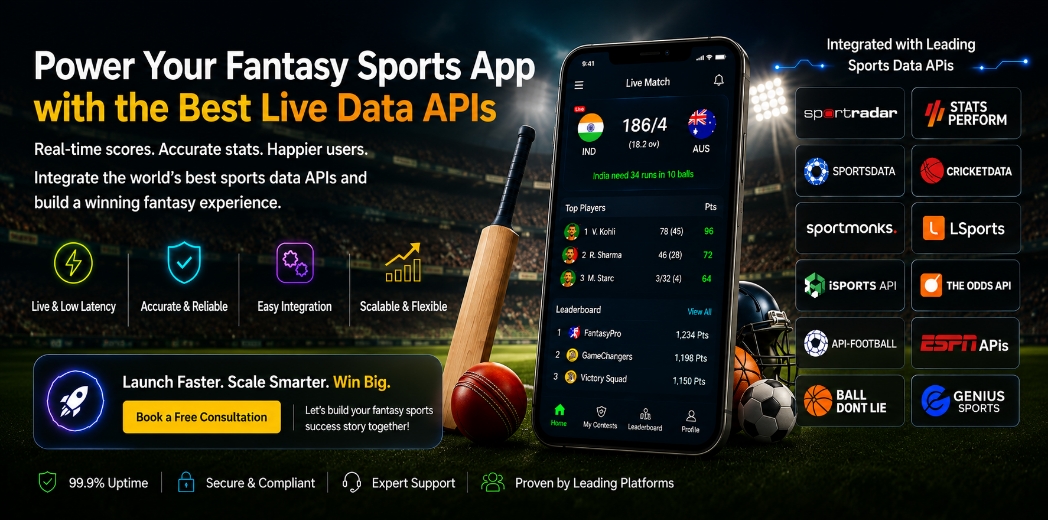
How to Choose the Right Sports API for Your Fantasy App
A practical decision path we use with clients:
- List your launch sports and leagues, specifically. Not “soccer” “EPL, La Liga, ISL.” Provider coverage gates by league and by plan tier.
- Decide your latency requirement honestly. Casual season-long fantasy tolerates 15–30 second updates; real-money live DFS demands push feeds.
- Match provider tier to business stage. Start with mid-tier providers and migrate to enterprise when data quality becomes business-critical that sequencing is normal, not a failure.
- Run parallel trials. Define a representative test scope and trial two or three providers under real conditions latency, completeness, error rates, support responsiveness. Marketing pages won’t tell you what a live match day will.
- Plan for multi-provider from day one. Multi-sport fantasy platforms almost always end up combining providers (e.g., SportMonks for football + CricketData for cricket + The Odds API for signals). Build an abstraction layer so your scoring engine never talks to a vendor’s format directly.
Sports API Evaluation Checklist
Before signing with any Sports Data API provider, run every candidate through the following checks. Each one exists because skipping it has cost a real fantasy platform real money at some point.
Sports coverage. Confirm the provider covers your exact leagues on the exact plan tier you intend to buy. Headline numbers like “2,000+ leagues” often gate the leagues you actually need behind higher tiers, so verify against the coverage page, not the marketing page.
Real-time updates. Check whether the provider offers push or webhook delivery, and measure actual latency during a live match rather than trusting the documentation. A feed that claims “real-time” but delivers events eight seconds behind the broadcast will show up in your user reviews.
Historical data. Make sure multi-season player statistics are included in your plan. Projections, player cards, and any future AI features all depend on historical depth, and this is the limitation teams usually discover only after they’ve already integrated.
Pricing model. Understand whether pricing is per-request, tiered, or flat, then model it against your peak match-day traffic instead of your average day. A plan that looks cheap on a quiet Tuesday can become expensive during a big slate.
Rate limits. Verify there’s enough headroom for your biggest projected match day, with room to grow. Free and starter tiers with daily caps tend to fail quietly in production the first time traffic spikes.
Documentation quality. Look for worked examples, sandbox access, and complete response schemas. Good documentation can save weeks of integration time, and its quality is usually a reliable signal of how the provider handles everything else.
SDK availability. Check for official client libraries in your stack, or at minimum a REST/JSON structure clean enough that you don’t need them. Community-maintained SDKs that haven’t been updated in two years are a warning sign, not a convenience.
Webhook support. Confirm the provider can fire event triggers for the moments your product depends on goals, wickets, lineup changes so your notifications and live scoring don’t rely on constant polling.
Uptime SLA. Read the published uptime numbers, and just as importantly, find out what compensation applies when they’re missed. An SLA without meaningful remedies is a marketing claim, not a guarantee.
Customer support. Test the human support channels during your trial period, not after you’ve signed. Send a technical question and time the response that’s the service level you’ll get during a live match-day incident.
Licensing terms. Confirm the license explicitly covers commercial fantasy use in every jurisdiction you operate in, and read the real-money clauses carefully. This is the item that turns into a legal problem rather than a technical one if skipped.
Scalability. Make sure there’s a clear upgrade path from your starting tier to enterprise scale that doesn’t require re-integration. Providers with consistent APIs across tiers let you grow with a config change; others effectively force a migration.
Common Challenges When Integrating Live Sports Data APIs
Here areReal problems from real projects, so you can plan for them:
Data model mismatches. Every provider structures teams, players, and events differently. Mapping their IDs to your internal entities and keeping mappings current through transfers and roster changes is ongoing work, not a one-time task.
Stat corrections after the fact. Official scorers amend stats hours after matches. Your settlement logic needs a policy: settle immediately and absorb corrections, or delay payouts for a verification window.
Match-day traffic spikes. Rate limits that felt generous in testing evaporate when 50,000 users refresh during a last-over finish. Cache aggressively and centralize API calls server-side never let clients hit the provider directly.
Provider outages at the worst moment. Feeds fail disproportionately during high-traffic events, because that’s when everything is under load. A fallback feed for your highest-revenue sport is insurance that pays for itself the first time you need it.
Silent schema changes. Smaller providers sometimes alter response formats with minimal notice. Contract tests that validate response shapes on every deploy catch this before your users do.
Live Sports Data API Integration in Fantasy Sports: Best Practices
- Build an abstraction layer. Your scoring engine should consume your normalized data model, with provider adapters behind it. This turns “switching providers” from a rebuild into a config change.
- Prefer webhooks over polling wherever offered. Lower latency, fewer wasted requests, and no rate-limit anxiety.
- Cache with intent. Fixtures and player metadata can cache for hours; live scores for seconds. Layered caching cuts API costs dramatically without hurting freshness.
- Log every payload during live matches. When a scoring dispute arrives (and it will), the raw feed history is your source of truth.
- Monitor latency as a product metric. Track feed-to-screen time continuously and alert on degradation your users notice before your dashboards do unless you build this.
- Test with replayed real match data. Simulate full match days, including corrections and out-of-order events, before your first real one.
Why Choose SonicTechPro to Integrate Live Data APIs for Fantasy Sports
We’ve integrated most of the providers in this list into production fantasy platforms, and that experience shows up in how we build:
Provider-agnostic architecture. Every integration we ship sits behind an abstraction layer, so you can change or add sports API providers without touching your scoring engine.
Failover built in. For high-stakes sports, we configure secondary feeds with automatic switchover match-day outages become a log entry, not an incident.
Match-day load engineering. Caching strategy, server-side API brokering, and load testing at multiples of projected peak traffic come standard.
Honest provider guidance. We’ll tell you when the €29/month option genuinely covers your needs and when it doesn’t our recommendation is based on your leagues, latency needs, and budget, not on partner commissions.
Full-stack fantasy delivery. API integration is one piece; we build the scoring engines, contest systems, wallets, and AI features that sit on top.
Planning your develop fantasy platform? we’ll map your sports and leagues to the right Sports Data provider mix and give you a fixed integration quote.
Key Takeaways
- Choose an API based on sport and league coverage first pricing means nothing if your leagues aren’t on the plan.
- Low latency is critical for live contests: push/webhook delivery beats polling, and betting-grade providers set the latency bar.
- Reliable documentation and clean JSON APIs meaningfully speed up development SportMonks and API-Football lead here at their price points.
- Budget realistically: production-grade feeds run from €29/month to €4,990+/month depending on tier, and data is usually a fantasy platform’s largest recurring cost after infrastructure.
- Multi-sport apps almost always need more than one data provider architect for it from day one with an abstraction layer.
- Consider scalability before you need it: rate limits, uptime SLAs, and upgrade paths matter most on your biggest match day.
- Run parallel real-condition trials before committing; live match behavior reveals what marketing pages don’t.
Frequently Asked Questions
