
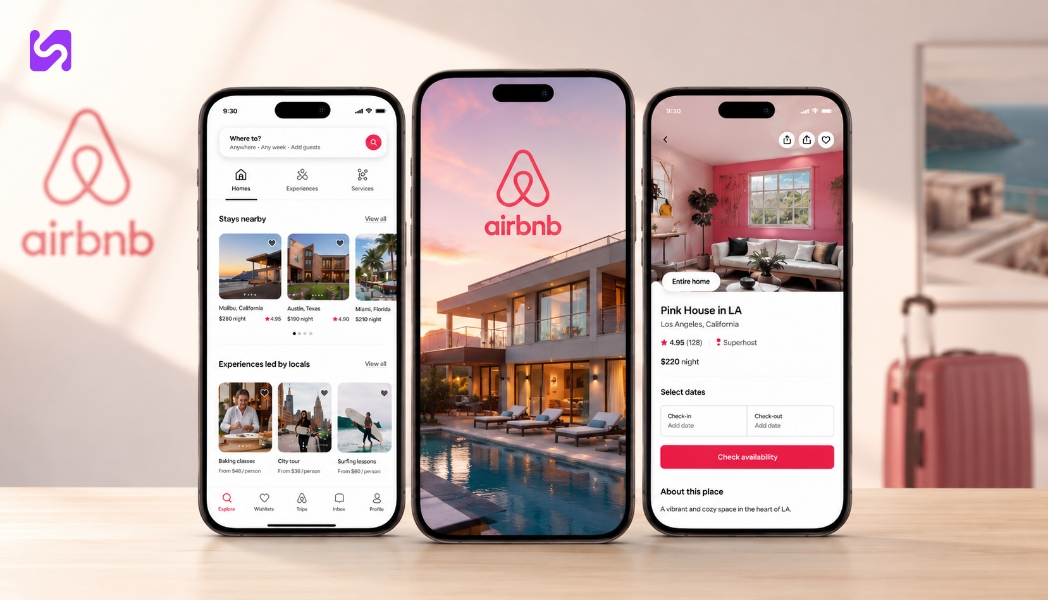
How to Build an App Like Airbnb in 2026: Cost Estimation, Features and Tech Stack
 by Sumit Kumar
Quick Summary
- This guide on how to build an app like Airbnb breaks down all of it, so you know exactly what you have to do before you write the first line of code.
- The cost to build an app like Airbnb in 2026 ranges from $40,000 to $300,000+, depending on how complex you want the product to be.
- A basic MVP (Minimum Viable Product) with core booking features typically costs $40,000–$80,000 and takes 3–5 months to launch.
- A mid-range vacation rental platform with AI recommendations, dynamic pricing, and multi-language support costs $80,000–$150,000 over 5–8 months.
- A full-featured, enterprise-grade travel marketplace comparable to Airbnb itself can cross $150,000–$300,000+ and require 9–12 months of development.
- Your final Airbnb app development cost depends on five things: feature depth, platform choice (iOS, Android, or both), your team’s location, third-party integrations, and how much AI you build in.
If you have ever wondered how to build an app like Airbnb, you’re asking the right question at the right time. The short-term rental app economy is no longer a niche experiment; it’s one of the most profitable corners of the travel industry, and there’s still room for new players who solve real problems for hosts and guests.
But here’s the honest truth most Airbnb clone app development service providers won’t tell you upfront: copying Airbnb’s interface is easy. Building the trust, liquidity, and booking experience that made Airbnb a household name is the hard part. This guide walks you through both, the practical steps to create an app like Airbnb and the strategic decisions that separate successful vacation rental platforms from the graveyard of forgotten clones.
Why Airbnb Became a Global Leader in Vacation Rentals
Airbnb didn’t win because it had the best code. It won the vacation rental domain because it removed friction from both sides of a broken market.
Before Airbnb, homeowners with a spare room had no safe, simple way to monetize it. Travelers wanting something cheaper or more authentic than a hotel had no trusted place to look. Airbnb connected the two with three things that still define the product today:
- Trust infrastructure. Identity verification, two-way reviews and ratings, secure payments held in escrow, and host guarantees turned “sleeping in a stranger’s home” from a risky idea into a mainstream behavior.
- A frictionless booking engine. Search, filter, view photos, check the availability calendar, pay, done. Every step was designed to take seconds, not minutes.
- Network effects. More hosts attracted more guests, which attracted more hosts. Once that flywheel spun up, competitors couldn’t simply out-spend it.
The results speak for themselves. Airbnb crossed $12.24 billion in revenue in 2025 with 533 million nights and experiences booked. Understanding why those numbers exist, not just that they exist, is the first step in How to Build An App Like Airbnb Right.
Understanding the Airbnb Business Model
Airbnb operates a two-sided travel marketplace. It owns no property. Instead, Airbnb earns money by facilitating transactions between hosts and guests, and taking a cut of each one.
Here’s how the money flows:
| Revenue Stream | How It Works |
| Guest service fee | Typically around 14% of the booking subtotal, charged to travelers at checkout |
| Host commission | Usually about 3% deducted from the host’s payout (higher for hosts on host-only fee structures, ~14–16%) |
| Experiences & services | Commission on tours, activities, and add-on services booked through the platform |
| Cross-currency fees | Additional fees applied when guests pay in a currency different from the listing’s |
This commission management model is powerful because revenue scales with booking volume, not headcount. Every new listing added to the property listing app increases inventory at nearly zero marginal cost.
Airbnb Business Model Canvas
Before jumping into how to build an app like Airbnb, Lets Understand the business model canvas of Airbnb.
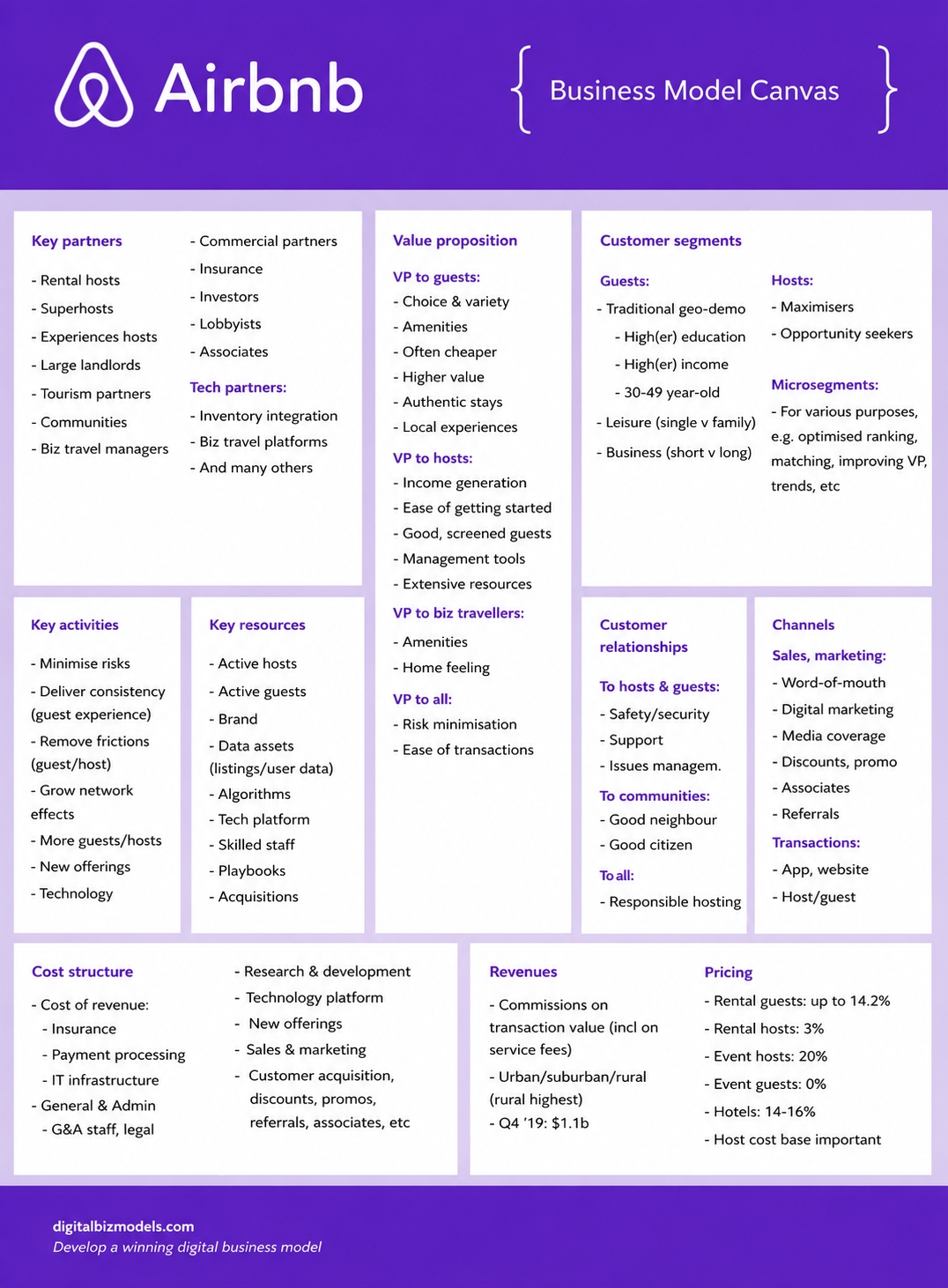
When you make an app like Airbnb, you’ll adopt some version of this model, and later in this guide on how to build an app like Airbnb, we’ll cover alternative monetization strategies (subscriptions, featured listings, ads) that can work even better in niche markets.
Market Opportunity for Vacation Rental Apps Like Airbnb
Is it still worth investing in developing an app like Airbnb and entering this market in 2026? The data says yes, especially for niche and regional plays. Here are the latest numbers every founder should know before starting vacation rental app development similar to Airbnb:
- The global vacation rental market is estimated at $101.69 billion in 2025 and projected to reach $121.94 billion by 2033, according to Grand View Research.
- The broader short-term vacation rental segment is growing even faster, from $165.7 billion in 2026 to a projected $362.4 billion by 2033, at an 11.8% CAGR.
- Fortune Business Insights projects the vacation rentals market will expand from $195.45 billion in 2026 to $481.8 billion by 2034, a 10.42% CAGR.
- Roughly 890 million people worldwide use vacation rentals in 2026, expected to grow to 1.11 billion users by 2030.
- Airbnb reported 533 million nights and seats booked in 2025 with $91.3 billion in Gross Booking Value, per its annual SEC filing.
- The platform now hosts over 8 million active listings supported by more than 5 million hosts across 220+ countries.
- The US vacation rental market alone generated $19.6 billion in 2025 and is projected to hit $22.16 billion by 2033.
- Millennials and Gen Z now account for 42% of vacation rental users, and Asia-Pacific is the fastest-growing region at an 8.76% CAGR through 2031, per Mordor Intelligence.
- Properties using dynamic pricing outperform static-rate listings by up to 30 percentage points in occupancy in markets like Italy, and by 13 points even in the mature US market.
- The luxury rental segment saw a 119% increase in booking volume and 169% increase in revenue value in the most recent annual data, the clearest growth pocket in the industry.
The takeaway: the pie is growing, demand is spreading geographically, and specific segments (luxury, long stays, leisure travel, pet-friendly, workcations) remain underserved. That’s the opportunity for your Airbnb clone app development project.
Popular Vacation Rental Apps Competing With Airbnb
Before you know how to build an app like Airbnb, study the competition. These three US-based platforms prove there’s room for more than one winner in the travel marketplace space:
- Vrbo (Expedia Group) Vrbo focuses exclusively on whole-home rentals, no shared rooms, no hosts on-site. This positioning makes it the go-to platform for family vacations and group trips. Its integration with Expedia’s One Key rewards program gives it distribution muscle Airbnb can’t match.
- Booking.com (Vacation Rental Vertical) Originally a hotel booking giant, Booking.com has aggressively expanded into short-term rentals and now lists millions of homes and apartments alongside hotels. Its strength is a massive existing traveler base and a frictionless online booking flow that hosts tap into instantly.
- HomeToGo HomeToGo takes a different approach: it’s a metasearch engine that aggregates listings from hundreds of vacation rental sites, letting travelers compare prices in one place. Its rapid growth shows that aggregation and price transparency are still unsolved problems in this market.
The lesson? None of these apps beat Airbnb by cloning it. Each carved out a distinct angle, whole homes, hotel-adjacent inventory, price comparison. Your rental marketplace app development strategy should do the same.
Must-Have Features To Build an App Like Airbnb
An Airbnb-like app is really three apps in one: a guest app, a host app, and an admin panel. Each serves a different user with different goals and skimping on any one of them breaks the marketplace. Here’s the complete feature checklist of airbnb like app, organized by panel:
| Guest (User) Panel | Host Panel | Admin Panel |
| Sign-up / login (email, phone, social) | Host registration & identity verification | Centralized dashboard with analytics |
| Profile creation & verification | Property listing app tools (photos, descriptions, amenities) | User & host management |
| Property search with smart filters | Availability calendar & booking calendar sync | Listing moderation & approval |
| Map integration with location-based search | Pricing controls & dynamic pricing tools | Commission management |
| Listing details, photo galleries, virtual tours | Booking requests: accept, decline, instant book | Payment & payout oversight |
| Booking engine with real-time availability | Host dashboard with earnings reports | Dispute resolution tools |
| Secure payment gateway (cards, wallets, UPI) | Guest management & communication | Content management system |
| Multi-currency support | In-app chat & messaging with guests | Reviews & ratings moderation |
| Wishlists & saved searches | Payout setup & transaction history | Promotions, coupons & referral control |
| Reviews & ratings (two-way) | Calendar sync with other platforms (iCal) | Reporting, fraud detection & security alerts |
| Push notifications & booking reminders | Push notifications for new requests | Multi-language support configuration |
| Trip history & cancellation management | Reviews of guests | SEO & marketing tool integrations |
| 24/7 in-app support & help center | Performance insights & occupancy stats | Tax & regulatory compliance settings |
A practical note from experience: founders consistently underestimate the host panel. Guests use your app a few times a year; hosts use it daily. If the host dashboard is clunky, your inventory dries up, and a booking app with no listings is just an empty map.
Planning to Build an App Like Airbnb?
Our travel app development experts help startups and enterprises build secure, scalable, AI-powered vacation rental platforms with custom features, real-time booking, payment integration, and cloud-native architecture.
Let’s convert your Idea Into Reality
AI & Advanced Features That Differentiate Your Airbnb Clone App Development
Every serious Airbnb clone app development project now faces the same reality: guests have been trained by Netflix, Amazon, and ChatGPT to expect software that anticipates what they want. The good news is that most of these AI capabilities no longer require an in-house data science team; mature APIs and pre-trained models put them within reach of startup budgets. Here are the AI and advanced features worth building into your roadmap:
- AI-powered search & recommendations. Instead of keyword filters, let travelers type “pet-friendly beach house near Goa under $100/night with fast Wi-Fi” and return ranked, relevant results. AI recommendations based on past behavior lift conversion meaningfully.
- Dynamic pricing engine. This is arguably the single highest-ROI AI feature for a rental marketplace, because it directly grows host income, and hosts stay loyal to platforms that make them money. Machine learning models that adjust nightly rates based on seasonality, local events, demand signals, and competitor pricing. As the data above shows, dynamic pricing is fast becoming the industry baseline, not a luxury.
- AI chatbots & virtual concierge. Guest questions follow a predictable pattern: check-in instructions, Wi-Fi passwords, parking details, appliance quirks, and local tips make up the overwhelming majority of messages. An AI concierge trained on each listing’s details can automate 70–80% of these conversations instantly, in the guest’s own language so hosts aren’t glued to their phones.
- Smart fraud detection. Trust is the currency of a two-sided travel marketplace, and fraud is how you lose it. Machine learning models can analyze booking velocity, payment patterns, account age, device fingerprints, and listing behavior to flag suspicious bookings , fake listings, stolen cards, and review manipulation before they damage trust.
- Automated listing optimization. Most hosts aren’t marketers, and their listings show it: dark photos, vague titles, missing amenities. AI can score listing photos for brightness, composition, and appeal, suggest better titles and descriptions based on what converts in that market, flag missing information that guests filter for, and tell hosts exactly what’s holding their conversion rate back. AI that scores listing photos, suggests better titles and descriptions, and tells hosts exactly what’s holding their conversion rate back.
- Image recognition & verification. Photo fraud is one of the oldest scams in the vacation rental industry, and computer vision now solves it at scale. Automatically verify that listing photos match reality and detect duplicate or stolen images across the platform.This protects guests from disappointment, protects honest hosts from copycats, and saves your admin team hundreds of hours of manual moderation.
- Personalized push notifications. Generic promotional blasts train users to ignore your app, or worse, uninstall it. Behavior-triggered nudges do the opposite: “Prices in Jaipur drop 18% next weekend,” “The villa you saved just opened up for your dates,” or “3 new pet-friendly homes matched your last search.” Because these messages are anchored to something the user actually did or wanted, open rates and re-engagement run several times higher than batch campaigns.
- Sentiment analysis on reviews. Reviews contain your platform’s most honest operational data, if you can read thousands of them at once. Natural language processing can scan every review as it’s posted, detect recurring complaints (noise, cleanliness, inaccurate photos, check-in friction), and surface them to hosts and admins before they snowball into refund requests, cancellations, or delisted properties.
You don’t need all of these on day one. But architect your platform so they can be added without a rebuild, that’s where an experienced development partner earns their fee.
Best Technology Stack To Create an App Like Airbnb
There’s no single “correct” stack, but this combination is battle-tested for two-sided marketplaces like Airbnb in 2026:
| Layer | Recommended Technologies |
| Mobile apps | React Native or Flutter (cross-platform); Swift (iOS) and Kotlin (Android) for native builds |
| Web frontend | React.js or Next.js with TypeScript |
| Backend | Node.js (Express/NestJS), Python (Django/FastAPI), or Ruby on Rails |
| Database | PostgreSQL for transactional data; Redis for caching; Elasticsearch for property search |
| Cloud & DevOps | AWS / Google Cloud; Docker + Kubernetes; CI/CD via GitHub Actions |
| Real-time features | WebSockets or Socket.io for chat & messaging; Firebase for push notifications |
| AI/ML | Python, TensorFlow/PyTorch, or API-based models for recommendations & dynamic pricing |
| Search & maps | Google Maps Platform or Mapbox for map integration and geolocation |
| Payments | Stripe, PayPal, Razorpay (for Indian markets), with PCI-DSS compliance |
| Analytics | Mixpanel or Amplitude for product analytics; Google Analytics 4 for acquisition |
Why this matters for Airbnb like app development cost: cross-platform frameworks like Flutter can cut mobile development cost by 30–40% compared to building separate native iOS and Android apps, without a noticeable quality drop for a booking app. For most startups building a vacation rental platform, cross-platform is the smart default.
What Third-Party Integrations Are Required To Make an App Like Airbnb
Smart founders buy, not build, everything that isn’t their core differentiator. These integrations save months of engineering time to create an app like Airbnb:
- Payment gateways – Stripe, PayPal, Braintree, or Razorpay for secure payment processing, split payouts, and multi-currency support.
- Identity verification – Onfido, Jumio, or Persona for KYC checks, document scanning, and selfie matching. Non-negotiable for trust.
- Maps & geolocation – Google Maps Platform or Mapbox for property search, neighborhood data, and distance calculations.
- Communication APIs – Twilio or Sendbird for SMS, in-app chat & messaging, and masked phone calls between hosts and guests.
- Push notifications – Firebase Cloud Messaging or OneSignal for booking alerts and re-engagement campaigns.
- Email services – SendGrid or Amazon SES for transactional emails (confirmations, receipts, reminders).
- Calendar sync – iCal integration so hosts can sync availability calendars with other platforms and avoid double bookings.
- Channel managers – Integrations with tools like Guesty or Hostaway attract professional property managers who control large inventories.
- Smart locks & IoT – August, Yale, or Nuki APIs for keyless self-check-in, a feature guests increasingly expect.
- Tax & compliance – Avalara or local tax APIs to handle occupancy taxes automatically, a growing regulatory requirement in most cities.
- Analytics & attribution – AppsFlyer or Adjust for tracking marketing performance across channels.
- Cloud storage & CDN – Amazon S3 + CloudFront for fast, global delivery of listing photos and videos.
How to Build An App Like Airbnb – Full System Architecture
Layer-by-layer breakdown of every component and its technology stack for creating a two-sided rental marketplace app like Airbnb.
| S. No | Layer | Component | What it does | Technology |
| Layer 1 — Client Applications | ||||
| 1.1 | Guest app | Guest mobile & web app
Search, browse listings, book stays, chat with hosts, manage trips |
Search, listing detail, booking, wishlists, trip history | React NativeFlutterNext.js (web) |
| 1.2 | Host app | Host dashboard app
Property listing management, calendar, pricing, earnings, guest messaging |
Listing tools, availability calendar, payout tracking | React NativeReact (web dashboard) |
| 1.3 | Admin panel | Internal operations dashboard
Listing moderation, user management, dispute resolution, fraud review |
Analytics, moderation queue, commission control | ReactTailwind CSS |
| Layer 2 — API Gateway & Auth | ||||
| 2.1 | API gateway | Unified entry point
Routes every client request to the correct microservice, enforces rate limits |
Request routing, throttling, load balancing | AWS API GatewayKong |
| 2.2 | Auth service | Identity management
Sign-up/login via email, phone, or social; session and role management for guest/host/admin |
OAuth2 social login, JWT session tokens | Auth0Firebase Auth |
| 2.3 | KYC & verification service | Identity verification
Document scanning, selfie matching, and host/guest identity checks — core to marketplace trust |
ID verification, address checks, background screening | OnfidoJumioPersona |
| Layer 3 — Marketplace & Booking Engine | ||||
| 3.1 | Listing service | Property listing management
CRUD for listings — photos, descriptions, amenities, house rules, pricing |
Listing creation, editing, approval workflow | Node.jsPostgreSQL |
| 3.2 | Search & discovery engine | Property search
Location, date, price, and amenity-based search with map view and smart filters |
Full-text + geo search, faceted filtering, ranking | ElasticsearchAlgolia |
| 3.3 | Availability & calendar service | Booking calendar
Real-time availability tracking per listing, prevents double-booking across channels |
Calendar sync, iCal integration, blocked-date logic | PostgreSQLRedis locks |
| 3.4 | Booking & reservation service | Booking engine
Handles booking requests, instant book, accept/decline flow, and cancellation logic |
Reservation state machine, cancellation policies | Node.jsPostgreSQL |
| 3.5 | Reviews & ratings service | Two-way review system
Post-stay reviews from guest and host, aggregated ratings, review moderation |
Review submission, moderation, aggregate scoring | Node.jsPostgreSQL |
| Layer 4 — Communication & Engagement | ||||
| 4.1 | In-app chat & messaging | Guest-host messaging
Real-time chat between guests and hosts, masked phone numbers for privacy |
Persistent chat threads, read receipts | SendbirdTwilio |
| 4.2 | Notification service | Push, SMS & email alerts
Booking confirmations, new message alerts, reminders, host response nudges |
Multi-channel notification delivery | Firebase FCMSendGridTwilio SMS |
| 4.3 | AI concierge / chatbot | Automated guest support
Handles check-in instructions, Wi-Fi info, and FAQs automatically, in-language |
NLP-based automated responses per listing | OpenAI APIDialogflow |
| Layer 5 — AI & Personalization | ||||
| 5.1 | Recommendation engine | Personalized search & listings
Suggests listings based on browsing history, past bookings, and preferences |
Collaborative filtering, behavior-based ranking | TensorFlowAWS Personalize |
| 5.2 | Dynamic pricing engine | Smart pricing for hosts
Adjusts nightly rates based on seasonality, demand, local events, and competitor pricing |
ML pricing model, revenue optimization | Python ML pipeline |
| 5.3 | Fraud & trust detection | Anomaly detection
Flags suspicious bookings, fake listings, stolen cards, and review manipulation |
Behavioral scoring, device fingerprinting | AWS Fraud Detector |
| 5.4 | Image recognition service | Listing photo verification
Detects duplicate/stolen photos and scores image quality for listing optimization |
Computer vision, duplicate detection | AWS Rekognition |
| Layer 6 — Payments & Wallet | ||||
| 6.1 | Payment gateway | Transaction processing
Handles guest payments, split payouts, multi-currency, and escrow-style holds |
Card, wallet, and bank transfer support | StripePayPalRazorpay |
| 6.2 | Payout & commission service | Host payout engine
Calculates commission splits and releases host payouts post-checkout |
Ledger management, scheduled payouts | Stripe ConnectPostgreSQL ledger |
| 6.3 | Tax & compliance service | Occupancy tax automation
Calculates and remits local short-term rental taxes automatically per jurisdiction |
Tax calculation, regulatory reporting | Avalara |
| Layer 7 — Data & Storage | ||||
| 7.1 | Primary database | Relational data store
Users, listings, bookings, transactions — source of truth for the platform |
ACID-compliant structured storage | PostgreSQLAWS RDS |
| 7.2 | Cache layer | In-memory cache
Fast reads for search results, availability locks, and session data |
Hot data caching, distributed locks | Redis |
| 7.3 | Media storage & CDN | Photo & video delivery
Stores and globally distributes listing photos, videos, and virtual tour assets |
Object storage + global edge delivery | AWS S3CloudFront |
| 7.4 | Maps & geolocation service | Location data
Property location, neighborhood data, distance calculations for search and maps |
Geocoding, map rendering, radius search | Google Maps PlatformMapbox |
| Layer 8 — Security, Compliance & Infra | ||||
| 8.1 | Security layer | WAF & DDoS protection
Protects checkout and API endpoints from attacks during high-traffic periods |
Traffic filtering, bot mitigation | CloudflareAWS WAF |
| 8.2 | Compliance service | Regulatory rules engine
Enforces local short-term rental regulations and permit requirements per city |
Geo-based rule enforcement | Custom rules engine |
| 8.3 | Cloud infrastructure | Auto-scaling hosting
Elastic infrastructure that scales during seasonal booking spikes and campaigns |
Container orchestration, CI/CD | AWS / GCPDocker + Kubernetes |
| 8.4 | Analytics & monitoring | Product & performance analytics
Tracks funnel drop-offs, booking conversion, and system health in real time |
Event tracking, dashboards, alerting | MixpanelAmplitudeGoogle Analytics 4 |
How to Build An App Like Airbnb – Step-by-Step Process
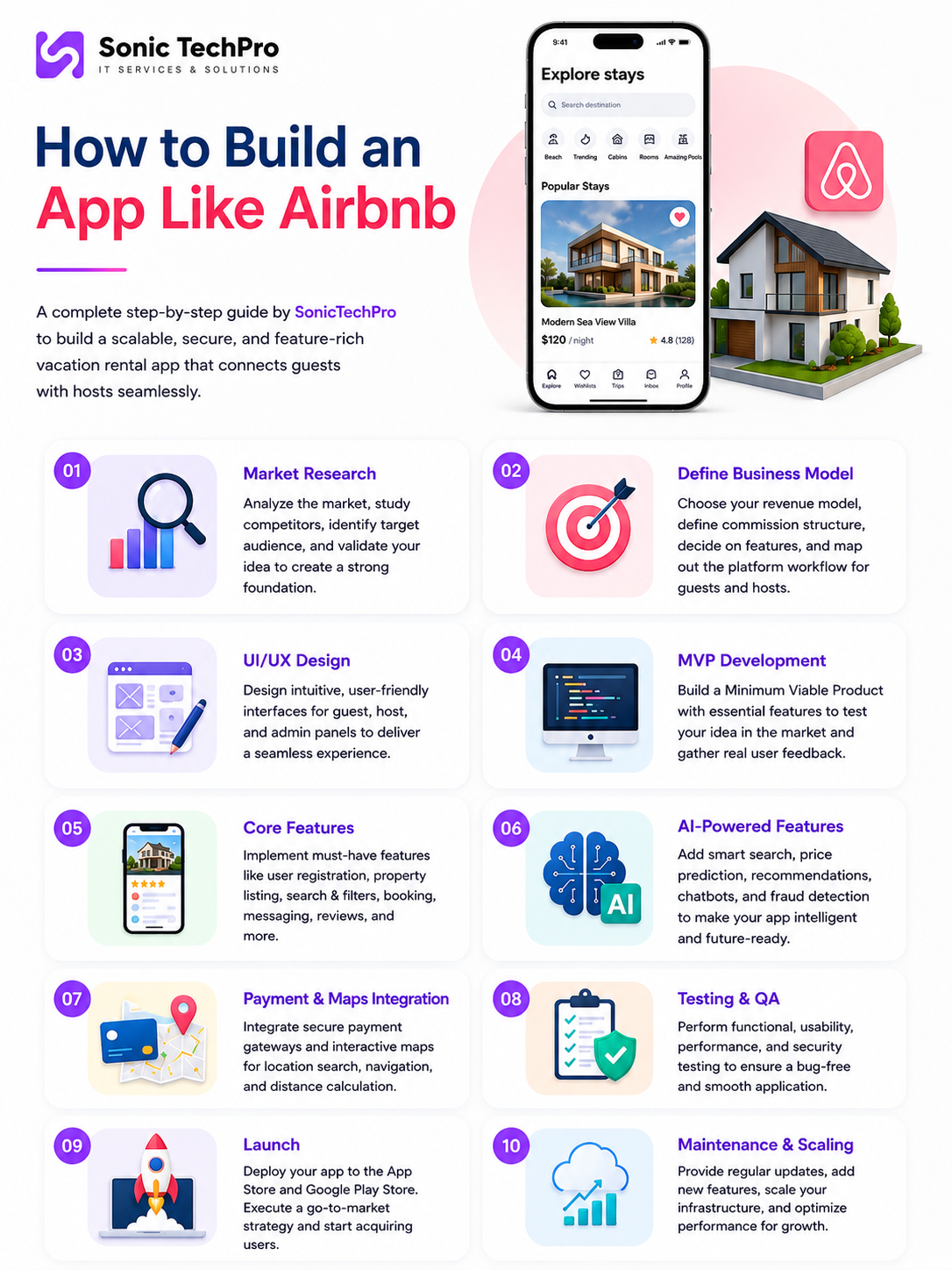
Here’s the exact process a professional team follows for Airbnb-style app development:
Step 1: Market research & niche definition (1–2 weeks). Identify your target segment, luxury villas, budget stays, pet-friendly homes, corporate housing, or a geographic region. Study competitors’ reviews to find what users hate about them.
Step 2: Define the business model & MVP scope (1–2 weeks). Decide your commission structure, list must-have features, and ruthlessly cut everything else from version one.
Step 3: UI/UX design (3–6 weeks). Wireframes → clickable prototypes → visual design. Prioritize a mobile-first experience and a booking flow that takes under two minutes.
Step 4: Architecture & tech stack setup (1–2 weeks). Design the database schema, API structure, and cloud infrastructure with scalability in mind from day one.
Step 5: MVP development (10–16 weeks). Build the guest app, host dashboard, and admin panel in parallel sprints. Integrate the payment gateway, maps, and identity verification early, they cause the most surprises.
Step 6: Testing & QA (3–4 weeks, overlapping). Functional testing, payment flow testing, load testing, and security audits. Test the double-booking scenario obsessively.
Step 7: Launch & host acquisition (ongoing). Soft-launch in one city. Manually onboard your first 50–100 hosts, this is unglamorous but essential. Liquidity in one neighborhood beats emptiness in fifty cities.
Step 8: Iterate with real data (ongoing). Track search-to-booking conversion, host response times, and cancellation rates. Ship improvements every two weeks.
How Much Does It Cost to Build an App Like Airbnb?
Let’s get specific. The cost to build an app like Airbnb in 2026 breaks down like this:
| App Complexity | What You Get | Estimated Cost | Timeline |
| Basic MVP | Core booking engine, search, listings, payments, reviews, one platform | $35,000 – $80,000 | 3–5 months |
| Mid-level app | Everything above + host dashboard, chat, multi-currency support, iOS + Android, basic AI recommendations | $80,000 – $150,000 | 5–8 months |
| Full-featured platform | Complete travel marketplace with dynamic pricing, AI search, channel manager integrations, multi-language support, advanced admin panel | $150,000 – $300,000+ | 9–12 months |
Airbnb like app development Cost breakdown by activity (for a mid-level build):
| Development Phase | Share of Budget | Approx. Cost |
| UI/UX design | 10–15% | $8,000 – $20,000 |
| Frontend & mobile development | 30–35% | $25,000 – $50,000 |
| Backend development | 25–30% | $20,000 – $45,000 |
| QA & testing | 10–15% | $8,000 – $20,000 |
| Project management & DevOps | 10% | $8,000 – $15,000 |
| Post-launch support (year one) | 15–20% of build cost annually | $12,000 – $30,000 |
Hourly rates by region (the single biggest cost lever):
- North America: $100 – $250/hour
- Western Europe: $80 – $180/hour
- Eastern Europe: $40 – $80/hour
- India & Southeast Asia: $25 – $60/hour
The same mid-level airbnb style app development that costs $250,000 with a US agency can often be built for $80,000–$120,000 with a strong Indian or Eastern European team, provided you vet their marketplace experience carefully.
Factors That Affect Airbnb Style App Development Cost
Why does one quote say $50,000 and another say $250,000 for “the same app”? These variables explain the gap:
- Feature scope. Every feature has a price tag. An availability calendar with iCal sync is a week of work; a machine-learning dynamic pricing engine is two months.
- Number of platforms. iOS + Android + web triples surface area. Cross-platform frameworks reduce, but don’t eliminate, the multiplier.
- Team location & structure. Region matters (see rates above), and so does structure: freelancers are cheapest but riskiest; dedicated agencies cost more but ship predictably.
- UI/UX complexity. Custom animations, interactive maps, and virtual tours look great and cost real money.
- Third-party integrations. Each integration (payments, KYC, smart locks, channel managers) adds development time plus ongoing subscription fees.
- AI & advanced features. AI recommendations, chatbots, and fraud detection can add $20,000–$60,000 depending on sophistication.
- Compliance & security. PCI-DSS for payments, GDPR/data-privacy compliance, and local short-term rental regulations all require engineering effort.
- Post-launch costs. Servers, third-party API fees, app store fees, maintenance, and updates typically run 15–20% of the original build cost per year. Budget for this or your app decays.
MVP vs. Full-Featured Roadmap To Build An App Like Airbnb
The smartest founders don’t ask “how do I build everything Airbnb has?” They ask “what’s the smallest product that proves people will book through me?”
Build Airbnb LIke MVP App (launch this first):
- User registration & profiles with basic identity verification
- Property listings with photos and amenities
- Property search with filters and map integration
- Booking calendar with real-time availability
- Secure payment gateway with escrow-style payouts
- Two-way reviews & ratings
- Push notifications for bookings and messages
- Basic in-app chat
- Simple admin panel for moderation and commission management
Version 2 (after product-market fit signals):
- Dynamic pricing tools for hosts
- AI recommendations and smarter search
- Multi-currency and multi-language support
- Instant Book, wishlists, and referral programs
- Channel manager and iCal integrations
- Host performance analytics
Version 3 (scale phase):
- AI concierge and automated guest messaging
- Experiences, add-on services, and upsells
- Loyalty program
- Advanced fraud detection
- Smart-lock and IoT integrations
- Web platform (if you started mobile-only)
This staged approach means you spend $40,000–$80,000 to learn whether your vacation rental app idea works, instead of $300,000 to find out it doesn’t.
Airbnb Like App Timeline Breakdown by Development Phase
For developing a mid-level Airbnb-like app, here’s a realistic timeline:
| Phase | Duration |
| Discovery, research & planning | 2–4 weeks |
| UI/UX design | 3–6 weeks |
| Backend + API development | 8–12 weeks |
| Mobile app development (runs partly in parallel) | 10–16 weeks |
| Admin panel development | 4–6 weeks (parallel) |
| Integrations (payments, maps, KYC, notifications) | 3–5 weeks (parallel) |
| QA, security testing & bug fixing | 3–5 weeks |
| Beta launch & refinements | 2–4 weeks |
| Total | ≈ 5–8 months |
A bare-bones MVP compresses this to 3–5 months; a full enterprise platform stretches it to 9–12.
Best Monetization Strategies for a Vacation Rental App Like Airbnb
The commission model is the default, but it’s not the only option, and in niche markets, hybrids often work better:
- Commission per booking. Charge 10–20% split between host and guest. Revenue scales with GMV. Best once you have booking volume.
- Host subscription plans. Monthly/annual fees for premium host tools, analytics, dynamic pricing, priority placement. Predictable recurring revenue.
- Featured & promoted listings. Hosts pay to appear at the top of property search results. High-margin and easy to implement.
- Guest service fees. A small percentage added at checkout, framed as covering support and payment protection.
- Value-added services. Professional photography, cleaning coordination, insurance, airport transfers, take a cut of each.
- Advertising. Local tour operators, restaurants, and rental car companies pay to reach your traveler audience. Use sparingly; too many ads erode trust.
- Freemium listing model. Free basic listings to build inventory fast, paid upgrades for visibility and tools. Great for cold-start markets.
Most successful platforms start with commissions plus featured listings, then layer in subscriptions once hosts see clear ROI.
Future Trends For Developing an Airbnb-Like Vacation Rental App
Build for where the market is going, not where it’s been:
- AI-native experiences. Conversational trip planning, AI-generated itineraries, and agents that book on the traveler’s behalf will reshape property search within a few years.
- Dynamic pricing as the baseline. Static pricing is dying. Platforms that offer built-in revenue management will win professional hosts, who already control roughly 69% of the US market.
- Long stays & workcations. Remote work keeps fueling 8–30 night stays, one of the fastest-growing booking segments. Monthly discounts, verified Wi-Fi speeds, and workspace filters matter.
- Luxury and experiential travel. With luxury booking volume up triple digits, premium inventory with concierge-style services is the highest-value niche available.
- Sustainability signals. Eco-certifications, carbon-footprint estimates, and green filters increasingly influence younger travelers’ choices.
- Regulation-ready platforms. Cities worldwide are tightening short-term rental rules. Apps that automate permits, tax collection, and compliance will attract hosts fleeing platforms that don’t.
- Blockchain & smart contracts. Still early, but transparent deposits, instant payouts, and tamper-proof reviews are genuine use cases to watch.
- Voice and super-app integration. Bookings initiated through voice assistants and embedded in messaging super-apps, especially across Asia-Pacific, the fastest-growing region.
Airbnb Like App Development at a Glance
| Category | Details |
| App Type | Vacation Rental Marketplace |
| Platforms | iOS, Android, Web |
| Development Time | 3–9 Months |
| Core Users | Hosts & Guests |
| Revenue Model | Commission, Service Fees, Premium Listings |
| Key Features | Property Listings, Booking, Payments, Messaging |
| AI Features | Recommendations, Dynamic Pricing, Chatbot |
| Integrations | Maps, Payment Gateway, Notifications, Analytics |
| Deployment | AWS, Azure, Google Cloud |
Expert Checklist for Building a Successful Vacation Rental App
How to Build An App Like Airbnb – Practical guidance from what actually moves the needle:
- Prioritize a simple booking experience. Every extra tap between “I like this place” and “booked” costs you conversions. Aim for a checkout under 90 seconds.
- Enable multilingual and multi-currency support early if you’re targeting international travelers, it’s far cheaper to architect for it now than retrofit later.
- Use dynamic pricing to maximize host revenue. Hosts stay where they earn more. Built-in pricing intelligence is one of the strongest retention tools you can offer.
- Build trust with verified profiles and transparent reviews. Identity verification, genuine two-way reviews, and visible response rates are what convert first-time users.
- Optimize for mobile-first experiences. The overwhelming majority of discovery and a growing share of bookings happen on phones. Design for thumbs, slow networks, and interrupted sessions.
- Solve the chicken-and-egg problem manually. Your first hundred hosts will come from calls, coffee meetings, and hand-holding, not marketing spend. Plan for it.
- Instrument everything. Track funnel drop-offs from search to payment from day one. Data beats opinions in every roadmap debate.
Key Takeaways on How to Build An App Like Airbnb
- Start with an MVP ($40,000–$80,000) to validate your business idea before committing to a full-featured build.
- Focus on trust, safety, and a seamless booking experience, these built Airbnb, and they’ll build you.
- AI Capabilities can meaningfully improve search, pricing, and personalization, and it’s becoming table stakes, not a bonus.
- Secure payment gateways and identity verification are essential; cut corners here and the marketplace collapses.
- Build a scalable architecture from day one so features like dynamic pricing and multi-language support don’t require a rebuild.
- The total cost to develop an app like Airbnb ranges from $40,000 to $300,000+, driven mainly by feature scope, platforms, and team location.
- Differentiate through a niche (luxury, long stays, a region, a traveler type) rather than cloning Airbnb feature-for-feature.
Conclusion – How to Build An App Like Airbnb
Building an app like Airbnb in 2026 is absolutely achievable, but success has less to do with code and more to do with strategy. The vacation rental market is growing at double-digit rates, demand is spreading into new regions and niches, and travelers are hungry for platforms that feel less generic and more tailored to how they actually travel.
The winning formula is straightforward, even if it isn’t easy: pick a niche the giants underserve, launch a focused MVP with rock-solid booking and payment flows, obsess over host and guest trust, and reinvest early revenue into AI-driven features like smart search and dynamic pricing. Budget realistically, $40,000–$80,000 for an MVP, more as you scale, and choose a travel app development partner like Sinic Techpro with real two-sided marketplace experience, not just a portfolio of generic apps.
More Services By Sonic Techpro
- Hotel Booking App Development
- Travel App Development Services
- OTA App Development Services
- Vacation Rental App Development
The market rewarded Airbnb for solving trust and friction in travel. There’s still plenty of trust and friction left to solve. The question is whether your app will be the one that does it.
Frequently Asked Questions
