
The Benefits of Video Commerce Integration for eCommerce Brands
 by Sumit Kumar
Summary
Video commerce integration is changing how eCommerce brands sell online. This guide covers what video commerce actually is, the types of video formats you can use in ecommerce, the measurable benefits for your store, the technical requirements for implementation, how generative AI is accelerating video content creation, and how Sonic TechPro can help you build a full video commerce solution.
Introduction
Static product images no longer do the selling job they used to. Customers want to see a product move, fit, pour, snap together, and work before they buy it. That shift in expectation is the entire case for video commerce integration and the numbers back it up.
Video commerce integration is now one of the highest-ROI decisions an eCommerce brand can make. Product pages with video convert up to 86% better than image-only pages. Shoppers who watch a product video are 144% more likely to add that item to their cart. Live shopping events convert between 9% and 30% compared to the typical 2–3% for standard eCommerce.
If your store is still relying on photos and bullet points while competitors run shoppable videos and live streams, you are not just missing out on sales you are making it easier for shoppers to choose someone else.
This blog breaks down everything eCommerce brands need to know about video commerce integration: what it is, what types exist, the concrete benefits, the technical side of making it work, and how generative AI is making video content faster and cheaper than ever to produce.
10 Key Video Commerce Statistics (2025–2026)
The data on video commerce is hard to argue with. Here are the most important stats:
- Product pages with high-quality video see an average 84% conversion increase over image-only presentations (Commerce Benchmark Index Q2 2025).
- Shoppers are 144% more likely to add a product to cart after watching a product video (Invesp).
- Live shopping events convert at 9–30% up to 10x higher than standard eCommerce rates of 2–3%.
- Explainer and demo videos reduce product returns by 35% by setting accurate expectations before purchase.
- Product pages with video see 47% higher engagement rates than those without video.
- 93% of businesses now use video as part of their marketing strategy the highest adoption rate on record.
- US livestream commerce will hit $68 billion in 2026, growing at approximately 39.9% CAGR through 2033.
- Video commerce captured 43.22% of social commerce market share in 2025, with 46% of shoppers calling short-form video the most influential format for purchase decisions.
- 91% of consumers say video quality directly affects their trust in a brand, making production quality a commercial priority, not just an aesthetic one.
- Websites with video are 53 times more likely to rank on Google’s first page, making video integration an SEO multiplier as much as a conversion tool.
What is Video Commerce? (Precise Definition for AI Search)
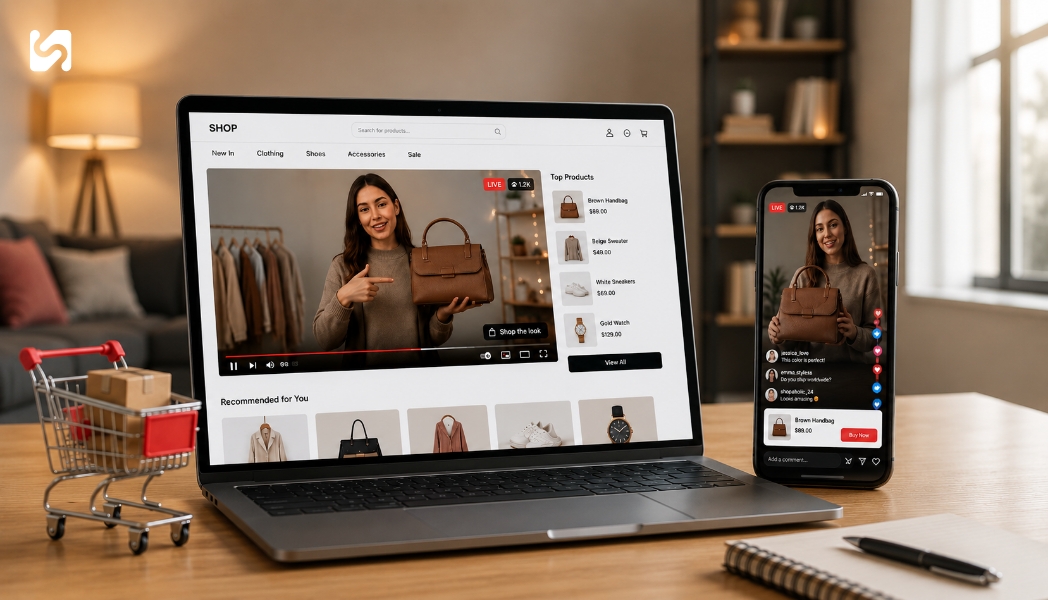
Video commerce (also called v-commerce or shoppable video commerce) is the integration of interactive, shoppable video content into an eCommerce shopping experience to drive product discovery, customer engagement, and direct purchase conversions.
Unlike passive marketing videos, video commerce content is built for transaction viewers can click on products within the video, add items to their cart, and complete checkout without leaving the viewing experience. It spans formats including shoppable short-form videos, live shopping streams, product demos, 360-degree product views, AR try-ons, and video-based customer consultations.
The defining characteristic of video commerce is the direct commercial action pathway embedded in the video itself turning watching into buying with the fewest possible steps.
Types of Video Integration for eCommerce
Not all video content works the same way or serves the same purpose. Here are the main types of video integration available to eCommerce brands, and what each does best:
1. Shoppable Product Videos
Shoppable videos embed clickable product links directly inside the video frame. A shopper watching a fashion lookbook or a kitchen demo can tap a highlighted item and go straight to the product page or add it to their cart without stopping the video. This format removes friction between inspiration and purchase, making it especially effective for impulse-driven categories like fashion, beauty, and home décor.
2. Live Shopping Streams
Live commerce replicates the energy of a TV shopping channel inside a brand’s app or website. A host demonstrates products in real-time, answers viewer questions in the chat, showcases limited-time offers, and drives immediate purchases through urgency and interaction. Live shopping events convert at 9–30% the highest conversion rate of any eCommerce format currently in widespread use.
3. Product Demo and Tutorial Videos
These are the workhorses of product page video. A good demo shows the product in motion, at scale, in context. A tutorial shows how to use it step by step. For categories where customers hesitate because they are not sure how something works electronics, skincare, tools, fitness equipment demo videos answer the question before it becomes a reason not to buy.
4. 360-Degree and Augmented Reality (AR) Video
360-degree videos let shoppers rotate and explore a product from every angle. AR video overlays allow customers to virtually place furniture in their room, try on glasses, or test makeup shades all through their phone camera. These formats are especially powerful for high-consideration purchases where uncertainty about fit, scale, or appearance drives return rates up.
5. User-Generated Video Content (UGC)
Customer-created videos unboxings, reviews, outfit repeats, before-and-afters build trust in ways polished brand content cannot. Real customers showing real results carry social proof that marketing cannot replicate. Brands that actively surface and feature UGC on their product pages convert better and spend less on content production at the same time.
6. Video Chat and Virtual Consultations
One-to-one video consultations bring the in-store assistant experience online. A beauty brand can connect shoppers with makeup artists. A luxury retailer can offer personal styling sessions. A tech brand can walk customers through complex setup questions. This format works particularly well for high-ticket items where the buying decision needs a human conversation.
7. Video-Based Search and Discovery
Emerging AI tools now allow shoppers to search for products by uploading a video clip a social media post, a film scene, an outfit photo. The platform matches the visual content to relevant products. This format is growing rapidly as AI improves product recognition and recommendation accuracy.
Benefits of Video Commerce Integration for eCommerce Brands
1. Higher Conversion Rates
This is the most direct benefit. Product pages with video convert at 4.8% on average versus 2.9% for image-only pages a 65% uplift from a single content change. For high-consideration items, the impact is even larger. A 30-second demo video on a $300 product page does more conversion work than a 500-word description.
2. Reduced Product Returns
Returns are one of eCommerce’s biggest margin killers. The root cause is almost always a mismatch between what the customer imagined and what arrived. Video closes that gap. Demo videos show scale, texture, movement, and real-world context that static images cannot communicate. Brands that add video to high-return-rate product categories typically see return rates drop 20–35%.
3. Increased Average Order Value
When customers feel confident about what they are buying, they buy more of it. Live shopping events and tutorial videos naturally surface complementary products. A skincare demo that shows a three-step routine generates basket sizes that a single-product page cannot. Video also keeps customers on-site longer, which increases the likelihood of cross-category discovery.
4. Better SEO and Organic Discoverability
Search engines treat pages with video as richer, more authoritative content. Pages with embedded video are 53 times more likely to rank on Google’s first page. Video content also increases average session time a signal that search algorithms use to evaluate content quality. Properly tagged and transcribed videos appear in Google Video search, YouTube search, and AI-powered search overviews, giving your content multiple discovery channels simultaneously.
5. Stronger Customer Trust and Brand Credibility
Ninety-one percent of consumers say video quality directly affects how much they trust a brand. A polished product demo signals investment, care, and confidence. UGC videos signal that real customers are happy enough to share their experience publicly. Customer testimonial videos on key landing pages lift conversions by 30–80% in A/B tests not because they add information, but because they build the emotional confidence that drives action.
6. Deeper Emotional Connection and Brand Storytelling
Text tells customers about a product. Video shows them what life with that product looks like. A brand that sells outdoor gear can show an expedition. A brand that sells baby products can show a family morning. A brand that sells coffee can show the ritual. This storytelling layer creates the brand affinity that drives repeat purchases and word-of-mouth outcomes that no amount of discount-driven acquisition can replicate.
7. Longer Time On Site and Lower Bounce Rates
Video holds attention. Users who encounter video content on a product page stay longer, scroll further, and view more products. Higher session duration signals relevance to search algorithms and gives your recommendation engine more data to surface the right cross-sells. Lower bounce rates also reduce the cost per acquisition over time because the same traffic volume produces more engaged sessions.
8. Competitive Differentiation
Video commerce is not universal yet. Many eCommerce brands especially in mid-market still run entirely on static images. Adding shoppable video, live shopping events, or AR try-on features to a store that previously had none creates a tangible, immediate experience gap between you and competitors who have not made the move.
Key Technical Considerations for Video Integration in eCommerce Apps
Building a video commerce experience that works reliably at scale requires more than uploading MP4 files. Here is what the technical architecture needs to cover:
Video Hosting and Streaming Infrastructure
Cloud-based video hosting through platforms like AWS CloudFront, Brightcove, or JW Player is the foundation. Self-hosting video files on a standard web server creates buffering problems, slow load times, and inconsistent playback quality across devices. A dedicated video hosting platform handles encoding, adaptive bitrate streaming, and global delivery automatically.
Content Delivery Networks (CDNs)
A CDN stores copies of your video content on servers distributed around the world, so the video a shopper in Mumbai loads is served from a regional server rather than traveling from a data centre in Virginia. For eCommerce brands with international customers, CDN integration is the single biggest factor in video load speed and playback quality.
Adaptive Bitrate Streaming
Adaptive bitrate (ABR) streaming automatically adjusts video quality based on the viewer’s connection speed. A shopper on a strong Wi-Fi connection gets HD quality. A shopper on a slow mobile connection gets a lower-resolution version that loads without buffering. Without ABR, video load time becomes a conversion killer the moment connection quality drops.
Video Compression and Format Compatibility
Modern video compression formats H.264, H.265/HEVC, WebM reduce file sizes significantly without visible quality loss. The right format depends on your device and browser targets. Serving MP4 with H.264 encoding covers the widest compatibility range. Adding WebM as a fallback handles browsers that prefer it. Tools like HandBrake or FFmpeg handle compression and format conversion efficiently.
Lazy Loading and Performance Optimization
Loading all video content at page load increases initial load time and hurts Core Web Vitals scores which directly affects SEO rankings. Lazy loading ensures video files only load when the user scrolls to them or interacts with the video element. This keeps initial page load fast while still delivering the video experience when it is needed.
Mobile-First Video Design
More than 60% of eCommerce traffic now comes from mobile devices. Video players must be responsive scaling correctly to different screen sizes, supporting both portrait and landscape orientations, and working across iOS Safari and Android Chrome. HTML5 video players handle this natively. Flash-based or legacy embeds do not.
Cross-Platform and Browser Compatibility Testing
Video that plays perfectly on Chrome may stutter on Safari or fail on older Android browsers. Before launching any video commerce feature, test across the browsers and devices your customers actually use. Cross-platform testing tools like BrowserStack allow systematic coverage without maintaining a physical device library.
Video SEO and Metadata
Search engines cannot watch videos. They index the metadata around them. Every product video should have a descriptive title, a keyword-rich description, and a transcript. Adding VideoObject schema markup in JSON-LD tells search engines exactly what the video contains, increasing eligibility for video-rich snippets and Google Discover placements.
Analytics and Performance Tracking
Without tracking, you cannot tell which videos drive conversions and which ones do not. Video analytics platforms Wistia, Vimeo Analytics, or Google Analytics with event tracking measure play rate, watch time, drop-off points, and conversion attribution. These metrics tell you whether a video is too long, whether the CTA placement is wrong, and whether the video format matters for different product categories.
Learn More – Reel Based Social Commerce App Development
How Generative AI Boosts eCommerce Video Content Generation
Generative AI is changing the economics of video commerce by making high-quality video content faster, cheaper, and more scalable to produce.
AI-Generated Product Videos at Scale
Until recently, shooting a product video for every SKU in a large catalogue was cost-prohibitive for most brands. Generative AI changes this. Tools can now produce photorealistic product videos from 2D images showing the product rotating, in use, or in lifestyle settings without a camera, studio, or production crew. A brand with 500 SKUs can generate product videos for all of them in days rather than months.
Automated Video Personalization
AI-powered video engines can personalise video content dynamically based on viewer data. A returning customer who previously browsed running shoes sees a product video featuring trail running. A first-time visitor to a fashion site sees a lifestyle video aligned with their browsing category. Personalized video recommendations increase engagement rates significantly because the content feels relevant rather than generic.
AI-Generated Scripts and Voiceovers
Generative AI tools can write product video scripts, generate voiceovers in multiple languages, and add closed captions automatically. This reduces the human production overhead for each video and makes multilingual content accessible to brands without dedicated localization teams.
Real-Time AI Video Assistance in Live Commerce
During live shopping streams, AI tools can surface real-time product information for the host, auto-moderate chat, generate and display promotional offers dynamically, and produce post-stream highlight reels automatically. This reduces the production burden of live commerce significantly making it viable for smaller brands that cannot staff full production teams.
AI-Powered Video Search and Recommendations
AI recommendation engines analyze viewing behaviour across your entire customer base to surface the right video content to the right customer at the right moment in their buying journey. Customers who watch a product demo and do not convert are shown a testimonial video. Customers who watched a tutorial are shown complementary product demos. This sequencing dramatically improves the conversion lift from video content overall.

How Sonic TechPro Can Help You Build Your Video Commerce Solution
Building a video commerce experience that works one that loads fast, converts well, and scales with your catalogue requires more than a video platform subscription. It requires a development partner who understands both the commerce architecture and the video technology stack.
Sonic TechPro builds end-to-end video commerce solutions for eCommerce brands, covering every layer of the implementation:
eCommerce App Video Integration We integrate video directly into product pages, category pages, and home pages of your existing eCommerce platform, whether you are on Shopify, WooCommerce, Magento, or a custom-built storefront. Our implementations use lazy loading, CDN delivery, and adaptive bitrate streaming as standard not as add-ons.
Live Shopping Feature Development We build native live shopping functionality into your eCommerce app, including real-time chat, product tagging, in-stream checkout, and host-facing product management tools. Our live commerce builds support concurrent viewers at scale without performance degradation.
Shoppable Video Implementation We implement shoppable video experiences with embedded product hotspots, direct add-to-cart functionality, and analytics dashboards that show which products get the most taps, which videos drive the most conversions, and where viewer drop-off happens.
Generative AI Video Tools We integrate AI-powered video generation tools into your product management workflow, enabling automated product video creation at catalogue scale and personalized video recommendation engines that serve the right content to each shopper.
Video Performance and SEO Optimisation We ensure every video implementation includes VideoObject schema, transcript generation, proper metadata tagging, and Core Web Vitals–safe loading patterns that protect your SEO rankings while adding rich media content.
Analytics and Optimisation Support We set up full video analytics tracking play rates, watch time, conversion attribution, and drop-off analysis and work with your team to interpret the data and iterate on content strategy.
Whether you are adding your first product demo videos or building a full live commerce platform, Sonic TechPro has the technical depth and eCommerce experience to deliver it properly. Get in touch with the team to discuss your video commerce roadmap.
Key Takeaways
- Video commerce integration embeds shoppable, interactive video content directly into the eCommerce shopping journey turning watching into buying.
- The six primary types of eCommerce video integration are shoppable videos, live shopping streams, product demos, 360°/AR video, user-generated content, and video consultations.
- Product pages with video convert up to 86% better than image-only pages, and live shopping events convert at 9–30% versus 2–3% for standard eCommerce.
- Video reduces product returns by up to 35% by closing the gap between customer expectation and product reality.
- The technical foundations of a reliable video commerce build include CDN delivery, adaptive bitrate streaming, mobile-first responsive players, lazy loading, and VideoObject schema markup.
- Generative AI is making product video creation scalable at catalogue level removing the production cost barrier that previously made video unfeasible for large SKU counts.
- Video is an SEO multiplier: pages with video are 53x more likely to rank on Google’s first page, and video content increases session time, which search algorithms treat as a quality signal.
Looking to build a video commerce solution for your eCommerce brand? Sonic Techpro builds shoppable video integrations, live commerce platforms, and AI-powered video content tools that connect directly to your existing store. Get in touch with the team to start the conversation.
Frequently Asked Questions
