
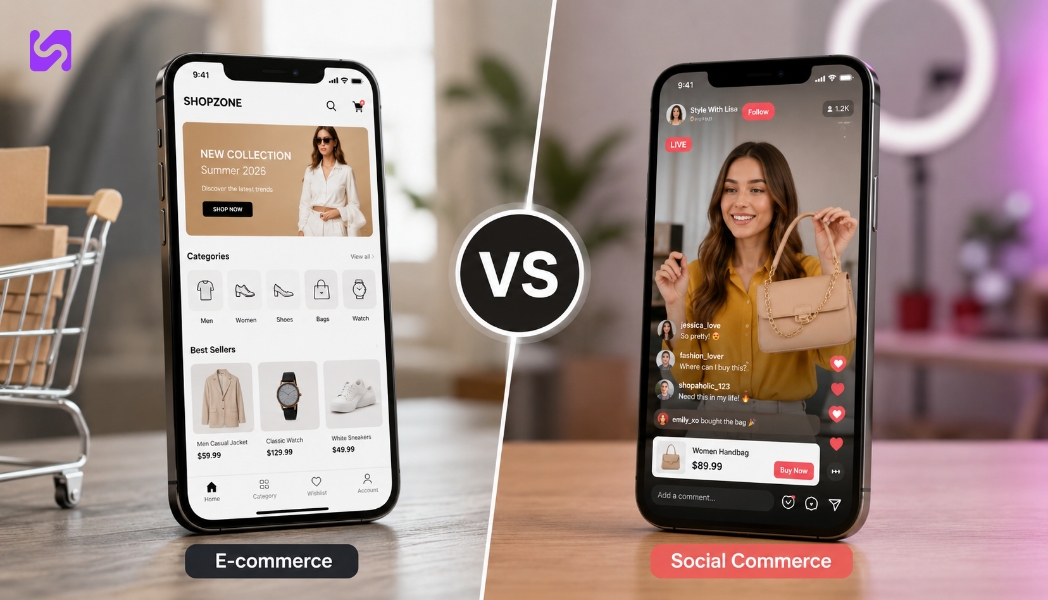
Social Commerce Vs Traditional Ecommerce: What’s the Difference & Which Is Better for Your Business?
 by Sumit Kumar
Summary : The debate around Ecommerce vs Social Commerce is becoming increasingly relevant as online shopping continues to evolve. While traditional ecommerce websites remain a cornerstone of digital retail, social commerce is transforming how consumers discover, engage with, and purchase products through social media platforms. This guide explains the difference between ecommerce and social commerce, explores how each model works, compares their strengths and limitations, and helps businesses decide which strategy best aligns with their growth objectives.
While traditional ecommerce model remains highly successful, a new approach has rapidly gained momentum – Social Commerce. Today, consumers no longer rely solely on search engines to find products. Instead, they discover them while scrolling through Instagram Reels, TikTok videos, Facebook feeds, Pinterest collections, and live shopping sessions. Recommendations from creators, influencers, and online communities have become powerful purchase drivers, making shopping more engaging and interactive than ever before.
This shift has fueled the growing discussion around Social Commerce Vs Traditional eCommerce. Businesses now face an important question: should they continue investing in traditional ecommerce, embrace social commerce, or combine both to maximize growth?
In this guide, we’ll explain what social commerce is, how it compares with traditional ecommerce, the benefits each model offers, and why AI-powered shopping experiences are shaping the future of online retail.
What is Social Commerce?
Social commerce is a subset of ecommerce that involves selling directly through social media platforms, and social commerce is a specialized subset of the broader ecommerce ecosystem rather than a competing channel. It combines social networking, content creation, influencer marketing, community engagement, and seamless in-app purchasing into one unified shopping experience.
Unlike traditional ecommerce, where customers intentionally search for products, social commerce encourages product discovery through entertaining and engaging content. Consumers often encounter products while watching short-form videos, browsing creator content, participating in live shopping events, or interacting with brands on social platforms.
Types of Social Commerce
Social commerce has evolved into multiple formats, each offering unique ways for brands to connect with shoppers and increase conversions.
Live Commerce – Brands host live shopping events where products are demonstrated in real time. Viewers can interact with hosts, ask questions, and purchase featured products instantly without leaving the livestream.
Shoppable Videos – Short videos include embedded product links that allow viewers to purchase featured items while watching engaging content. This format has become especially popular on TikTok, Instagram Reels, and YouTube Shorts.
Creator & Influencer Commerce – Creators and influencers promote products to highly engaged communities. Their recommendations build trust, increase product visibility, and significantly influence purchasing decisions.
Social Marketplace – Businesses create digital storefronts within platforms such as Facebook Shops and Instagram Shops, allowing customers to browse catalogs and purchase products directly inside the app.
Community Commerce – Customers join brand communities, discussion groups, and social forums where product recommendations, reviews, and user-generated content influence purchasing behavior.
Conversational Commerce – Brands use messaging platforms, AI chatbots, and live customer support to answer questions, recommend products, and complete purchases through personalized conversations.
What Makes Social Commerce Unique?
Social commerce is much more than selling products on social media. It transforms shopping into an interactive, personalized, and community-driven experience. Instead of simply displaying products in an online catalog, brands engage customers through content, conversations, creators, and AI-powered recommendations. Here are the features that set social commerce apart from traditional ecommerce.
Content-Driven Product Discovery – Unlike traditional ecommerce, where customers search for products using keywords, social commerce allows users to discover products naturally through reels, short videos, stories, live streams, and creator content. Every scroll creates a new opportunity for product discovery.
Seamless In-App Shopping – Social commerce minimizes purchase friction by allowing users to browse, compare, and purchase products without leaving the social platform. This shorter buying journey improves customer convenience and increases conversion rates.
Creator and Influencer-Led Selling – Consumers trust recommendations from creators they follow. Influencers demonstrate products through authentic experiences, tutorials, and reviews, helping brands establish credibility and accelerate purchase decisions.
AI-Powered Personalization – Artificial Intelligence analyzes customer behavior, interests, purchase history, and engagement patterns to recommend highly relevant products. Personalized shopping feeds create better customer experiences while increasing average order values.
Interactive Shopping Experience – Instead of one-way communication, social commerce encourages conversations. Customers can comment, ask questions, participate in live shopping sessions, vote in polls, and receive instant responses, making shopping more engaging and enjoyable.
Community-Driven Purchase Decisions – User-generated content, ratings, reviews, and customer discussions provide valuable social proof that influences buying behavior. Shoppers are more likely to trust real experiences shared by other customers than traditional advertisements.
Popular Social Commerce Platforms
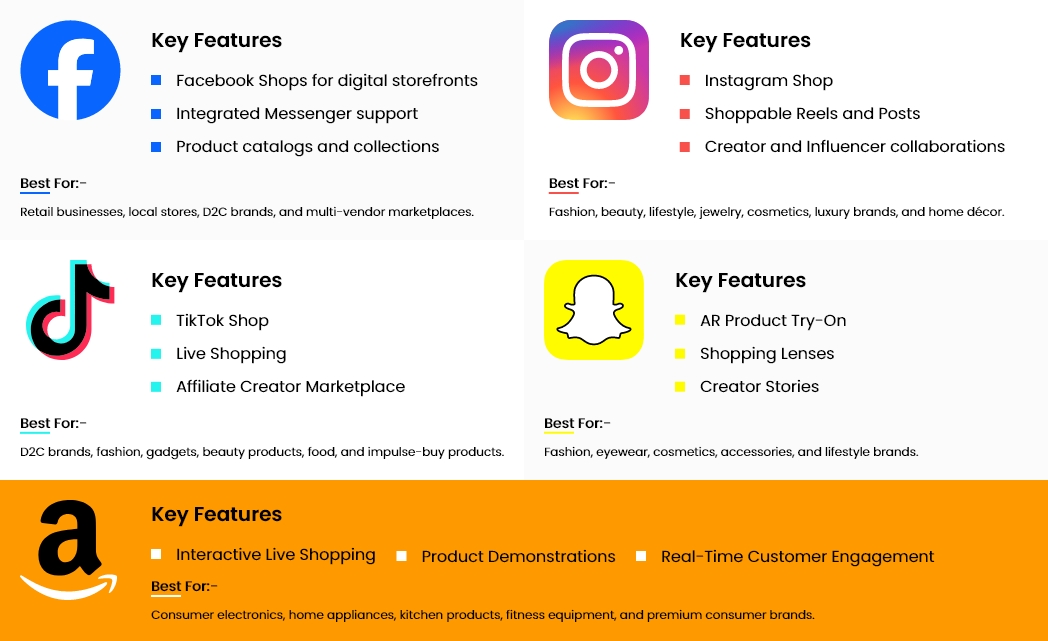
Every social platform offers unique shopping capabilities that help businesses connect with customers in different ways. Choosing the right platform depends on your products, audience, and marketing strategy.
Facebook – Facebook Shops allows businesses to create digital storefronts directly on the platform, enabling users to browse products, interact with brands, and complete purchases seamlessly.
Instagram – Instagram has become one of the most influential social commerce platforms by combining visual storytelling with integrated shopping experiences.
TikTok – TikTok Shop has transformed product discovery through short-form entertainment, creator-led recommendations, and viral shopping experiences.
Snapchat – Snapchat focuses on immersive shopping experiences through augmented reality, allowing users to visualize products before making purchases.
Amazon Live – Amazon Live combines live product demonstrations with ecommerce, enabling brands and creators to showcase products while viewers purchase instantly.
What Is the Social Commerce Edge Over Traditional Ecommerce?
While traditional ecommerce remains highly effective, social commerce introduces capabilities that create stronger customer engagement, faster buying decisions, and better brand visibility.
Higher Customer Engagement – Social commerce encourages users to interact with brands through comments, likes, shares, live sessions, and community discussions. These interactions increase customer loyalty and brand recall.
Faster Product Discovery – Customers often discover products organically while browsing content rather than actively searching for them. This opens new opportunities for impulse purchases and brand awareness.
Increased Conversion Rates – Shoppable videos, creator recommendations, live shopping, and one-click purchases reduce friction throughout the buying process, resulting in higher conversion rates.
Stronger Customer Trust – Authentic creator content, customer reviews, and user-generated experiences provide social proof that builds credibility and reduces purchase hesitation.
Personalized Shopping Journeys – AI-powered recommendation engines deliver tailored product suggestions based on browsing behavior, interests, demographics, and previous interactions, making every shopping experience unique.
Better Mobile Shopping Experience – Since most social platforms are mobile-first, users enjoy faster browsing, simplified navigation, instant payments, and seamless shopping experiences optimized for smartphones.
Statistics Showing Why Social Commerce Is on the Boom
The rapid growth of social commerce is supported by strong market trends and changing consumer behavior worldwide.
- The global social commerce market is valued at roughly $2.11 trillion in 2026, growing at a 29.12% CAGR toward $7.55 trillion by 2031 Mordor Intelligence
- US social commerce sales are projected to cross $100 billion for the first time in 2026, an 18% year-over-year jump Ringly
- Traditional ecommerce made up 15.8% of total US retail sales in Q3 2025 (not seasonally adjusted) U.S. Census Bureau
- 43% of internet users research products on social media before buying, showing how much influence happens before checkout even begins DataReportal
- 34% of shoppers recently bought directly through a social platform, and 21% purchased because an influencer recommended the product Salsify
- TikTok Shop is projected to generate $23.4 billion in US ecommerce sales in 2026 outselling online-only revenue from retailers like Target or Costco Ringly
- Live shopping events convert at up to 30%, dramatically higher than the 2–3% average conversion rate typical of traditional ecommerce sites Ringly
- Direct social-to-purchase conversion paths average around 1.81% in the US, compared with 2.5%–3% for standard ecommerce sites Conbersa
- The broader social commerce market is expected to hit $8.5 trillion globally by 2030, with the US segment alone worth $126.6 billion in 2026 SellersCommerce
Role of Short Videos, Influencers & Live Shopping
Consumer behavior has shifted from search-driven shopping to discovery-driven shopping. Instead of visiting an online store with a product in mind, customers now discover products while scrolling through entertaining videos, watching creators, or joining live shopping sessions. This evolution has made short videos, influencers, and live commerce the driving forces behind modern social commerce.
Short Videos Drive Product Discovery
Short-form videos on platforms like Instagram Reels, TikTok, YouTube Shorts, and Facebook Reels have transformed how consumers interact with brands. Rather than relying on static product images, businesses can showcase products through demonstrations, tutorials, behind-the-scenes content, customer testimonials, and unboxing experiences.
These engaging videos capture attention quickly, increase product awareness, and encourage viewers to take immediate action. Since videos appear naturally within users’ feeds, brands can reach potential customers even before they begin actively searching for a product.
Influencers Build Trust and Credibility
Influencer marketing has become one of the most effective ways to promote products online. Consumers often trust recommendations from creators they follow because they perceive them as authentic and relatable.
Live Shopping Creates Real-Time Buying Experiences
Live commerce combines entertainment with instant purchasing. During a live shopping event, brands or creators showcase products, answer customer questions, demonstrate product features, announce limited-time offers, and encourage viewers to buy immediately.
How AI is Transforming Social Commerce
Artificial Intelligence is redefining how brands attract, engage, and retain customers. Instead of offering the same shopping experience to every visitor, AI enables businesses to deliver highly personalized journeys based on customer behavior, preferences, and purchasing intent.
Modern AI-powered social commerce platforms help businesses improve customer engagement while automating many manual processes involved in online selling.
- Personalized Product Recommendations
- AI Shopping Assistants
- Intelligent Content Generation
- Smart Product Discovery
- Predictive Analytics
- Fraud Detection & Secure Transactions
- Personalized Marketing Automation
- AI Video Commerce
How Do You Win Social Commerce Across Channels?
Success in social commerce isn’t about being present on every platform—it’s about creating a connected shopping experience wherever your customers spend their time.
To build a high-performing social commerce strategy:
- Create platform-specific content instead of reposting identical content everywhere.
- Use short-form videos to capture attention and introduce products naturally.
- Partner with creators and influencers who genuinely align with your brand values.
- Host live shopping events to answer questions and showcase products in real time.
- Enable seamless in-app purchasing to reduce checkout friction.
- Encourage customers to share reviews, photos, and user-generated content to build trust.
- Leverage AI for personalized recommendations, targeted campaigns, and customer support.
- Track engagement, conversions, and customer behavior continuously to refine your strategy.
- Integrate your social channels with your ecommerce website to create a unified omnichannel shopping experience.
- Stay agile by experimenting with new formats, emerging platforms, and evolving consumer trends.
Businesses that successfully combine engaging content, community interaction, creator partnerships, and AI-powered personalization are better positioned to increase customer loyalty, improve conversions, and drive long-term growth.
What Is Traditional Ecommerce?
Traditional ecommerce is the process of buying and selling products or services through a dedicated website, online marketplace, or mobile application. Customers visit an online store, browse product categories, compare options, add items to a shopping cart, and complete purchases through a secure checkout process.
Unlike social commerce, which focuses on product discovery through content and social interactions, traditional ecommerce is primarily driven by customer intent. Shoppers usually know what they are looking for and actively search for products using search engines, marketplaces, or brand websites.
Types of Ecommerce Businesses
Traditional ecommerce supports multiple business models depending on the target audience and the nature of transactions.
Business-to-Consumer (B2C) – B2C is the most common ecommerce model where businesses sell products directly to individual customers through online stores or marketplaces.
Examples: Fashion brands, electronics retailers, grocery stores, beauty brands, and furniture retailers.
Business-to-Business (B2B)
In the B2B model, businesses sell products or services to other businesses. These platforms often include bulk ordering, negotiated pricing, quotations, and account-based purchasing.
Examples: Industrial equipment suppliers, wholesale distributors, software providers, and manufacturing companies.
Direct-to-Consumer (D2C) – D2C brands eliminate intermediaries by selling products directly from manufacturers to consumers through their own ecommerce websites. This model allows businesses to maintain complete control over branding, pricing, customer relationships, and marketing.
Consumer-to-Consumer (C2C) – C2C platforms enable individuals to buy and sell products directly with one another through online marketplaces.
Examples: Used goods, collectibles, handmade products, and second-hand marketplaces.
Consumer-to-Business (C2B) – In this model, individuals provide products or services to businesses. Common examples include freelance marketplaces, influencer collaborations, stock photography platforms, and digital content licensing.
Marketplace Ecommerce – Marketplace platforms connect multiple sellers with buyers while managing payments, product listings, customer support, and logistics. Businesses benefit from wider reach, while customers enjoy greater product variety.
What Are the Characteristics of Traditional Ecommerce?
Traditional ecommerce remains one of the most reliable digital business models because it provides businesses with complete ownership of their online operations. Several defining characteristics distinguish it from social commerce.
Dedicated Online Store – Traditional ecommerce revolves around a branded website or mobile application where businesses control every aspect of the shopping experience, from product presentation to checkout.
Search-Driven Customer Journey – Customers typically begin their shopping journey with a search query. They visit an ecommerce website after identifying a product need rather than discovering products through social content.
Large Product Catalogs – Traditional ecommerce platforms are designed to manage extensive inventories with organized product categories, advanced search filters, detailed specifications, and comparison tools.
Structured Shopping Experience
Customers follow a clear purchasing path:
Product Search → Product Page → Shopping Cart → Checkout → Payment → Order Confirmation
This structured flow makes online shopping predictable and efficient.
Advanced Business Operations – Traditional ecommerce platforms integrate with ERP systems, CRM software, inventory management, warehouse management, shipping providers, taxation tools, payment gateways, and analytics platforms to streamline business operations.
What Is the Transactional Nature of Traditional Ecommerce?
Traditional ecommerce is designed to efficiently convert customer intent into completed purchases. Its structured approach prioritizes convenience, trust, and operational efficiency.
Intent-Based Shopping – Customers usually arrive with a clear purpose. They search for a specific product, compare available options, and make informed purchasing decisions based on their requirements.
Detailed Product Information – Traditional ecommerce websites provide comprehensive product descriptions, specifications, pricing details, customer reviews, FAQs, warranty information, and comparison tools that help customers make confident decisions.
Secure Checkout Process – A secure checkout experience builds customer confidence through encrypted payment processing, multiple payment methods, address verification, and transparent order confirmation.
Efficient Order Fulfillment – Traditional ecommerce platforms integrate logistics partners, inventory systems, and warehouse management solutions to ensure accurate order processing, shipment tracking, and timely deliveries.
Key Players & Platforms in Traditional Ecommerce
Several global ecommerce companies have transformed online retail by building scalable platforms that serve millions of buyers and sellers.
Amazon – Amazon is the world’s largest ecommerce marketplace, offering millions of products across virtually every category. Its strengths include an extensive product selection, fast delivery through Prime, advanced recommendation engines, and a highly trusted customer experience.
Walmart – Walmart combines its extensive physical retail network with a growing ecommerce platform, offering groceries, electronics, home essentials, and everyday products through omnichannel shopping experiences.
AliExpress – AliExpress enables international buyers to purchase products directly from manufacturers and merchants, making it a popular platform for affordable consumer goods and cross-border ecommerce.
eBay – eBay pioneered online marketplace commerce by allowing individuals and businesses to sell both new and pre-owned products through auctions and fixed-price listings.
Best Buy – Best Buy specializes in electronics and appliances while combining ecommerce capabilities with in-store pickup, technical support, installation services, and product consultations.
Alibaba – Alibaba connects manufacturers, wholesalers, suppliers, and businesses across the globe, making it one of the largest B2B ecommerce ecosystems for international trade.
Where Does Traditional Ecommerce Excel?
Despite the rapid growth of social commerce, traditional ecommerce continues to deliver significant advantages for businesses that require operational control, scalability, and comprehensive digital commerce capabilities.
Complete Brand Ownership – Businesses have full control over their website design, branding, customer journey, pricing, promotions, and user experience without relying on third-party platform algorithms.
Extensive Product Catalog Management – Traditional ecommerce platforms efficiently handle thousands of products with advanced search, filters, categories, inventory tracking, and product management capabilities.
Strong Search Engine Visibility – Optimized ecommerce websites attract high-intent traffic through search engines, enabling businesses to generate consistent organic traffic using SEO and content marketing.
Advanced Business Integrations – Traditional ecommerce seamlessly integrates with ERP systems, CRM software, accounting tools, warehouse management, logistics providers, payment gateways, and marketing automation platforms.
Global Scalability – Businesses can expand into new regions, support multiple currencies and languages, and manage international shipping from a centralized ecommerce platform.
Rich Customer Data & Analytics – Unlike social platforms, traditional ecommerce gives businesses direct access to customer behavior, purchase history, conversion metrics, and first-party data that can be used to improve marketing strategies and customer retention.
Which Businesses Should Invest in Traditional Ecommerce?
Traditional ecommerce is the ideal choice for organizations that require complete ownership of their digital storefront, extensive product management capabilities, and long-term scalability.
It is particularly well-suited for:
- Large retail brands with extensive product catalogs.
- Manufacturers selling directly to consumers or distributors.
- Wholesale and B2B businesses managing bulk orders.
- Electronics and appliance retailers requiring detailed product specifications.
- Healthcare and pharmaceutical suppliers handling regulated products.
- Automotive parts and industrial equipment providers with complex inventories.
- Furniture and home décor companies offering broad product selections.
- Grocery and supermarket chains managing recurring purchases.
- Subscription-based businesses delivering products or services regularly.
- Global brands expanding into multiple countries with localized shopping experiences.
For businesses focused on SEO-driven customer acquisition, enterprise integrations, and complete control over the buying journey, traditional ecommerce remains an essential foundation. However, combining it with social commerce can unlock even greater opportunities for customer engagement and revenue growth.
What Is the Difference Between Ecommerce and Social Commerce?
Although both models aim to sell products online, they differ significantly in how customers discover products, interact with brands, and complete purchases. The main difference between social commerce and ecommerce is where the purchase happens: social commerce lets customers discover and buy inside social apps like Instagram and TikTok, while traditional ecommerce sends them to a dedicated website or marketplace.
Understanding the difference between ecommerce and social commerce helps businesses choose the right strategy or combine both for maximum growth.
| Aspect | Social Commerce | Traditional Ecommerce |
| Primary Goal | Inspire product discovery and encourage impulse purchases through engaging content. | Help customers efficiently find and purchase products they are actively searching for. |
| Customer Journey | Discovery → Engagement → Purchase | Search → Compare → Purchase |
| Shopping Location | Within social media platforms like Instagram, TikTok, Facebook, Pinterest, and live shopping apps. | On dedicated ecommerce websites, online marketplaces, or branded mobile apps. |
| Traffic Source | Social media feeds, influencers, creators, communities, and paid social campaigns. | Search engines, direct traffic, email marketing, paid search, and marketplaces. |
| Product Discovery | Algorithm-driven recommendations, reels, stories, live videos, and creator content. | Search bars, navigation menus, categories, and product filters. |
| Purchase Intent | Users often discover products unexpectedly while consuming content. | Users usually have a clear buying intent before visiting the website. |
| Customer Engagement | High engagement through comments, likes, shares, live sessions, and community discussions. | Limited interaction, primarily through product pages, reviews, and customer support. |
| Content Strategy | Video-first, creator-led, influencer marketing, and user-generated content. | Product catalogs, landing pages, blogs, buying guides, and promotional campaigns. |
| Checkout Experience | In-app checkout with minimal purchase friction. | Multi-step checkout process on the ecommerce platform. |
| Trust Factors | Influencer recommendations, creator content, customer reviews, and community validation. | Brand reputation, detailed product information, ratings, warranties, and secure payments. |
| Personalization | AI-driven content recommendations and personalized shopping feeds. | Product recommendations based on browsing history and purchase behavior. |
| Marketing Focus | Engagement, storytelling, community building, and viral content. | SEO, PPC, email marketing, affiliate marketing, and retargeting campaigns. |
| Conversion Driver | Emotional engagement and social proof. | Product need, price comparison, and customer intent. |
| Best For | Fashion, beauty, lifestyle, D2C brands, and visually appealing products. | Large retailers, B2B businesses, marketplaces, electronics, and businesses with extensive catalogs. |
| Customer Relationship | Built through ongoing conversations and community engagement. | Built through customer service, loyalty programs, personalized offers, and repeat purchases. |
| Business Control | Platform-dependent with algorithm influence. | Complete ownership of branding, customer data, and business operations. |
| Scalability | Rapid audience growth through viral content and creators. | Long-term scalable growth through SEO, technology, and operational excellence. |
Social Commerce vs Ecommerce : Which Model Is Right for You?
There is no universal winner in the Social Commerce vs Ecommerce debate because each model serves different business goals. The ideal choice depends on your target audience, product category, customer acquisition strategy, and long-term growth plans.
Choose Social Commerce If…
Social commerce is the right investment when your goal is to create engaging shopping experiences that encourage product discovery.
It works particularly well if you:
- Sell visually appealing consumer products.
- Target Millennials or Gen Z audiences.
- Invest heavily in influencer marketing.
- Want to leverage short-form videos and live shopping.
- Launch products frequently.
- Depend on impulse purchases.
- Focus on community building and customer engagement.
- Want AI-powered personalized shopping experiences.
Businesses in fashion, beauty, fitness, lifestyle, consumer electronics, food, and D2C retail often see strong results with social commerce.
Choose Traditional Ecommerce If…
Traditional ecommerce remains the preferred option when your business requires complete operational control and robust online selling capabilities.
It is ideal if you:
- Manage large product catalogs.
- Need advanced inventory management.
- Sell B2B products or wholesale solutions.
- Require ERP and CRM integrations.
- Depend on search engine traffic.
- Operate internationally.
- Need detailed product specifications.
- Require complete ownership of customer data.
Manufacturers, enterprise retailers, wholesalers, healthcare companies, industrial suppliers, and large ecommerce businesses benefit greatly from traditional ecommerce.
The Best Strategy? Combine Both Ecommerce and Social Commerce
The most successful brands no longer choose between social commerce and ecommerce they integrate both. Social commerce captures customer attention, builds engagement, and drives discovery. Traditional ecommerce provides a powerful platform for product management, customer accounts, advanced search, loyalty programs, order fulfillment, and long-term customer relationships.
When connected effectively, these two models create a seamless omnichannel shopping experience that improves both customer acquisition and retention.
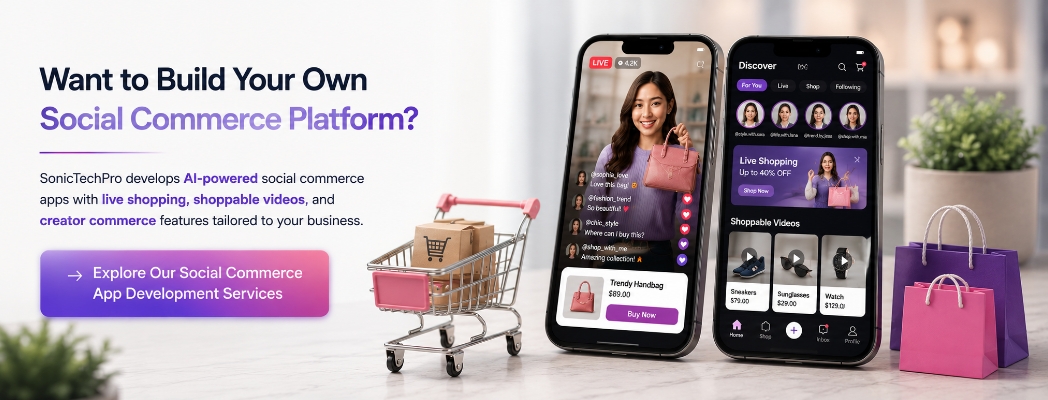
How Can Sonic TechPro Help Your Business Become Part of the Social Commerce Revolution?
The future of digital commerce extends far beyond traditional online stores. Today’s consumers expect personalized recommendations, creator-driven content, live shopping experiences, and seamless purchasing across every digital touchpoint.
At Sonic TechPro, we help businesses transform these expectations into scalable digital commerce solutions.
Our team specializes in:
- Custom Social Commerce App Development
- AI-powered Social Commerce Platforms
- Live Commerce Solutions
- Video Commerce Solution Development
- Shoppable Video Platforms
- Multi-Vendor Marketplace Development
- Ecommerce Platform Development
- Creator & Influencer Commerce Platforms
- AI Recommendation Engines
- Real-Time Live Streaming Integration
- Secure Payment & Wallet Solutions
- Cross-platform Android, iOS, and Web Applications
Whether you’re a startup launching a new shopping platform or an established ecommerce brand expanding into creator-led commerce, we build secure, scalable, and feature-rich solutions tailored to your business goals.
Ecommerce vs Social Commerce – Key Takeaways
- Social commerce and traditional ecommerce serve different purposes but work best together. Social commerce drives product discovery and customer engagement, while traditional ecommerce provides a structured shopping experience, detailed product information, and complete business control.
- Short-form videos, influencer marketing, and live shopping are reshaping online buying behavior. Modern consumers increasingly discover products through social media, making content-driven commerce a powerful growth channel for brands.
- Artificial Intelligence is accelerating the evolution of social commerce. AI-powered product recommendations, intelligent search, personalized shopping experiences, predictive analytics, chatbots, and generative content help businesses improve conversions and customer satisfaction.
- Traditional ecommerce remains essential for scalable digital commerce. Businesses with large product catalogs, complex inventory, B2B operations, or global expansion plans continue to benefit from dedicated ecommerce websites and mobile applications.
- The most successful brands adopt an omnichannel commerce strategy. Integrating social commerce with traditional ecommerce creates a seamless customer journey, strengthens brand visibility, improves engagement, and increases long-term customer loyalty.
- Investing in the right technology partner is critical for long-term success. Whether you need a custom ecommerce platform, AI-powered social commerce solution, live commerce app, or video commerce platform, partnering with an experienced development company like Sonic TechPro ensures a secure, scalable, and future-ready digital commerce ecosystem.
Frequently Asked Questions
