
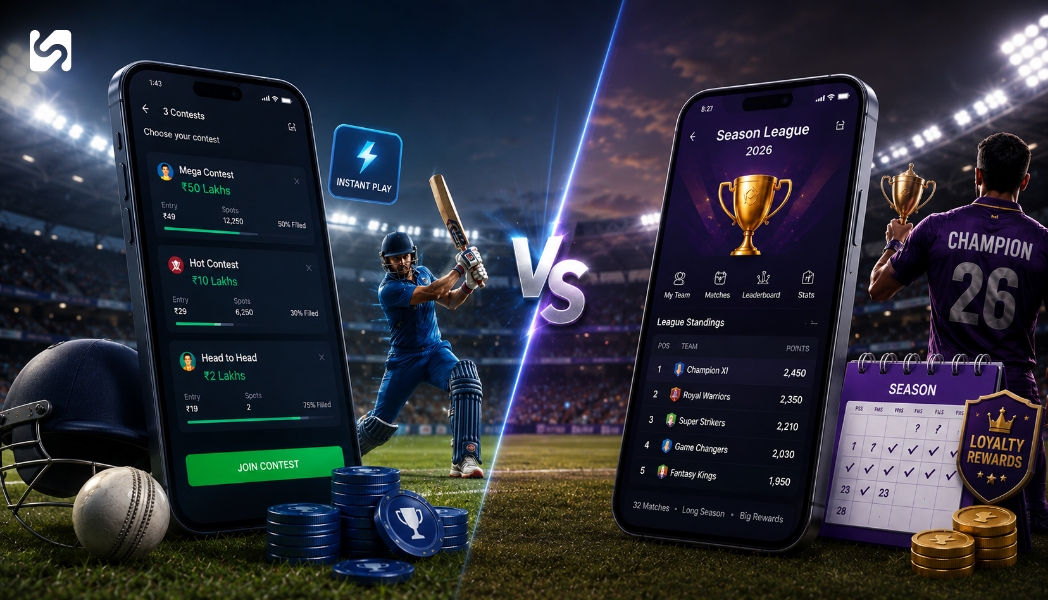
DFS vs Season-Long Fantasy Sports: Complete Comparison Guide 2026
 by Sumit Kumar
The DFS vs season-long fantasy sports debate is one every founder in this space eventually faces. Both fantasy sports formats let users draft real players and compete on real performance, yet they behave like completely different businesses underneath. Daily fantasy sports thrive on fast, high-frequency, transaction-heavy play. Season-long fantasy sports builds slow-burning, community-driven loyalty that lasts months. Choosing between daily and season long fantasy sports as your business model, shapes your revenue model, your development cost, your user retention, and your path to profit.
This comparison guide breaks down daily fantasy sports vs season-long fantasy sports in plain business terms. We will cover what each format is, the advantages of each, the key differences, the revenue and cost comparison, the technology each demands, and finally which fantasy sports business model is more profitable for startups and enterprises. The fantasy sports market is booming, so getting this decision right matters more than ever.
Why this matters now: The global fantasy sports market was valued at around $24.85 billion in 2024 and is forecast to reach roughly $56.38 billion by 2030, growing at about 15.2% CAGR. North America leads with the largest revenue share. Whichever model you pick, you are entering a fast-growing market. (Source: Grand View Research.)
What Are Daily Fantasy Sports (DFS)?
Daily fantasy sports is the fast lane of fantasy gaming. Instead of committing to a whole season, users build a fresh team for a single day or a single weekend of games. Users pick real players, those players compete in actual matches, and points are scored based on real performance. By the end of the day, users know whether they have won. The appeal is speed and flexibility. There is no months-long commitment and no waiting to see results. A user can build a lineup in the morning, watch the games, and collect winnings that night. This makes DFS a transaction-focused, high-frequency model where users play often and money moves quickly. Platforms like DraftKings and FanDuel built their reputations on this format.
Advantages of a developing Daily Fantasy Sports App
- Quick results. Users see outcomes the same day, which drives instant gratification and repeat play.
- Play anytime. No season-long commitment means busy users can join whenever they like.
- Fresh strategy every time. Each contest is a clean slate, so users experiment with new lineups and tactics.
- Real-money excitement. A small entry fee can turn into a payout, which is a powerful draw.
- Higher transaction frequency. More contests per user means more revenue events for the platform.
What Are Season-Long Fantasy Sports?
Season-long fantasy sports is the marathon to DFS’s sprint. At the start of a season, users draft a team and then manage that same roster for months. Each week they set lineups, make trades, pick up free agents, and respond to injuries. Points accumulate across the entire season, and the goal is to finish on top. This format is built on depth and community rather than speed. Users become emotionally invested in their teams and stay engaged week after week, often within leagues of friends, family, or coworkers. ESPN and Yahoo Fantasy are the classic examples. Because entry is often low-cost or free among friends, season-long play leans community-driven rather than transaction-heavy.
Advantages of developing a Season-Long Fantasy Sports App
- Long-term engagement. Users return every week for months, driving sustained activity and retention.
- Deep strategy. Drafting, trading, and lineup management reward skill and keep users invested.
- Strong community. Friend-group leagues create social bonds that lock users into the platform.
- Loyal user base. Emotional investment in a team builds habits that are hard to break.
- Lower churn. Season-long commitment naturally reduces drop-off compared to one-off contests.
Key Differences Between DFS and Season-Long Fantasy Sports
The two formats share the same DNA but diverge sharply on the things that matter to a business. Here’s an extended side-by-side comparison of DFS vs season-long fantasy sports across the aspects that matter most to players and to the business building the platform.
DFS vs Season-Long Fantasy Sports – At a Glance for Players
| Aspect | Daily Fantasy Sports (DFS) | Season-Long Fantasy Sports |
| Duration | Single day or weekend | Full sports season (months) |
| Time commitment | Low, play and done | High, weekly management |
| Draft process | New team every contest | One draft, managed all season |
| Roster control | Fresh lineup each time | Trades, waivers, weekly lineups |
| Pace | Fast, instant results | Slow burn, results over time |
| Skill emphasis | Short-term, matchup analysis | Long-term planning and strategy |
| Impact of injuries | Minimal, pick around them | High, you are committed to players |
| Emotional investment | Low to moderate | High, attachment to your team |
| Social element | Mostly solo or large contests | Strong, friend-and-group leagues |
| Best suited for | Quick action and fast wins | Full-season fans and communities |
Which Format Should You Play?
Play DFS if you want to jump in on any given Sunday without committing to an entire season. It suits people with unpredictable schedules who still want a competitive fantasy experience. It also suits people who want the chance to win real money quickly DFS tournaments regularly pay out five and six-figure prizes to top finishers.
Play season-long if you want the full experience the draft, the rivalry, the weekly trash talk, and the satisfaction of winning a championship that took four months to build. Season-long leagues are better for people who want to stay connected to a consistent group and care more about bragging rights than prize pools.
Play both if you can manage it. A lot of serious fantasy players run their season-long league and dip into DFS on high-value game weeks. They’re not competing formats — they scratch different itches.
Building a fantasy sports platform instead of playing on one? Keep reading. The section below breaks down the DFS vs season-long decision from a completely different angle the business model, the development requirements, the revenue potential, and which format gives a startup the best path to profitability in 2026.
DFS vs Season-Long Fantasy Sports – Business & Technical Aspects
| Aspect | Daily Fantasy Sports (DFS) | Season-Long Fantasy Sports |
| Revenue model | Entry fees / rake per contest | League fees, subscriptions, premium |
| Revenue frequency | High, many events per user | Lower per event, spread over season |
| Revenue stability | Variable, depends on activity | Steady and predictable |
| User acquisition | Easier, fast results attract users | Slower, bigger commitment to join |
| User retention | Harder, faster churn | Strong, season-long loyalty |
| Lifetime value (LTV) | Strong if activity stays high | Strong through loyalty and low churn |
| Marketing demand | Heavy, constant promotions needed | Lighter, community-driven growth |
| Real-time infrastructure | Critical, high concurrency | Moderate, less time-sensitive |
| Technical complexity | Higher, instant scoring + payments | Moderate, league logic + data tracking |
| Development cost | Higher upfront | Comparatively lower |
| Scaling style | Fast but infrastructure-heavy | Steady but acquisition-slow |
| Regulatory sensitivity | Higher, real-money + frequency | Lower, often low-cost or free leagues |
| Short-term profitability | Stronger | Moderate |
| Long-term profitability | Depends on retention | Stronger per user |
| Best business fit | Funded startups, fast-revenue goals | Community brands, steady growth |
DFS vs Season Long Fantasy: Revenue Models Compared
The way each format makes money is where the business cases truly separate.
DFS revenue. Daily fantasy is transaction-led. DFS platform earns a commission, often called the rake, on every contest entry. Because users play frequently, revenue events pile up fast. This makes DFS potentially high-revenue, but it depends on constant user activity and a steady flow of new contests.
Season-long revenue. Season-long fantasy earns through league fees, premium features, and subscriptions, spread across a longer engagement window. Revenue per event is lower, but it is more stable and predictable because users stay for months. The lifetime value of a loyal season-long user can be strong even if individual transactions are smaller.
Daily Vs Season Long Fantasy Sports: User Acquisition and Retention
DFS and season-long fantasy pull in opposite directions on the classic growth equation. Daily fantasy excels at acquisition. Quick results, real-money prizes, and free-contest bonuses make it easy to attract new users fast. The challenge is retention, since users can leave just as quickly as they arrive. Constant fresh contests and promotions are needed to keep them active. Season-long fantasy is the reverse. Acquisition is slower because the commitment is bigger, but retention is excellent. Once users draft a team and join a league with friends, they are locked in for the season. For a fantasy sports startup, this means DFS favors aggressive marketing while season-long favors community building.
DFS vs Season-Long Fantasy Sports: Development Cost Comparison
Daily fantasy sports and season-long platforms differ in where the technical complexity sits, and that affects DFS app development cost and timeliness’s DFS platforms demand robust real-time infrastructure. They must handle high concurrency, instant scoring, frequent contest creation, secure high-volume payments, and fraud protection, all under heavy daily load. This raises the engineering bar and the development cost. Season-long platforms need deep league-management features such as drafting tools, trades, waivers, and long-running data tracking, but the real-time pressure is lower. Both can be built as a custom solution or launched faster with a white label DFS platform or fantasy software. For startups, white label often lowers the upfront cost and speeds time to market for either format.
DFS vs Season-Long Fantasy Sports: Technology Requirements For Both Platforms
The right fantasy sports technology stack keeps either platform fast, fair, and stable.
- Frontend and mobile: React Native, Flutter, Swift, Kotlin
- Backend: Node.js, Django, Laravel
- Database: PostgreSQL, MongoDB, with Redis for real-time state
- Real-time data: WebSockets and trusted sports data APIs for live scoring
- Payments: Stripe, Razorpay, PayPal, and compliant gateways
- Cloud: AWS, Google Cloud, or Azure with auto-scaling for traffic spikes
- Security: KYC, fraud detection, and responsible-gaming controls
| Additional TechStack for DFS | Additional TechStack for Season Long |
|
|
DFS leans harder on real-time, high-concurrency infrastructure, while season-long leans on data persistence and league logic. A capable fantasy sports software development company can build either, tuned to your format.
DFS vs Season-Long Fantasy Sports Format: Monetization Opportunities
Both Season long and DFS formats support multiple income streams beyond their core model. A smart fantasy sports app monetization strategy usually blends several.
Entry Fees and Platform Commission (Rake)
Entry fees are the primary revenue source for DFS platforms. Users pay to join contests, and the platform keeps a small commission before distributing prizes. Since players can enter multiple contests daily, this creates recurring revenue. Season-long leagues also charge entry fees, but usually only once per season.
Subscription Plans
Premium subscriptions provide users with exclusive features like advanced player statistics, expert insights, AI-powered recommendations, and premium contests. This model works particularly well for season-long fantasy sports, where users stay engaged for several months.
In-App Advertising
As your platform grows, in-app ads and sponsored content become valuable revenue sources. Sports brands and advertisers often pay to reach an active audience without affecting the core gaming experience.
Premium Features
Offering advanced analytics, lineup optimization tools, detailed player insights, or enhanced league management as paid features allows platforms to generate additional revenue while improving the user experience.
Sponsorships and Partnerships
Partnering with sports brands, media companies, or tournament sponsors can create new income opportunities. These collaborations are especially effective for season-long fantasy communities with highly engaged users.
Freemium Upsells
A freemium model lets users join free contests before encouraging them to upgrade to paid leagues, premium memberships, or exclusive features. It’s an effective strategy for increasing user acquisition and converting free players into paying customers.
DFS vs Season-Long Fantasy Sports: Which Platform Is Easier to Scale?
Scaling looks different for each model. DFS scales on transaction volume. More users and more contests mean more revenue, but also more pressure on real-time systems and payment processing. It can grow revenue quickly, yet it demands infrastructure that never buckles under match-day spikes. Season-long fantasy scales on community and retention. Growth is steadier and the technical load is more predictable, which can make it easier to manage operationally. However, acquisition is slower, so scaling the user base takes more time and marketing effort. In short, DFS scales fast but hard, while season-long scales steadily but slowly.
Daily vs Season-Long Fantasy Sports: Which Model Is More Profitable?
Here is the question every founder really wants answered. The honest verdict: it depends on your strengths and goals. There is no universal winner in the DFS vs Season-Long Fantasy Sports debate. Each models DFS can be more profitable in the short term because of its high transaction frequency. Every contest is a revenue event, and active users generate income constantly. But that profit relies on relentless engagement, heavy marketing, and strong retention tactics. If activity dips, revenue dips with it. Season-long fantasy tends to be more profitable in the long term per user, thanks to loyalty and low churn. Revenue is steadier and lifetime value is strong, but the slower acquisition means it takes longer to build scale. The most profitable answer for many businesses is not either-or. A platform that offers both formats captures fast DFS revenue and loyal season-long retention at once. Quick gut check: Want fast revenue and can fund aggressive marketing? Lean DFS. Want loyal, low-churn users and steady growth? Lean season-long. Want both? Build a hybrid.
DFS vs Season-Long Fantasy Sports: Final Verdict for Startups and Enterprises
For startups, the DFS vs Season-Long Fantasy Sports choice often comes down to budget and strengths. If you have the capital for marketing and want fast revenue, DFS is compelling. If you want to build a loyal community with lower churn and a leaner ongoing spend, season-long is the safer foundation. Many startups begin with one format using a white label solution to validate demand, then expand. For enterprises, the answer is usually both. A combined platform captures the high-frequency revenue of daily fantasy and the long-term loyalty of season-long play, while spreading risk across two engines. Whichever route fits your business, the fantasy sports market is growing fast, and a well-built platform in either format has real room to win.
Related Reading: Custom vs white label fantasy sports software White label fantasy sports app development guide Aamax.co Fantasy sports app development services
Frequently Asked Questions
