
Live Commerce Vs Shoppable Videos- Comparison Guide 2026
 by Sumit Kumar
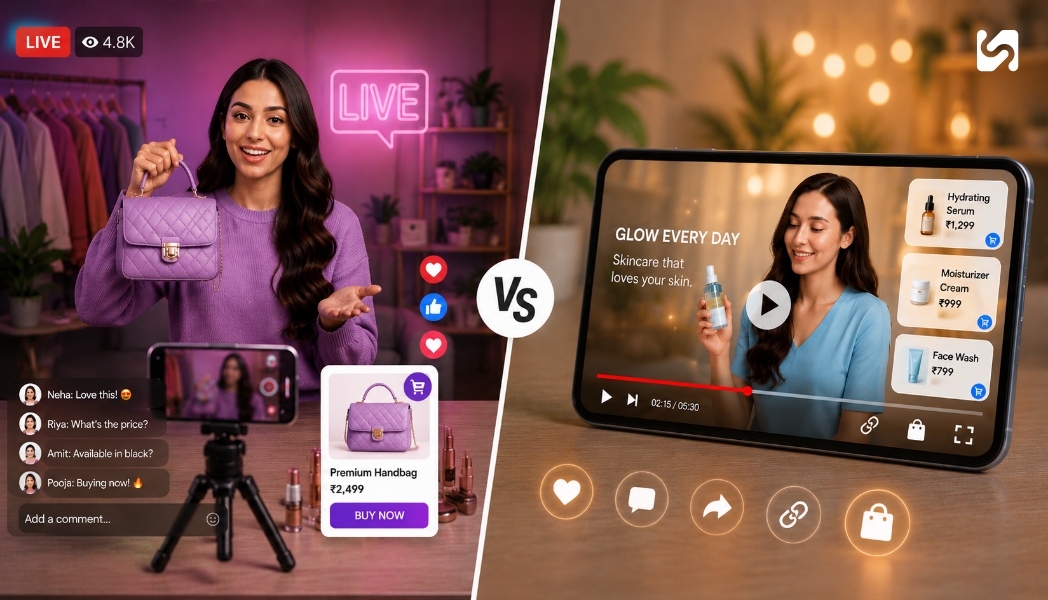
live shopping vs shoppable videos – Video commerce has reshaped how people shop online. Rather than clicking through static product pages, customers now discover what they want through video they actually enjoy watching a far more interactive and engaging way to shop. It’s no surprise brands are pouring investment into the format like Live Commerce and Shoppable Videos . Video holds attention, explains products in ways a photo never can, and builds the kind of trust that turns browsers into buyers – which shows up directly in higher engagement and conversion rates.
Two formats dominate the space: live shopping and shoppable videos. Both live commerce and shopping videos let customers buy straight from video content, but they work differently and suit different business goals. Here’s how each one works, and when to use it in live shopping vs shoppable videos comparison guide.
What Is Live Shopping?
Live shopping sometimes called live streaming shopping is a real-time, video-based buying experience. Brands go live, and viewers watch product demos, ask questions, chat with hosts, and buy on the spot, all during the event.
Think of it as the energy of shopping with a great salesperson, minus the trip to the store. live shopping blends entertainment, discovery, and instant purchasing into one live shopping experience and anyone can join from anywhere.
Key features of live shopping platforms:
- Real-time video streaming
- Live chat and audience interaction
- Product showcases and demonstrations
- Limited-time offers and discounts
- Instant in-stream purchasing
- Influencer and brand-hosted events
Popular live shopping use cases: Live shopping shines for product launches, seasonal sales, influencer collaborations, and any product that benefits from a hands-on demonstration. Brands lean on live events to build buzz and drive purchases while attention is at its peak.
What Are Shoppable Videos?
Shoppable videos are pre-recorded clips that let viewers buy as they watch. Tap a product tag, hotspot, or buy button embedded in the video, and the purchase begins no separate product page required.
The big difference from live shopping is timing. Shoppable videos sit on demand, so customers watch whenever it suits them and shop at their own pace, long after the video was first published.
Types of shoppable video content:
- Product demonstrations
- How-to tutorials
- Customer testimonials
- Product reviews
- Fashion lookbooks
- Social media video content
- Brand storytelling videos
Common use cases across industries: Fashion, beauty, electronics, and home décor brands use shoppable videos heavily. They let customers explore products in a natural, low-pressure way while cutting the number of steps it takes to check out.
Live Shopping vs Shoppable Videos – Quick Comparison
A complete comparison guide on live shopping Vs Shoppable videos across every aspect – content, tech, cost, conversion, and more.
| Aspect | Live Ecommerce
Live Shopping · Live Streaming Commerce |
Shoppable Video
Video Commerce · Video Shopping |
| 01 Live Ecommerce Vs Video Commerce – Definition & Format | ||
| What it is | A real-time broadcast where a host presents products live. Viewers watch, chat, and buy simultaneously during the stream. | Pre-recorded product videos embedded with clickable buy buttons, product tags, and hotspots. Customers watch and shop at any time. |
| Also known as | Live shopping, live stream shopping, livestream commerce, live video commerce | Shoppable video, video commerce, video shopping, interactive video, clickable video |
| Content format | Live broadcast – product drops, hauls, try-ons, influencer collabs, Q&A sessions | Pre-recorded – product demos, tutorials, look books, unboxings, brand stories |
| Video length | 20 minutes – 3 hours (typically) | 15 seconds – 10 minutes (typically) |
| 02 Live Shopping Vs Shoppable Videos – Audience Experience | ||
| Viewing time | Fixed – must watch during the live event | Flexible – watch anytime, anywhere |
| Interaction | ✓ Two-way – live chat, polls, reactions, Q&A with host | ✗ One-way – watch and tap to buy; no live interaction |
| Community feel | High – shared live experience with other viewers | Low – solo viewing experience |
| FOMO / urgency | Very high – live-only deals, countdown timers, limited stock alerts | Low – no inherent urgency (can add artificial timers) |
| Replay available | ~ Optional – recorded replay can be published after | ✓ Always – content is already recorded and evergreen |
| 03 Live Streaming Commerce Vs Video Shopping – Conversion & Engagement | ||
| Avg. conversion lift vs static pages | 5x – 10x during live event Winner | 2x – 4x on-demand |
| Avg. engagement rate | High – viewers stay 4–7x longer than pre-recorded | Medium – depends on video quality and product relevance |
| Average order value | Higher – social proof + host influence drives upsells | Moderate – product-focused, fewer impulse triggers |
| Cart abandonment | Lower – urgency and host nudges reduce drop-off | Medium – no external pressure to complete purchase |
| Content lifespan | Single event – peak traffic during broadcast only | Evergreen – keeps driving traffic and sales long-term Winner |
| 04 livestream Commerce Vs Video Commerce – Content Production | ||
| Production effort | High – host, lighting, crew, real-time coordination required | Medium – shoot once, edit, publish and reuse forever |
| Skill required | Confident live presenter, production team, social media coordinator | Videographer, editor, product stylist – no live skills needed |
| Reshoots possible | ✗ No – live means live; mistakes are public | ✓ Yes – edit and re-publish anytime |
| Content frequency | Weekly or event-driven (new event = new production effort) | Build a library – one shoot populates multiple pages |
| Scalability | Medium – scales with team bandwidth and schedule | High – runs 24/7 with zero ongoing effort Winner |
| 05 live video commerce Vs clickable video Shop – Technology & Infrastructure | ||
| Core tech | Live streaming CDN, WebRTC / RTMP protocol, real-time chat engine, concurrent viewer management, instant checkout | Video player SDK (Mux, Wowza), product tag API, hotspot overlay engine, CDN video delivery, in-video checkout embed |
| Infrastructure complexity | High – real-time streaming, low latency at scale is hard | Lower – standard CDN video delivery, no real-time constraints |
| Latency requirement | Sub-3 second latency critical – delays break the live experience | Not applicable – pre-recorded content has no latency constraints |
| Concurrent users | Must handle traffic spikes during live events (100 – 100,000+ simultaneous viewers) | Traffic is spread evenly – easier to scale infrastructure gradually |
| eCommerce integrations | ✓ Shopify, WooCommerce, Magento, custom APIs | ✓ Shopify, WooCommerce, Magento, custom APIs |
| Mobile support | ✓ iOS, Android, Web | ✓ iOS, Android, Web |
| Analytics available | Peak viewers, concurrent watchers, chat activity, live CVR, drop-off points | Play rate, watch time, click-through on product tags, CVR per video, heatmap |
| 06 Live Ecommerce Vs Video Commerce – Development & Cost | ||
| Development time | 10 – 18 weeks (typical full build) | 6 – 12 weeks (typical full build) Faster |
| Development cost | Higher – real-time streaming infrastructure adds significant complexity | Lower – simpler stack, shorter timeline Winner |
| Maintenance effort | High – live uptime, stream quality monitoring, real-time bug fixes | Medium – standard app maintenance, video CDN costs |
| Ongoing content cost | High – new production every event | Low – evergreen content requires no repeat investment |
| 07 Live Shopping Vs Shoppable Videos – Marketing & SEO | ||
| SEO benefit | Low – live content is not indexable in real time | High – product video pages are indexed, ranked, and discoverable Winner |
| Social media amplification | Very high – shareable moments, clips go viral post-stream | Medium – shareable but no live event buzz |
| Email / retargeting | Pre-event email campaigns, post-event replay links | Embed videos in email, retarget viewers who watched but didn’t buy |
| Influencer / creator fit | Very high – built for influencer-led selling | Medium – works with UGC and brand-produced content |
| Brand awareness | High – event generates PR, social buzz, and press | Medium – steady brand exposure over time |
| 08 Live Streaming Commerce Vs Video Shopping – Industry & Use Cases | ||
| Best industries | Fashion, beauty, electronics, food & beverage, sports, luxury goods | D2C brands, home décor, furniture, health & wellness, B2B product catalogues |
| Top use cases | New product launches, seasonal sales, influencer collabs, brand events, flash deals | Product education, how-to tutorials, lookbooks, SEO landing pages, email embeds |
| Business size fit | Mid-to-large brands with production budget and audience base | Startups to enterprise – low barrier to entry, scales with catalogue size |
| Platform examples | Amazon Live, TikTok Shop, Instagram Live Shopping, Bambuser | Firework, Vudoo, Tolstoy, Instagram Reels Shopping, YouTube Shopping |
| 09 livestream commerce Vs video commerce – Pros & Cons Summary | ||
| Key advantages | ✓ Highest conversion rates during events
✓ Builds community and brand loyalty ✓ Real-time feedback from customers ✓ Strong influencer marketing fit ✓ Creates social buzz and virality |
✓ Works 24/7 without a team
✓ Evergreen – content compounds over time ✓ SEO-friendly and indexable ✓ Lower development and content cost ✓ Easy to A/B test and optimise |
| Key disadvantages | ✗ High production cost per event
✗ Complex real-time infrastructure ✗ Requires confident, trained hosts ✗ One-time traffic spike, not sustained ✗ No SEO benefit during live stream |
✗ Lower peak conversion vs live
✗ No real-time audience interaction ✗ No built-in urgency or FOMO ✗ Requires good video production quality ✗ Less suited for viral social moments |
| 10 live shopping Vs shoppable Videos Final Verdict — Which Should You Build? | ||
| Choose this if… | Live Ecommerce
|
Shoppable Video
|
| Most successful brands run both. Live events drive spikes. Shoppable video sustains growth between them. SonicTechPro builds both formats and seamlessly integrates them into a single video commerce platform for your store. | ||
When Should You Choose Live Shopping?
- Product Launches: Live shopping works well when you’re introducing a new product. Customers can see the product in action, ask questions, and get answers on the spot. This creates excitement and helps build confidence before they buy.
- Flash Sales and Seasonal Promotions: If you’re running a limited-time offer, live shopping can help create a sense of urgency. Shoppers know the deal won’t last forever, which often leads to faster buying decisions.
- Influencer-Led Campaigns: Influencers bring their audience into the shopping experience. During a live session, they can share honest opinions, demonstrate products, and interact with viewers in real time. This often feels more genuine than traditional advertising.
- High-Consideration Products: Some products need a little more explanation before customers are ready to buy. Live commerce gives brands the chance to answer concerns, explain features, and demonstrate how the product works.
When Should You Choose Shoppable Videos?
- Product Catalogues and Collections: Shoppable videos are a practical way to showcase multiple products in one place. Customers can browse and purchase items directly from the video without leaving the experience.
- Educational Content and Tutorials: People often watch videos to learn something before making a purchase. Tutorials and how-to content help explain product benefits while making it easy for viewers to buy featured items.
- Fashion Lookbooks: Fashion brands can use shoppable videos to showcase complete outfits and styling ideas. Customers can explore different looks and purchase products as they watch.
- Evergreen Marketing Campaigns: Unlike live events, shoppable videos continue working long after they are published. They can attract new visitors, generate product views, and drive sales for months or even years.
Live Shopping vs Shoppable Videos: Industry Use Cases
| Industry | Live Shopping Use Cases | Shoppable Video Use Cases |
| Fashion & Apparel | Perfect for launching new collections, hosting influencer sessions, and revealing seasonal trends while interacting with shoppers in real time. | Ideal for lookbooks, styling tips, outfit inspiration, and showcasing products that customers can purchase instantly. |
| Beauty & Cosmetics | Great for live makeup demonstrations, skincare consultations, product launches, and audience Q&A sessions. | Useful for beauty tutorials, product reviews, application guides, and educational content that helps customers shop with confidence. |
| Electronics | Helps brands explain features, answer technical questions, and demonstrate products before purchase. | Works well for unboxing videos, product comparisons, reviews, and detailed buying guides. |
| Home & Furniture | Suitable for live room tours, furniture showcases, and home design sessions. | Allows brands to display products in real homes and inspire customers with décor ideas and room setups. |
| Food & Beverage | Effective for cooking demonstrations, live tastings, recipe sessions, and promotional events. | Great for recipe videos, meal preparation content, and showcasing products that viewers can purchase immediately. |
Brands Can Maximise ROI with a Hybrid Video Commerce Strategy
Many brands no longer see livestream commerce and shoppable videos as competing options. Instead, they use both together. A live shopping event can attract attention, spark conversations, and drive immediate sales. Once the event is over, the recording can be turned into a shoppable video and shared across websites, apps, and social channels. This gives the content a longer life and allows brands to keep generating sales from a single piece of content. By combining both formats livestream commerce and shoppable videos, businesses can reach more customers and get greater value from their video marketing efforts.
Conclusion
The best choice between live shopping vs shoppable videos depends on what you’re selling and how your customers prefer to shop. Live shopping app development is a strong option when you want real-time engagement, product demonstrations, and quick sales. Shoppable videos are better for ongoing product discovery and long-term conversion growth.
For many brands, the smartest approach is to use both. Live shopping creates excitement and builds trust through direct interaction. Shoppable videos keep the shopping journey going long after the live event ends. Together, they create a more engaging customer experience and can help increase both conversions and customer loyalty.
Frequently Asked Questions
