
Best Live Commerce Platforms for eCommerce Businesses in 2026
 by Sumit Kumar
The best live commerce platforms have turned real-time video into one of the highest-converting sales channels in modern retail. Live shopping sessions convert at far higher rates than standard product pages and the global livestream shopping market is now measured in the tens of billions of dollars. If you run an online store and want a piece of that growth, choosing the right livestream shopping platform is the decision that shapes everything else.
This guide compares the best live commerce platforms and ecommerce live streaming platforms available in 2026. For each one you will find a quick introduction, the standout features, the strengths, the limitations, and the type of business it suits best. Whether you sell fashion in London, beauty in New York, or homeware in Mumbai, the goal is the same: help you match a real-time shopping platform to your store instead of guessing.
Why Choose a Live Commerce Platform Over Building Your Own Infrastructure?
Before we get to the top live shopping software list, it is worth answering a question many founders ask. Why license a live commerce solution at all, rather than build the streaming and shopping infrastructure yourself?
The honest answer is speed, cost, and reliability. Real-time video shopping at scale is genuinely hard to build. You need low-latency streaming, live product tagging, in-stream checkout, chat, and analytics, all working flawlessly when thousands of viewers arrive at once. A custom build of that depth takes months and a serious engineering budget, and it carries real technical risk. A ready-made livestream commerce solution gives you all of it out of the box, usually installable with a plugin or a single line of code. You go live in days, not quarters, and you let the vendor carry the burden of uptime, scaling, and updates.
For most brands the maths is simple. Building from scratch only makes sense at very large scale, where you need total control and own infrastructure. For everyone else, a proven live commerce platform is faster, cheaper, and far less risky. Many businesses start on a livestream ecommerce platform to prove the channel works, then consider custom development only once the volume clearly justifies it.
Best Live Commerce Platforms – Quick Comparison
Here’s the side-by-side comparison of top live commerce platforms across the key aspects.
| Platform | Best For | Deployment | Key Strength | Channel Focus | Pricing Tier |
| Channelize.io | Multi-storefront DTC brands & retailers | SaaS – Shopify, WooCommerce, Magento + social | Omnichannel simulcasting + mini-player | Owned + social | Free plan → mid-tier |
| LiveMeUp | Shopify brands wanting premium live selling | SaaS – Shopify app | 24/7 real human support, hour-based pricing | Owned (Shopify) + multistream | Free → SMB/mid |
| Bambuser | Enterprise & luxury fashion/beauty | SaaS – website & app embed | Premium production + clienteling (verify status) | Owned, enterprise | Sales-gated (enterprise) |
| Terrific Live | DTC brands & publishers, data-first | SaaS – on-site embed | Owns customer journey + evergreen replays | Owned channel | Sales-gated / quote |
| CommentSold | US boutiques selling live frequently | SaaS – white-label mobile app | End-to-end inventory, shipping & fulfillment | Social-driven + owned app | Mid-tier+ |
| Livescale | Brands running scheduled live events | SaaS – web & app | Frictionless built-in in-stream checkout | Owned events | Sales-gated |
| Sprii | Mid-market & European multichannel retailers | SaaS – website + social | Multichannel reach, analytics by default | Owned + social | Scalable / quote |
| Videeo | Shopify brands wanting a branded app | SaaS – Shopify + native app | Turns store into branded iOS/Android app | Owned (mobile app) | Free → SMB |
| TalkShopLive | Creator- & host-led selling | SaaS – embeddable players | Broad embeddability + personality-led shows | Owned + social | Mid-tier (varies) |
| Immerss | High-consideration, consultative sales | SaaS – web embed | Live selling + 1:1 video clienteling | Owned | Sales-gated |
| LiSA | Brands wanting on-site AI personalization | SaaS – on-site embed | AI recommendations + full data ownership | Owned (website only) | Quote-based |
| NTWRK | Streetwear, collectibles & culture brands | Marketplace destination | Built-in engaged drop-culture audience | Marketplace (not owned) | Marketplace terms |
What Are the Best Live Commerce Platforms for Live Shopping?
Here are 12 best Livestream Shopping Platforms in 2026. Some of these also offer evergreen shoppable video, thus at times blurring the lines between live and on-demand. We have concentrated on the strengths of each platform in their live-selling aspect.
1. Channelize.io – Best for Live Commerce
About Channelize.io: Channelize.io provides a full stack live shopping platform for any merchant selling on multiple channels and storefronts simultaneously.
Features: Shopify, WooCommerce, Magento, Social Media simulcasting, Floating Mini Player, a place for shoppers to browse without leaving the stream, Carousels, Floating Icons, Story Widgets (verticals).
Pros: Multiple UX formats, reported improved sales and cart abandonment, and omnichannel flexibility. A free plan means that you can begin with no obligation.
Limitation: It has a wide range of features but has a learning curve which is a little steeper than single purpose tools.
Ideal for: Multi-location DTC brands and retailers looking for a single platform in all their stores.
2. LiveMeUp

LiveMeUp is a live video selling solution for Shopify brands with a great emphasis on human support, and ranked among the premium ones.
Features: One-click in-stream purchase, automatic product sync, multistreaming to Facebook, YouTube, and Instagram, built-in SMS and Klaviyo marketing, shoppable replays and detailed post-event analytics.
Weaknesses: The free plan is limited to 10,000 views per month, and the pricing model is unclear, as streaming hours aren’t specified.Pros: Real people available 24/7 instead of chatbots, pricing is clear (based on streams, not viewers) and you can test it with the free plan (which includes 10,000 views per month).
Limitation: It is mainly Shopify oriented so that’s that.
Ideal for: Shopify brands looking for top-of-the-line live selling features and hands-on assistance.
3. Bambuser

About Bambuser: Bambuser is a live shopping platform trusted by major brands around the world including fashion and beauty brands, trusted by enterprises.
Features include one-to-many and one-to-one live shopping, deep customization, a powerful backend, product data scraping and enterprise analytics and integrations.
Weaknesses: High production costs, high maintenance requirements, and clienteling applications tailored to luxury brands.
Limitation: Suitable for big teams with resources and budgets to develop, not suited to small stores. Additionally, there is the need to confirm the status of a company prior to a long-term agreement.
Ideal for: Enterprise budgets and tech resources, large retailers and luxury brands.
4. Terrific Live
Brands that want to control their complete customer journey from their website have a wonderful platform to do so – Introduction: Terrific Live.
Features: Live shopping, evergreen shoppable video being embedded on your own website, live multicasting with Instagram, TikTok, YouTube, full-screen viewing (vertical and horizontal), in-stream checkout and smart analytics.
Weaknesses: Limited access to third-party traffic and does not provide production-partner support.
Limitation: works best for brands with a more owned-channel approach than a social-first selling approach.
Ideal use cases: DTC brands and publishers focused on first-party data, brand consistency, and Content ROI over time.
5. CommentSold

The live-selling platform is very popular among the small businesses and boutiques that conduct regular events for live selling which is known as Introduction: CommentSold.
Features: White labeled mobile app, comment-to-buy automation, multi-channel broadcasting and end-to-end inventory, shipping and fulfillment.
Pros: Designed for business-to-consumer companies that sell live frequently, and have robust social-driven selling capabilities and a full operational back-end.
Limitation: Designed for a high frequency live-selling model, and this might not be necessary for the occasional seller.
Ideal for U.S. boutiques and small and medium-sized retail stores that accept live shows.
6. Livescale

Introduction: Livescale is all about livestream shopping, enabling brands to host a well-rounded live event featuring the checkout process.
Includes: Branded live shopping events, in-stream checkout, real-time engagement tools, and event analytics.
Weaknesses: No trials available, weak for event-driven campaigns.Opportunities: Frictionless built-in checkout keeps buyers in the live experience, strong for event-driven campaigns.
Limitation: More targeted than always-on shoppable video to scheduled live events.
Ideal for: Brands that are developing a livestream program for their planned events and product launches.
7. Sprii

Introduction: Sprii is a live shopping platform with proven capabilities across multiple live shopping tools in Europe.
Benefits: Multi channel distribution on website, Facebook page, Instagram page, partner page, comment-to-buy automation, branded overlays, shoppable replays and analytics (default).
Weaknesses: Analytics locked down behind upgrades, pricing that can grow without notice or additional charges.
Limitation: If you have a European origin, please check that your market supports you and that your data resides in that area.
Best suited for: Mid-market and European retailers that are hosting regular multichannel live events.
8. Videeo
Videeo is a Shopify-first solution that transforms stores to live shopping branded mobile apps.
Features: Include native app building for iOS and Android, direct Shopify product sync, push notifications, loyalty integrations and live video selling.
Strength: It offers a branded mobile presence, seamless integration with Shopify, and a free trial so you can explore the waters.It has a branded mobile presence, seamless integration with Shopify and a free plan so you can test the waters.
Limitation: Focused on the Shopify/mobile-app use case, so it is the best suited to that use case.
Ideal for: Shopify brands that are looking to build a branded mobile app that has live shopping within it.
9. TalkShopLive

TalkShopLive, a US live shopping platform, is renowned for its creator- and personality-driven selling and embeddable live video.
Features: Shoppable live streams, embeddable players on a variety of sites, social media, selling driven by the host, and replayable shoppable content.
Weaknesses: Limited in being a creator and being a host of a brand.
Limitations: Appropriate for personality-driven selling, not all brands are suited for.
Ideal for: Brands and creators who are using host-led live shopping campaigns.
10. Immerss

Immerss is a live commerce platform that is integrated with live commerce selling and one-to-one video clienteling.
Features: Live Shopping Events, 1 to 1 video consultation, in-stream purchases, and engagement analytics.
Leverages broadcast live selling and personal, appointment-style video for high consideration products.
Limitation: The clienteling aspect is best suited to the higher-touch sales, not the low-ticket, quick selling items.
Ideal for: Brands looking for live commerce, in addition to 1:1 video selling.
11. LiSA

About LiSA: LiSA is a German video commerce platform based on personalized live shopping on the website and shoppable video.
Features: On-site live shopping, interactive overlays, AI-powered product recommendations, shoppable video and stories, and performance analytics, along with turnkey and enterprise options for multi-creator programs.
Weaknesses: Lack of ownership of all customer data and limited AI recommendations.Strengths: personalization of strengths, AI recommendations, full customer-data ownership and a modern on-site experience.
Limitation: Website-centric experience, and not multi-channel social stream or comment to buy.
Ideal for: Brands who are innovation-focused and desire customizable, in-store video sales and community-based selling.
12. NTWRK

Introduction: NTWRK is a live shopping destination known for culture-driven drops, exclusives, and creator collaborations, especially in streetwear and collectibles.
Features: Live shopping events, limited-edition drops, creator-led shows, and a built-in audience of engaged shoppers.
Strengths: A ready-made, highly engaged community and a proven model for hype-driven product launches.
Limitation: It is a marketplace destination rather than owned infrastructure, so you operate within its ecosystem and audience.
Best for: Brands in streetwear, collectibles, and culture categories that thrive on drops and exclusives.
What are the Key Features of A Live Commerce Platform?
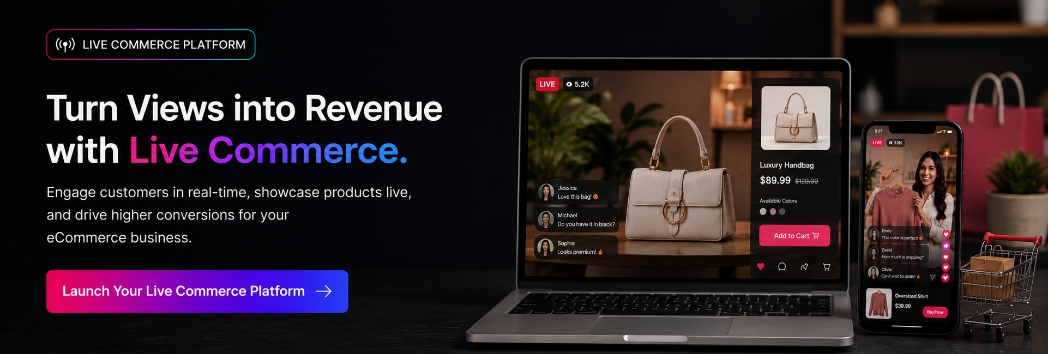
Not all live shopping software should have all the functionalities, however, the best live commerce software has a core that is consistent. Watch for these:
- In-stream checkout – customers must not be directed anywhere: each redirection is a conversion killer.
- Real-time product tagging (tag & highlight products in real-time as they are shown by the host).
- Multichannel streaming – simultaneously broadcast to your website, Instagram, TikTok and YouTube, and bring traffic back to your store.
- Low latency video – smooth video, even on drops, with thousands of concurrent viewers.
- Live chat and engagement tools – comments, reactions, Q&A and build community and trust.
- Evergreen, on-demand replays – convert live events into shoppable, evergreen content that sells again and again.
- First party data and analytics – viewer engagement, product click, drop-off analysis and conversion data that you truly own.
- Easy to implement – Not a large development project, it is a plugin or single line of code.
- Clear, scalable pricing – no hidden charges or penalties with an increasing user base.
Essential Criteria for Choosing Your Live Commerce Platforms
Features are what a live shopping platform can do. These details will help you determine if it’s suited for your business.
The platform and the stack. For Shopify store owners, look for a live commerce platform that has strong integration with Shopify like LiveMeUp or Videeo. Omnichannel tools like Channelize or Sprii are the obvious choice when it comes to WooCommerce or Magento setups or headless setups.
Owned versus social. Choose to stick with traffic and data at your own sites (Terrific, LiSA, Bambuser) or creator-driven social reach (CommentSold, TalkShopLive, NTWRK). The best strategies are usually a combination of both.
Business Size and Budget: The size of your business and the amount of money you have. Free-to-start, transparent-pricing solutions are ideal for SMBs, boutiques and other enterprise brands that have a large catalog should receive quote-based, sales-gated pricing and scale depending on usage.
Your Niche. There are platforms dedicated to fashion, beauty, collectibles and culture. A niche tool will tend to perform better if it contains relevant case studies, compared to the generalist.
Data ownership. Be clear on what customer and transaction data you have and can export. Your audience is a valuable resource, and don’t lose it in platforms that lock it up.
Region and support. Ensure that the data is located in the relevant markets from which you serve, including the U.S., U.K., EU, India and Southeast Asia, and that the team is responsive.
Conclusion
There is no single best live commerce platform, You need to choose only the best livestream shopping software for your store. Shopify SMBs gravitate toward LiveMeUp, Videeo, or Channelize. Owned-channel and data-first brands lean toward Terrific, LiSA, or Bambuser. Live-event and boutique sellers do well with CommentSold, Sprii, or Livescale. And culture-driven brands find their audience on NTWRK. Your right pick comes down to your platform, your niche, your budget, and whether you value owned data or social reach.
Whichever ecommerce livestream software fits the needs, will decide the direction of your ecommerce business. Live commerce has moved from novelty to necessity, and the brands winning in 2026 are the ones that go live consistently, engage authentically, and turn viewers into loyal customers. Pick a live shopping platform that removes friction from your workflow, and you give yourself the best possible start.
Frequently Asked Questions
